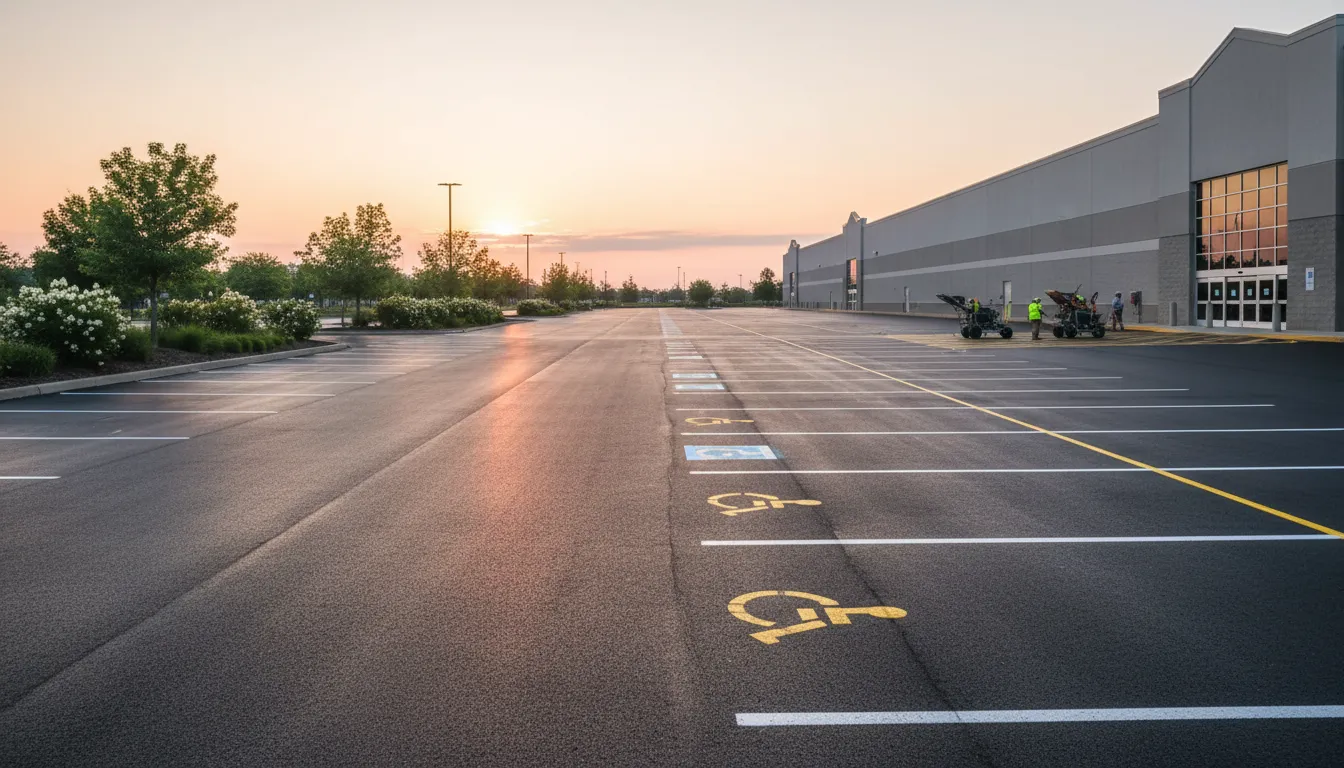
Find the Best Parking Lot Striping Companies for Your Business
No obligation • Fast responses • Nationwide coverage

Why you can trust Tidy Parking
Tidy Parking is a leading U.S. source for parking lot maintenance services, including striping, sealcoating, sweeping, paving, resurfacing, and repairs. Our content is created independently, and providers cannot pay to influence ratings or recommendations.
Search providers near you
Top Parking Lot Striping Companies in Sugar Land, Texas Ranked
Maintaining clear, compliant pavement markings is a critical responsibility for any property owner or manager in Sugar Land. Parking lot striping, also known as line marking or pavement marking, is far more than just painting lines; it's a legal requirement that ensures safety, accessibility, and efficient traffic flow for your customers and visitors. In Sugar Land, striping must adhere to a specific set of state and local codes, including the Texas Accessibility Standards (TAS) and Fort Bend County fire regulations. This guide explains the key requirements, common layouts, and considerations for keeping your property's markings up to code, helping you understand what to look for when evaluating local line striping services.
AAA Paving Since 1964
14601 Lillja Rd, Houston, TX 77060
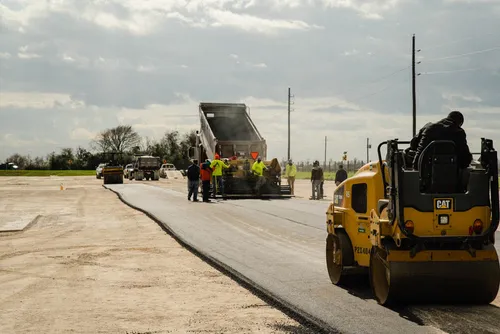
AAA Paving Since 1964 is a commercial paving company based in Houston, TX, offering a wide range of services including asphalt paving, sealcoating, parking lot striping, milling, resurfacing, and concrete paving. With over 50 years of experience, they serve various commercial properties such as retail centers, industrial parks, and office complexes. The company emphasizes thorough site preparation, proper drainage, and the use of high-quality materials to ensure durable and long-lasting pavement surfaces. AAA Paving operates its own milling equipment, allowing for efficient pavement removal and resurfacing while maintaining tight quality control throughout each project.
Kingsmenwash & Striping
Houston, TX
Kingsmenwash & Striping is a parking lot striping company based in Houston, TX. They provide striping services to a wide range of nearby communities including Clear Lake, Friendswood, Pasadena, Webster, League City, Galveston, Rosharon, Alvin, Deer Park, Seabrook, Pearland, Richmond, Dickinson, Missouri City, Katy, and Bellaire. Their work focuses on maintaining clear and organized parking areas to enhance safety and accessibility.
Rose Paving Houston
10924 Grant Rd, Houston, TX 77070
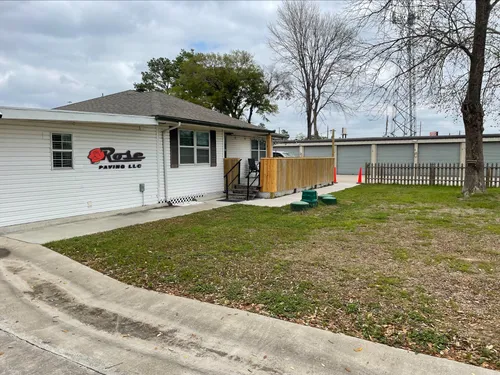
Rose Paving Houston is a commercial paving and parking lot maintenance company serving Houston, TX. They offer a wide range of services including asphalt and concrete repair, crack sealing, sealcoating, parking lot striping, and storm basin drainage. With over 50 years of industry experience, Rose Paving Houston focuses on extending the lifespan and improving the safety and appearance of parking lots while ensuring ADA compliance. Their expertise includes crack sealing to prevent water damage, which is especially important in Houston's climate.
G-FORCE Parking Lot Striping of Houston - South
Houston, TX
G-FORCE Parking Lot Striping of Houston - South is a veteran-owned company providing parking lot striping, sealcoating, and repair services in Houston, TX. They serve Houston - South and surrounding areas including Sugar Land, Missouri City, and Katy. The company offers a range of services such as warehouse floor markings, ADA parking compliance, fire lane striping, pothole repair, and bollard installation. Using Sherwin-Williams premium traffic paints and advanced striping equipment, G-FORCE delivers durable pavement markings. Their veteran ownership brings a focus on precision and accountability to every project.
Pelagic Paving LLC
907 74th St, Houston, TX 77011
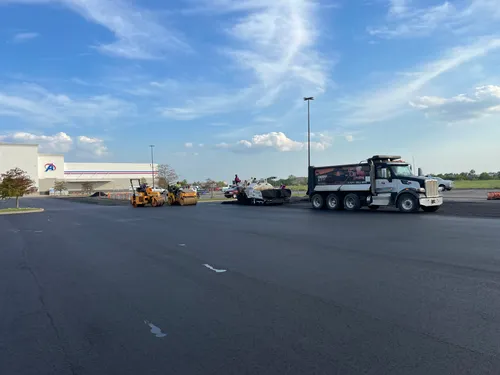
Pelagic Paving LLC is a paving contractor based in Houston, TX, specializing in parking lot striping, sealcoating, paving, and repair services. With over 25 years of experience, they serve a range of clients including residential, commercial, and municipal properties throughout Houston and Southeast Texas. Their capabilities include asphalt paving, crack sealing, and concrete repair, using advanced materials and techniques to enhance pavement durability and compliance with ADA standards. Pelagic Paving emphasizes tailored solutions and ongoing maintenance to extend the life and appearance of paved surfaces.
Understanding Local Striping Regulations
In Sugar Land, your parking lot markings are governed by two primary sets of rules: state accessibility laws and county fire safety codes. Non-compliance isn't just a minor oversight-it can lead to significant fines, increased liability, and even the towing of vehicles from improperly marked areas 1. The goal of these regulations is to create a safe, navigable environment for everyone, from drivers looking for a spot to pedestrians walking to your entrance.
The Texas Accessibility Standards (TAS), which align with the federal Americans with Disabilities Act (ADA), dictate exactly how accessible parking must be configured and marked 2. Simultaneously, the Fort Bend County Fire Marshal's Office enforces strict guidelines for marking fire lanes to ensure emergency vehicles always have clear access. A professional striping contractor familiar with Sugar Land will know how to apply both sets of rules to your specific property layout.
ADA & TAS Compliance for Accessible Parking
Properly marking handicapped parking spaces is a legal and ethical necessity. The TAS provides precise dimensions and marking specifications that must be followed.
Space and Aisle Dimensions: Each accessible parking space must be at least 8 feet (96 inches) wide. Crucially, each space must have an adjacent access aisle. For standard accessible spaces, this aisle must be at least 5 feet wide. For van-accessible spaces, the required aisle width is 8 feet 3. This aisle is part of the accessible route and must be kept clear at all times.
Marking the Access Aisle: The access aisle must be clearly marked with diagonal blue or white stripes. The words "NO PARKING" should also be stenciled within the aisle to discourage improper use 4.
Required Signage: Each accessible space must be accompanied by a vertical sign displaying the International Symbol of Accessibility. This sign must be mounted so the bottom of the sign is at least 60 inches above the parking surface. For van-accessible spaces, additional "Van Accessible" text is required on the sign.
Quantity and Location: The number of required accessible spaces depends on your lot's total capacity. For example, lots with 1 to 25 total spaces require 1 accessible space, while lots with 51 to 75 spaces require 3, at least one of which must be van-accessible 5 6 7. These spaces must be located on the shortest possible accessible route to the building entrance.
Fort Bend County Fire Lane Marking Requirements
Fire lane marking is a major component of parking lot striping in Sugar Land. These regulations are designed to keep access roads clear for fire trucks and other emergency apparatus.
Color and Border: Fire lanes must be outlined with a 6-inch wide red traffic paint border. This is typically applied to the curb face or the pavement itself.
Stencil Lettering: The words "NO PARKING FIRE LANE" or "FIRE LANE NO PARKING" must be stenciled in 4-inch high white letters on the red background. This lettering must be repeated at intervals not exceeding 25 feet 8.
Supporting Signs: In addition to pavement markings, "NO PARKING FIRE LANE" signs (typically 12 inches by 18 inches) must be posted. These signs should be installed at intervals of 50 feet and mounted approximately 7 feet above the ground 9.
Width and Maintenance: Fire lanes are generally required to be 20 to 24 feet wide to accommodate large vehicles 10. These markings must be maintained for legibility. Faded or worn fire lane markings do not fulfill the legal requirement and can result in citations. Repainting is often recommended every 1 to 2 years depending on traffic volume and paint quality.
Marking for Safety: Crosswalks and Traffic Flow
Beyond compliance, effective striping guides traffic and protects pedestrians. Clear lane lines, directional arrows, and stop bars help prevent accidents and congestion.
Crosswalk Specifications: Marked crosswalks are essential where pedestrian paths cross vehicular travel lanes, especially near building entrances. They should be marked with solid white lines between 6 and 24 inches wide 11. For enhanced visibility and safety, longitudinal (or "zebra stripe") crosswalk markings are often the preferred standard 12.
Passenger Loading Zones: For areas designated for passenger pick-up and drop-off, specific markings apply. An access aisle at least 5 feet wide and 20 feet long is required adjacent to the loading zone 13. The surface must be nearly level, with a slope not exceeding 1:50 (2%), and must provide a minimum vertical clearance of 114 inches (9.5 feet) to accommodate accessible vans 13.
Find the perfect parking lot striping companies for your needs
Get personalized recommendations and expert advice
Common Parking Lot Layouts and Striping Patterns
A well-designed layout maximizes space and safety. Standard parking stall angles (like 90°, 60°, or 45°) affect how many spaces you can fit and how traffic circulates. Two-way aisles typically need to be at least 24 feet wide, while one-way aisles can be as narrow as 12 feet. Compact car spaces, if used, must be clearly identified. Your striping plan should also include clear markings for no-parking zones, speed bumps, and directional arrows at aisle intersections to keep traffic moving smoothly.
Material Choices: Paint vs. Thermoplastic
The longevity and visibility of your markings depend heavily on the material used.
- Water-Based Latex Paint: This is the most common and economical choice for parking lot line striping. It's quick-drying and suitable for most commercial lots. However, it typically lasts only 1-3 years before needing reapplication, depending on weather and traffic conditions.
- Thermoplastic: This is a melted plastic material that is applied hot and forms a thick, durable coating. Thermoplastic markings are highly reflective and can last 3-6 years or longer. While the upfront cost is higher, the extended lifespan can make it more cost-effective for high-traffic areas.
- Preformed Thermoplastic Tape: This is a less common but effective option involving adhesive-backed plastic strips that are applied to the pavement. It offers good durability without the need for specialized heating equipment.
For compliance, note that fire lane borders require durable red traffic paint, and accessible aisles need a specific diagonal stripe pattern that must remain highly visible 14 15.
Cost Considerations for Striping in Sugar Land
Costs for parking lot striping can vary based on the scope of work, materials, and pavement condition. Here is a general breakdown based on local data:
- Standard Parking Stall Lines: $2.00 - $5.00 per linear foot of line.
- Complete ADA Stall (Space, Symbol, Aisle): $150 - $300 or more per accessible space, due to the detailed stenciling and additional markings required.
- Fire Lane Curb Painting (Red border + stencil): $3.00 - $6.00+ per linear foot.
- Minimum Service/Mobilization Fee: Many contractors charge a minimum fee of $300 - $600+ to bring equipment and crew to a site, which is a key factor for smaller projects 16.
- Full Lot Restriping: For a smaller lot, a complete restriping project often ranges from $1,000 to $3,000, but this can scale significantly with lot size 17.
The final price is influenced by the pavement's condition (cracked or uneven surfaces take more time and paint), the type of paint selected, and how easily crews can access the site.
Timing and Frequency for Restriping
How often should you restripe? For most lots in the Texas climate, a full restriping is recommended every 1.5 to 2 years to maintain legibility and compliance. The best time of year for pavement marking is during dry, mild weather-typically spring and fall in Sugar Land. Paint adheres best when pavement temperatures are above 50°F and rising. Planning your restriping during slower business hours or days minimizes disruption to tenants and customers.
Frequently asked questions
Sources
Footnotes
-
Texas Law About Parking Lot Striping - https://underwaycs.com/parking-lots/texas-law-about-parking-lot-striping/ ↩
-
Texas Accessibility Standards Parking Lot Codes - SMR Striping - https://smrstriping.com/texas-ada-parking-lot-codes/ ↩
-
Parking Lot Striping & ADA Compliance: What to Know - https://brixco.co/parking-lot-striping-ada-compliance/ ↩
-
Accessible Parking Spaces | ADA.gov - https://www.ada.gov/topics/parking/ ↩
-
Texas ADA Parking Lot Compliance Checklist - https://www.northtexaslinestriping.com/blog/texas-ada-parking-lot-compliance ↩
-
Parking Lot Striping & ADA Compliance: What to Know - https://brixco.co/parking-lot-striping-ada-compliance/ ↩
-
ADA Compliance Guide for Parking Lot Line Striping - https://www.pavementsolutions.org/ada-compliance-guide-for-parking-lot-line-striping/ ↩
-
Fire Lane Legal Requirements in Texas: What Property ... - https://www.northtexaslinestriping.com/blog/fire-lane-legal-requirements-in-texas-what-property-owners-need-to-know ↩
-
FIRE LANE DESIGN FIRE LANE MARKING - https://cms2.revize.com/revize/sulphurspringsnew/FIG_7-03%28FIRELANE%292pg.pdf ↩
-
Fort Bend County Fire Marshal's Office - FIRE LANES - https://www.fortbendcountytx.gov/sites/default/files/document-central/document-central/fire-marshal-documents/construction-permits/FireLanes.pdf ↩
-
PM(4)-20 - https://ftp.dot.state.tx.us/pub/txdot-info/cmd/cserve/standard/traffic/pm4-20.pdf ↩
-
ADA Design Guidelines and Parking Lot Striping - Alpha Paving - https://alphapavingtexas.com/ada-design-guidelines-parking-lot-striping/ ↩
-
TEXAS ACCESSIBILITY STANDARDS (TAS) - https://www.tdlr.texas.gov/ab/tas/tassection04_02_to04_09.pdf ↩ ↩2
-
FIRE LANE REQUIREMENTS - epcesd1 - https://www.epcesd1.com/wp-content/uploads/2022/03/Fire-Lane-Requirements.pdf ↩
-
Texas Law About Parking Lot Striping - https://underwaycs.com/parking-lots/texas-law-about-parking-lot-striping/ ↩
-
Get Parking Lot Striping in Sugar Land, TX - https://canyonlotstriping.com/parking-lot-striping-sugar-land-tx ↩
-
Restriping Cost Calculator | Houston Parking Lot Striping - https://stripeitright.com/parking-lot-restriping-cost-calculator/ ↩