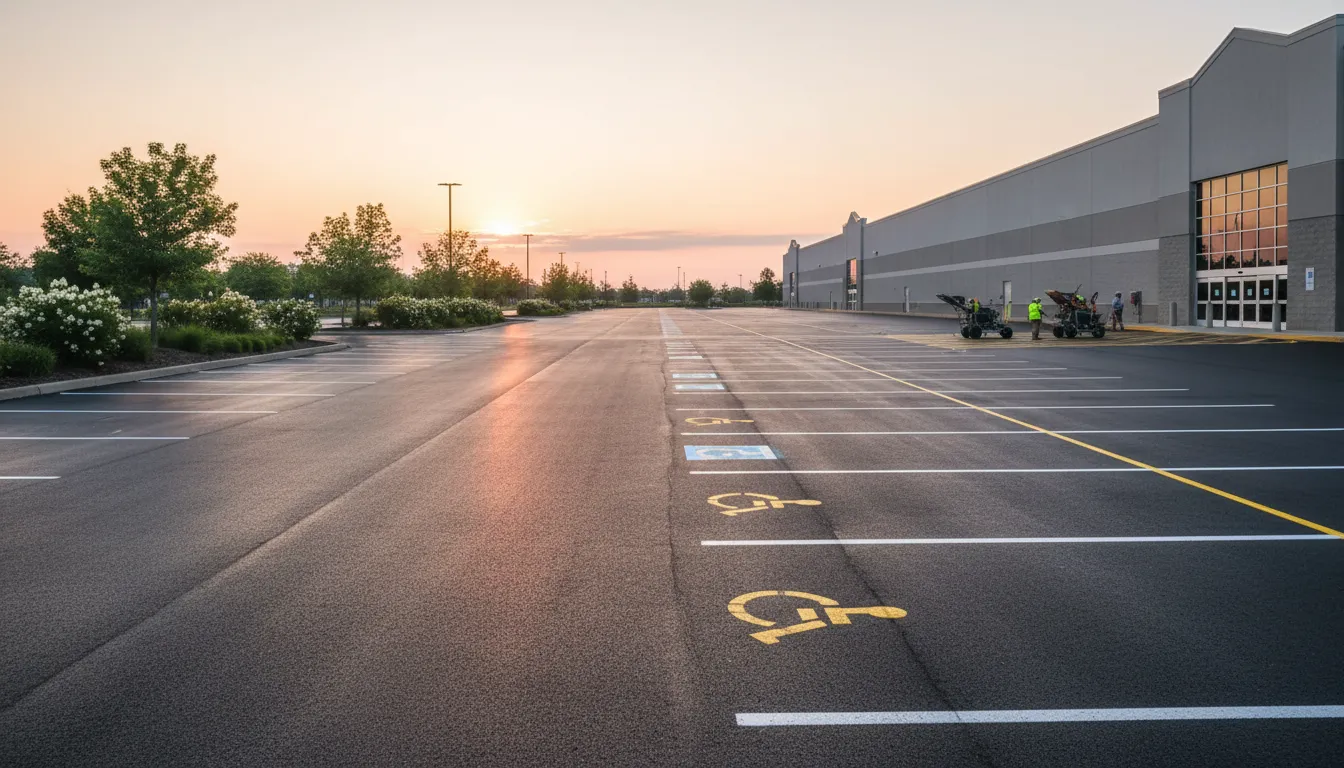
Find the Best Parking Lot Striping Companies for Your Business
No obligation • Fast responses • Nationwide coverage

Why you can trust Tidy Parking
Tidy Parking is a leading U.S. source for parking lot maintenance services, including striping, sealcoating, sweeping, paving, resurfacing, and repairs. Our content is created independently, and providers cannot pay to influence ratings or recommendations.
Search providers near you
Find Parking Lot Striping Companies near you
A well-striped parking lot is far more than just painted lines; it's a critical system for safety, efficiency, and legal compliance. Proper parking lot line striping guides traffic flow, maximizes space, prevents accidents, and ensures accessibility for all. In the United States, this work is governed by a mix of federal ADA standards, state regulations, and local building codes. Understanding these requirements is essential for any property owner or manager. This guide explains the key standards, costs, and best practices to help you plan your project and connect with qualified local professionals who can execute it correctly.
Search providers near you
Why Proper Striping Matters
Faded, incorrect, or non-existent pavement markings create a host of problems. They lead to chaotic parking, increased risk of vehicle collisions and pedestrian accidents, inefficient use of space, and potential legal liabilities for non-compliance with accessibility laws. Fresh, clear parking lot markings communicate rules instantly, organize traffic, enhance the property's appearance, and demonstrate a commitment to safety and inclusivity. It's one of the most cost-effective maintenance tasks for protecting your investment and the people who use it.
Core Standards for Parking Lot Line Striping
Adhering to established standards is not optional for commercial and public properties. These guidelines ensure consistency and safety.
Line Widths and Colors
The foundation of any striping project is the application of lines in the correct dimensions and colors.
- Line Width: The industry standard in the US is a 4-inch wide line. For enhanced visibility, especially in high-traffic areas or lots used frequently at night, 6-inch lines are often recommended.
- Colors and Their Meanings:
- White: Used for standard parking stall lines, directional arrows, and crosswalk lines (when used with pedestrian symbols).
- Yellow: Designates no-parking zones, fire lanes (often on curbs), loading areas, and is used for curbing and islands to indicate "caution".
- Blue: Reserved exclusively for the boundaries of parking spaces designated for individuals with disabilities (ADA-accessible stalls).
- Red: Used for curbs in fire lanes, typically accompanied by white "NO PARKING FIRE LANE" stenciling.
Essential Markings Beyond Stalls
A complete pavement marking plan includes more than just parking spaces.
- Directional Arrows: Crucial for guiding one-way traffic flow within the lot.
- Stop Bars: Thick white lines placed at intersections within the lot or at exits onto public streets.
- Pedestrian Crosswalks: Clearly marked pathways, often with white parallel lines or zebra stripes, and accompanied by international pedestrian symbols.
- Speed Bump Markings: Yellow diagonal stripes on the approach and crest of speed bumps for visibility.
- Curb Markings: Yellow or red paint on curbs to indicate restrictions.
ADA Compliance: A Legal Requirement
The Americans with Disabilities Act (ADA) sets forth specific, non-negotiable requirements for accessible parking. Failure to comply can result in significant fines and lawsuits.
Number of Required Accessible Spaces
The quantity is based on the total number of parking spaces in the lot. Here are key benchmarks:
- 1 to 25 spaces: Minimum of 1 accessible space.
- 26 to 50 spaces: Minimum of 2 accessible spaces.
- 51 to 75 spaces: Minimum of 3 accessible spaces.
- 76 to 100 spaces: Minimum of 4 accessible spaces.
- 101 to 150 spaces: Minimum of 5 accessible spaces.
- 151 to 200 spaces: Minimum of 6 accessible spaces.
- 201 to 300 spaces: Minimum of 7 accessible spaces.
- 301 to 400 spaces: Minimum of 8 accessible spaces.
- 401 to 500 spaces: Minimum of 9 accessible spaces.
- 501 to 1000 spaces: 2% of the total number of spaces.
Furthermore, one out of every six accessible spaces must be "van-accessible".
Dimensions and Layout
Accessible spaces are defined by both the stall and the crucial access aisle.
- Standard Accessible Space: Must be at least 8 feet wide with an adjacent 5-foot-wide access aisle. The aisle can be shared between two spaces.
- Van-Accessible Space: Must be at least 8 feet wide with an 8-foot-wide access aisle, or 11 feet wide with a 5-foot-wide access aisle1.
- Access Aisle Marking: The access aisle must be marked with diagonal hatch lines (often in blue) to clearly indicate it is a no-parking zone for vehicles not displaying placards or plates. This aisle is essential for deploying wheelchair ramps and lifts.
- Surface Slope: The surface of the accessible space and access aisle must be as level as possible, with a maximum slope of 1:48 (approximately 2%) in any direction to ensure stability 2 3.
Signage Requirements
The space is not compliant without proper signage.
- Design: Must display the International Symbol of Accessibility.
- Mounting Height: The bottom of the sign must be at least 60 inches (5 feet) above the ground to ensure visibility.
- Location: Signs must be positioned at the head of the parking space, visible to the driver when the space is occupied.
Find the perfect parking lot striping companies for your needs
Get personalized recommendations and expert advice
Fire Lane Markings
Fire lane striping is critical for life safety, ensuring emergency vehicles have unimpeded access. These areas are strictly enforced.
- Curb Painting: Fire lanes are marked by painting the adjacent curb red.
- Stenciling: The words "NO PARKING FIRE LANE" are typically stenciled in white on the red curb or directly on the pavement surface along the lane 4.
- Local Codes: Requirements for lettering size, spacing, and the exact wording are often dictated by local fire marshal codes, which can be more stringent than general guidelines.
Understanding Parking Lot Striping Costs
Costs for lot striping can vary based on the size of the project, condition of the pavement, complexity of the layout, and regional labor rates. Prices are often broken down as follows:
- Per Linear Foot: For painting lines, costs typically range from $0.30 to $0.60 per linear foot5. This is the most common pricing method for new layouts or full repaints.
- Per Stall (Restriping): For simply re-painting existing stall lines, a per-stall price of $5 to $10 is common.
- ADA Stencils: Applying the blue accessible symbol and hatch marks for the access aisle generally costs between $50 and $150 per stencil application.
- Sign Installation: Installing a compliant ADA sign, including the post, hardware, and labor, can range from $100 to $250 per sign6 7.
Important Note: These are national estimates. Always get detailed quotes from local contractors, as prices can be higher in major metropolitan areas or for lots that require extensive surface preparation.
Planning Your Striping Project: Best Practices
- Audit Your Current Layout: Before calling professionals, assess your lot. Note faded lines, incorrect dimensions, and whether your accessible spaces meet current counts and specs.
- Check Local Codes: Contact your local building or planning department. Municipal codes often exceed federal ADA minimums for space counts, stall dimensions, or fire lane specifications.
- Prioritize Surface Preparation: Striping will not adhere properly to dirty, oily, or crumbling asphalt. A clean, dry surface is mandatory. For older lots, crack sealing and sealcoating may need to precede striping for a long-lasting result.
- Use Quality Materials: Professional contractors use durable, traffic-grade thermoplastic or high-performance water-based paints designed to withstand weather and tire wear.
- Schedule Strategically: Plan the work for dry weather with moderate temperatures (typically between 50°F and 90°F for most paints). Consider doing the work during off-peak hours or on weekends to minimize disruption.
Frequently asked questions
Sources
Footnotes
-
Accessible Parking Spaces | ADA.gov - https://www.ada.gov/topics/parking/ ↩
-
ADA Requirements for Parking: Standards, Compliance, and Penalties - https://www.accessibilitychecker.org/blog/ada-requirements-for-parking-standards-compliance-and-penalties/ ↩
-
Parking Lot Striping Standards: Measurements, Colors, and ... - https://www.getonecrew.com/post/parking-lot-striping-standards ↩
-
Basic Guide to Parking Lot Striping - Traffic Safety Resource Center - https://www.trafficsafetystore.com/blog/guide-to-parking-lot-striping/ ↩
-
Commercial Parking Lot Striping: Costs, Standards + Pro Tips - https://www.getonecrew.com/post/commercial-parking-lot-striping ↩
-
ADA Compliance Guide for Parking Lot Line Striping - https://www.pavementsolutions.org/ada-compliance-guide-for-parking-lot-line-striping/ ↩
-
Parking Lot Striping and ADA Compliance: Everything You Need to ... - https://theparkinglotpro.com/parking-lot-striping-and-ada-compliance-everything-you-need-to-know/ ↩