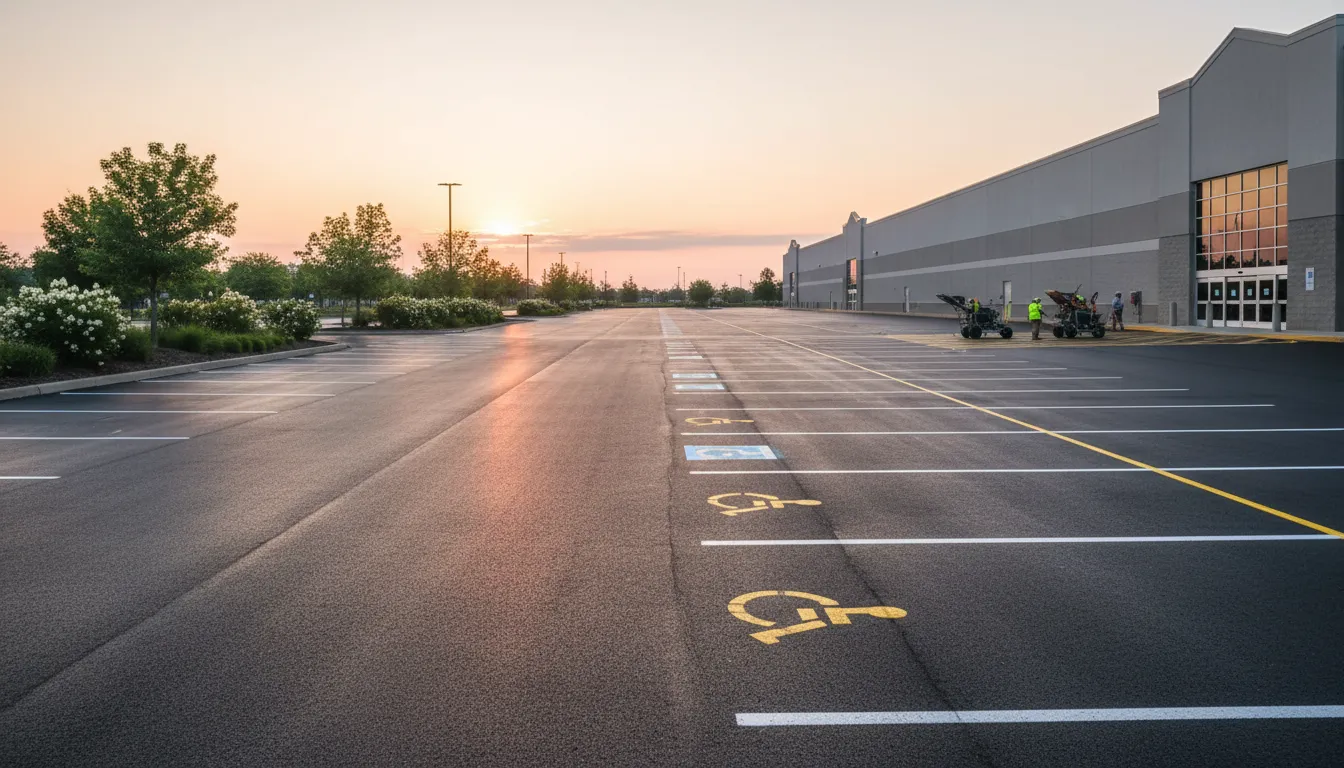
Find the Best Parking Lot Striping Companies for Your Business
No obligation • Fast responses • Nationwide coverage

Why you can trust Tidy Parking
Tidy Parking is a leading U.S. source for parking lot maintenance services, including striping, sealcoating, sweeping, paving, resurfacing, and repairs. Our content is created independently, and providers cannot pay to influence ratings or recommendations.
Search providers near you
Best Parking Lot Striping Companies in Vermont Ranked
Parking lot striping is the application of painted lines, symbols, and stencils that organize traffic flow, designate parking spaces, and ensure safety and legal compliance. In Vermont, this work is governed by a combination of federal ADA standards and state-specific fire and accessibility codes. Proper markings are not just about aesthetics; they are a critical component of public safety, accessibility, and liability management for property owners. This guide explains Vermont's specific requirements and helps you understand what to look for when seeking a professional to handle your pavement marking project.
Understanding Vermont's Legal Framework for Pavement Markings
In Vermont, parking lot line painting is regulated to ensure accessibility and fire safety. The primary governing bodies are the federal Americans with Disabilities Act (ADA) and the Vermont Division of Fire Safety 1. Non-compliance isn't just a matter of a fine; it can create barriers for people with disabilities and impede emergency responders, leading to serious safety risks and potential lawsuits.
Businesses and property owners are responsible for maintaining clear, compliant markings. This includes regular repainting, as faded lines can be considered non-compliant. A 2017 investigation by WCAX found hundreds of Vermont businesses were in violation of accessible parking rules, highlighting the importance of vigilance in maintenance and layout 2.
ADA Parking Space Requirements in Vermont
ADA-compliant striping is non-negotiable. The rules specify dimensions, signage, and location for accessible parking spaces.
Space Dimensions and Layout:
- Standard Accessible Car Space: Must be at least 96 inches (8 feet) wide.
- Access Aisle: A 60-inch (5-foot) wide access aisle must be adjacent to the space. This aisle is part of the accessible route and must be marked, typically with diagonal hatch lines, to discourage parking 3 4. The aisle must be at the same level as the parking space, with a maximum slope of 1:48 (2.08%) 5.
- Van Accessible Space: Requirements are more stringent. A van space must be at least 132 inches (11 feet) wide with a 60-inch aisle, or it can be 96 inches wide if it has a 96-inch wide access aisle.
Signage Specifications: Each accessible space must have a proper sign mounted at least 60 inches above the ground to the bottom of the sign.
- Vermont-Specific Design: The state suggests a green-on-white sign measuring 12" wide by 18" high with the words "RESERVED PARKING" and the International Symbol of Accessibility (ISA) 6.
- Van Accessible Marking: Spaces designed for vans must include additional "Van Accessible" text on the sign.
- Small Lot Exception: Parking lots with four or fewer total spaces are required to have one accessible space but are exempt from the sign requirement, though the space must still be properly sized and marked on the pavement.
Quantity and Location: The number of required accessible spaces is based on the total number of spaces in the lot. For example, lots with 1 to 25 spaces require at least one accessible space, while lots with 26 to 50 require two 7 8. These spaces must be located on the shortest accessible route to an accessible building entrance 9.
Fire Lane Marking Regulations
Fire lane markings are crucial for keeping access clear for emergency vehicles. Vermont fire codes, often enforced at the local level, have specific mandates for how these areas must be marked.
Curb and Pavement Markings:
- Color: Curbs within designated fire lanes must be painted red.
- Text: The curbs must be marked with the words "NO PARKING - FIRE LANE -- TOW AWAY ZONE" in white letters at least 3 inches tall. This text must be repeated at intervals not exceeding 50 feet.
- Lane Width: Fire lanes are generally required to be no less than 24 feet wide to accommodate fire apparatus 10.
Supporting Signage: In addition to curb painting, 12" x 18" signs with 3-inch-tall letters stating "FIRE LANE NO PARKING" should be posted, typically every 25 feet, to reinforce the restriction 11. It is also a best practice to post "Unauthorized vehicles will be towed at owner's expense" signs at every vehicle entrance to the lot 12.
Find the perfect parking lot striping companies for your needs
Get personalized recommendations and expert advice
Best Practices for Layout and Maintenance
A well-designed parking lot maximizes space, improves safety, and ensures longevity of the markings.
Layout Design:
- Traffic Flow: Use arrows and directional markings to create a one-way flow where possible, reducing conflict points.
- Pedestrian Safety: Marked crosswalks in high-traffic areas between parking and building entrances are essential.
- Aisle Marking: Clearly mark access aisles for ADA spaces with diagonal yellow or white hatch lines 13.
- Loading Zones: Clearly designate and stripe areas for loading and unloading.
Maintenance Schedule: Markings fade due to traffic, weather, and snow plowing. Vermont's harsh winters make regular maintenance critical.
- Repainting Cycle: Industry standard recommends repainting parking lot lines every 1 to 2 years to maintain visibility and compliance.
- Pre-Striping Surface Prep: For the paint to adhere properly, the pavement should be clean, dry, and free of oil, dirt, and loose debris. Crack sealing or minor repairs may be needed before restriping.
- Winter Considerations: Discuss snow plow policies with your contractor. Using a slightly recessed stencil or more durable thermoplastic markings can help stripes withstand plow blades.
Cost Considerations for Parking Lot Striping in Vermont
The cost of a line striping project in Vermont varies significantly based on the scope, compliance needs, and condition of the pavement.
Project Scope & Pricing:
- Basic Restriping: For a small lot where the existing layout is simply being repainted, costs can range from $500 to $1,500.
- ADA & Fire Lane Compliance Projects: If the project involves reconfiguring the layout to add or modify ADA spaces, paint fire lanes, or add stenciling, costs increase. Medium to large projects often range from $2,000 to over $10,00014 15.
- Major Factors Influencing Cost:
- Square Footage & Linear Feet: The total area and the length of lines to be painted are the primary cost drivers.
- Layout Complexity: Adding new ADA spaces, arrows, symbols, or handicap stencils adds time and labor.
- Surface Preparation: If the lot requires power washing, crack filling, or patching before painting, this will add to the cost.
- Material Type: Standard traffic paint is the most economical. More durable options like thermoplastic or preformed tape cost more upfront but last longer.
- Local Regulations: Adhering to specific town-level fire lane requirements may involve additional signage or marking specifications.
Choosing a Professional Striping Contractor
Selecting the right contractor is key to a compliant, durable, and professional-looking result.
Key Qualifications to Look For:
- Knowledge of Vermont Codes: The contractor should be familiar with both ADA standards and Vermont Division of Fire Safety requirements, and ideally, local town ordinances.
- Proper Insurance: Ensure they carry general liability and workers' compensation insurance.
- Portfolio & References: Ask for examples of previous work, especially projects that involved ADA compliance or fire lane marking.
- Detailed Proposal: A professional quote should detail the scope, specify paint types, include a layout diagram, and outline the project timeline.
Questions to Ask:
- Can you provide a diagram of the proposed layout for my review?
- How do you ensure ADA and fire lane markings meet Vermont specifications?
- What type of paint or material do you recommend for my specific pavement and traffic conditions?
- What is your process for surface preparation?
- What is your expected timeline for completion and drying time?
Frequently asked questions
Sources
Footnotes
-
Americans with Disabilities Act (ADA) and Accessibility - https://firesafety.vermont.gov/buildingcode/ada ↩
-
Hundreds of Vt. businesses break accessible parking rules - WCAX - https://www.wcax.com/content/news/Hundreds-of-Vt-businesses-break-accessible-parking-rules-454857983.html ↩
-
Parking signs in Vermont | MyParkingSign.com Blog - https://www.myparkingsign.com/blog/parking-signs-in-vermont/ ↩
-
ADA Compliance Brief: Restriping Parking Spaces - https://www.ada.gov/resources/restriping-parking-spaces/ ↩
-
ADA Compliance Brief Restriping Parking Spaces 2015 - https://hrc.vermont.gov/sites/hrc/files/publications/ADA%20Compliance%20Brief%20Restriping%20Parking%20Spaces%20%202015.pdf ↩
-
VERMONT - State Specific Signs - https://www.compliancesigns.com/media/resource-bulletins/CRB-State-Vermont.pdf ↩
-
ADA Parking Lot Requirements - The Pavement Network - https://pavementnetwork.com/ada-parking-lot-requirements/ ↩
-
Accessible Parking - ADA National Network - https://adata.org/factsheet/parking ↩
-
Accessible Parking Spaces | ADA.gov - https://www.ada.gov/topics/parking/ ↩
-
FIRE LANE REQUIREMENTS - Horizon Fire Department - https://www.epcesd1.com/wp-content/uploads/2023/08/ESD1-Fire-Lane-Requirements-IFC-2021.pdf ↩
-
FIRE LANE REQUIERMENTS - https://mpcity.net/wp-content/uploads/2021/07/Fire-Lane-Requierments.pdf ↩
-
ADA-Compliant Parking Lots: How To Design Your Signs - https://landmarkpaving.com/ada-compliant-parking-lots-how-to-design-your-stripes-and-signs/ ↩
-
ADA Compliance Guide for Parking Lot Line Striping - https://www.pavementsolutions.org/ada-compliance-guide-for-parking-lot-line-striping/ ↩
-
Vermont Parking Lot Line Striping | ADA & Fire Lane Marking - https://vermontpavement.com/line-striping/ ↩
-
Cost to Restripe a Parking Lot - Truline Striping Company - https://trulinestripingco.com/blog/cost-to-restripe-a-parking-lot/ ↩