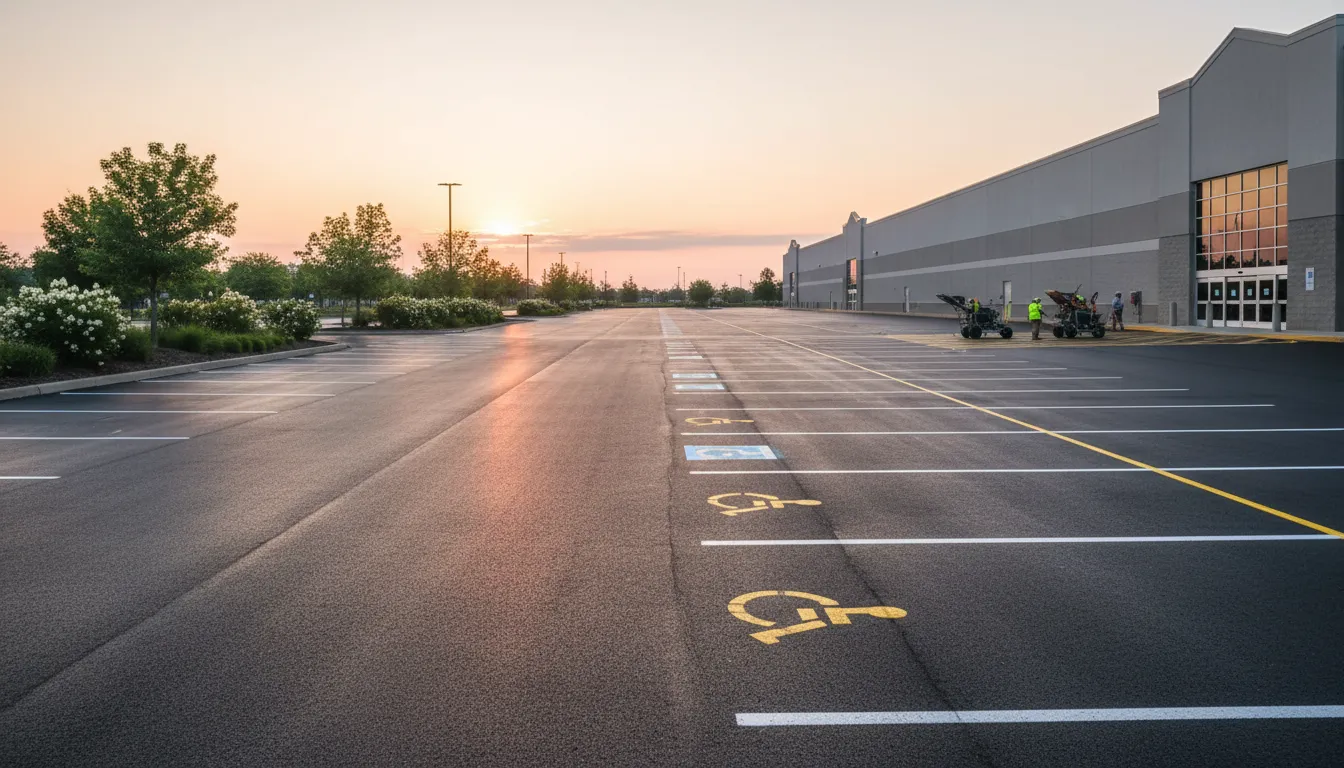
Find the Best Parking Lot Striping Companies for Your Business
No obligation • Fast responses • Nationwide coverage

Why you can trust Tidy Parking
Tidy Parking is a leading U.S. source for parking lot maintenance services, including striping, sealcoating, sweeping, paving, resurfacing, and repairs. Our content is created independently, and providers cannot pay to influence ratings or recommendations.
Search providers near you
Best Parking Lot Striping Companies in Alaska Ranked
Clear, durable pavement markings are essential for safety, accessibility, and efficient traffic flow in any parking area. In Alaska, this work is governed by a unique combination of federal accessibility laws and stringent local fire codes designed for challenging weather conditions. Proper line striping, stenciling, and signage ensure your property is compliant, safe for all users, and protects you from liability. This guide explains the key regulations, costs, and best practices for parking lot striping and marking in The Last Frontier, helping you understand what's required and how to connect with qualified local professionals for your project.
Onyx Asphalt, LLC
1221 Huffman Park Dr #110836, Anchorage, AK 99511
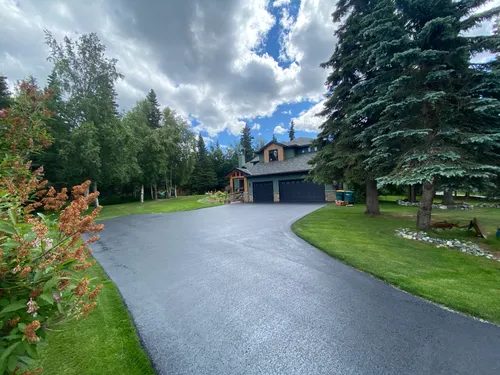
Onyx Asphalt, LLC is a parking lot striping and sealcoating company based in Anchorage, AK. They provide professional asphalt maintenance services including sealcoating, crack sealing, and striping, designed to protect and extend the life of asphalt surfaces in the region. Their work helps shield asphalt from harsh Alaskan weather conditions such as snow, ice, and UV exposure. The company emphasizes using proven methods and durable materials to ensure long-lasting pavement protection. Onyx Asphalt also offers snow removal services, maintaining properties year-round.
AK Pave Co.
9044 Hartzell Rd, Anchorage, AK 99507
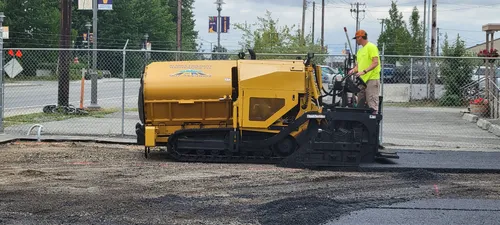
AK Pave Co. is a commercial and residential asphalt paving and maintenance contractor based in Anchorage, AK. They provide services including asphalt paving, parking lot striping, crack filling, seal coating, repairs, and commercial snow plowing with 24-hour availability. The company serves Anchorage, Girdwood, the Mat-Su Valley, and surrounding areas. AK Pave Co. offers custom driveway and parking lot installations designed for Alaska's northern climate, ensuring durable and well-prepared surfaces. They have an owner on-site for quality control and provide a one-year warranty on new pavement.
Northland Property Services, Inc.
Anchorage, AK
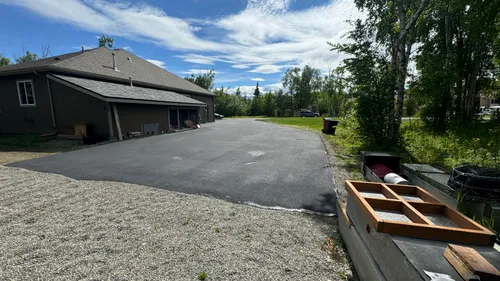
Northland Property Services, Inc. is a parking lot striping, sealcoating, and paving contractor based in Anchorage, AK. They provide commercial and residential asphalt maintenance, paving, and snow removal services to clients in Anchorage and the Mat-Su Valley. Their offerings include year-round snow removal and asphalt care to maintain properties in all seasons.
Straightline
Anchorage, AK
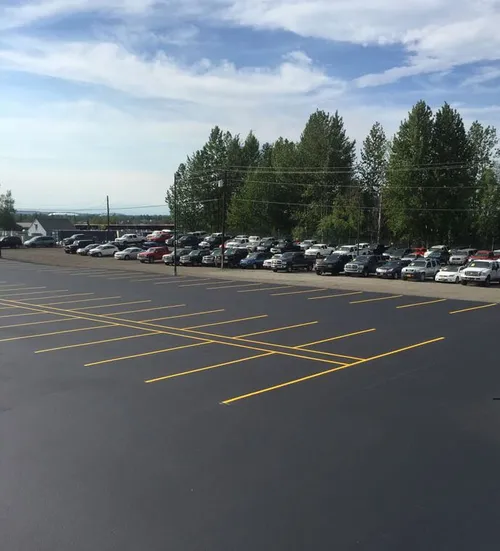
Straightline is a pavement maintenance contractor based in Anchorage, AK, serving Anchorage, Palmer, Wasilla, and surrounding areas. They provide commercial and residential services including crack sealing, sealcoating, pavement marking (striping), sweeping, power washing, and snow and ice management. Established in 1999 initially as a striping company, Straightline expanded its services over the years to offer a comprehensive pavement maintenance solution. Their team is bonded, insured, and fully licensed with up-to-date knowledge of local regulations and industry standards.
Matsu Asphalt Maintenance, Inc
547 E Mountain Ash Loop, Wasilla, AK 99654
Matsu Asphalt Maintenance, Inc is a family-owned asphalt maintenance and repair company based in Wasilla, serving Anchorage, AK, and the surrounding Matsu Valley area. They offer services including seal coating, crack sealing, line striping, and asphalt repair for both small driveways and large commercial parking lots. The company uses commercial-grade materials such as a two-coat asphalt-based pavement sealer and ADOT-approved paint for striping. While they do not provide paving services, they handle small to mid-sized repairs like oil and gas stain removal and pothole fixes. Matsu Asphalt Maintenance focuses on protecting asphalt investments with quality workmanship and reliable equipment.
Understanding ADA Compliance for Parking in Alaska
All businesses and public facilities in Alaska must adhere to the federal Americans with Disabilities Act (ADA) Standards for Accessible Design 1. These standards are not optional and are enforced to ensure equal access. For parking lots, this means providing a specific number and type of accessible parking spaces based on the total number of spaces in your lot. Compliance involves precise dimensions, signage, and location.
Key ADA Requirements for Accessible Parking Spaces:
- Space and Aisle Dimensions: A standard accessible parking space must be at least 96 inches (8 feet) wide. It must be paired with an adjacent access aisle that is a minimum of 60 inches (5 feet) wide 2. This aisle provides room for wheelchair lifts and ramps.
- Van-Accessible Spaces: One out of every six accessible spaces must be van-accessible. These require more room: either a 132-inch (11-foot) wide space with a 60-inch aisle, or a 96-inch wide space with a 96-inch wide aisle 3. Each van-accessible space must be identified with an additional "van accessible" sign.
- Access Aisle Markings: The access aisle must be marked with diagonal hatch lines or similar markings to clearly indicate it is a "no parking" zone 4. This is crucial to keep the area clear for wheelchair users.
- Signage: Each accessible space must have a sign displaying the International Symbol of Accessibility. The bottom of the sign must be mounted at least 60 inches above the ground to ensure visibility 5. Van-accessible signs are placed below the ISA sign.
- Location and Slope: Accessible spaces must be located on the shortest accessible route from the parking area to the building's accessible entrance. Furthermore, the slope of the space and access aisle cannot exceed 1:48 (approximately 2%) in any direction to ensure stability for wheelchairs 6 7.
Failure to maintain these standards can result in fines and legal liability. Regular restriping is necessary as markings fade, especially after harsh Alaska winters.
Fire Lane Marking Regulations: A Critical Safety Measure
In Alaska, clear marking of fire lanes is a non-negotiable safety requirement. These regulations are often detailed in local municipal codes and are strictly enforced by fire departments, such as the Anchorage Fire Department. The goal is to guarantee unimpeded access for emergency vehicles at all times, which is particularly vital in high-snow regions where visibility can be obscured.
Standard Fire Lane Marking Specifications:
- Curb Painting: Any curb bordering a designated fire lane must be painted red 8.
- Stenciling: The words "FIRE LANE" or "NO PARKING - FIRE LANE" must be stenciled in white, uppercase letters on the red curb. Letters are typically required to be at least 4 inches tall. This stenciling must be repeated at regular intervals, often not exceeding 50 feet 9.
- Signage: In addition to curb markings, official fire lane signs (usually with red lettering on a white reflective background) must be posted. Requirements often state signs at each end of the lane and at intermediate points no more than 100 feet apart 10. Anchorage, for example, specifies 12"x18" signs on sturdy posts 11.
- Pavement Markings: If no curb is present, a 6-inch wide red stripe must be painted directly on the pavement to delineate the fire lane 12.
These markings must be kept clear of snow and ice. Property owners are responsible for ensuring fire lanes are not blocked, which includes maintaining highly visible, freshly painted markings.
Cost Factors for Parking Lot Striping in Alaska
The cost to stripe or restripe a parking lot in Alaska varies based on several factors, including the lot's size, the complexity of the layout, the type of paint used, and the current condition of the pavement. Given the state's vast geography, a mobilization fee for contractor travel is common.
Typical Cost Breakdown:
- Per-Stall or Linear Foot Pricing: Many contractors price by the individual parking stall or by the linear foot of paint line. A common range is $5 to $20 per stall, with a simple 18-foot line often costing between $4 and $5 13.
- Project-Based Estimates: For small to medium-sized lots, total project costs often fall between $300 and $1,500 14 15. Larger commercial lots will cost significantly more.
- ADA and Specialty Markings: Accessible space symbols (the wheelchair icon) and stenciling cost extra, typically $25 to $50 per space 16. Painting curbs for fire lanes or loading zones averages around $1 per linear foot 17.
- Mobilization Fee: To cover travel, equipment setup, and minimum service charges, contractors may add a fee ranging from $150 to $350 18.
- Surface Preparation: If old markings need to be removed or the pavement requires extensive cleaning, this will add to the cost. Cracked or uneven surfaces also make the job more time-consuming.
Find the perfect parking lot striping companies for your needs
Get personalized recommendations and expert advice
The Impact of Alaska's Climate on Pavement Markings
Alaska's extreme weather is the single biggest factor affecting the longevity and maintenance of parking lot markings. Long winters with heavy snowfall, freeze-thaw cycles, and the use of snowplows and ice-melting chemicals take a severe toll on paint.
- Snow Plow Damage: Plow blades can scrape and chip away at pavement markings. Using high-quality, durable paint and ensuring markings are applied correctly (at the proper thickness and temperature) can help them withstand this abuse.
- Chemical Deicers: Salt and other deicing agents can break down paint over time, causing it to fade and peel more quickly.
- Freeze-Thaw Cycles: Water seeps into tiny cracks in the paint and pavement. When it freezes and expands, it can cause the paint to flake off and worsen pavement deterioration underneath.
- Maintenance Schedule: Due to these harsh conditions, parking lots in Alaska generally require restriping more frequently than in milder climates. A typical recommendation is to restripe every 18 to 36 months, depending on traffic volume and wear 19. Regular inspections after winter are advised to assess marking visibility.
Best Practices for Planning a Striping Project
- Audit Your Current Lot: Start by counting your total spaces and verifying your current number of ADA-compliant spaces meets the federal ratio. Check the condition of all markings, including fire lanes, directional arrows, and loading zones.
- Consult Local Codes: Always check with your local city or borough planning department and fire department for any regulations that exceed state or federal minimums, especially regarding fire lane specifications.
- Choose the Right Paint: Discuss paint options with your contractor. Thermoplastic paint, while more expensive upfront, is often more durable and reflective than standard latex-based traffic paint, making it a worthwhile investment for Alaska's conditions.
- Schedule Strategically: The best time for striping is during dry, warm weather, typically late spring through early fall. Paint requires specific temperature ranges (often above 50°F) for proper application and curing.
- Hire an Experienced Local Contractor: Choose a professional with proven experience in Alaska. They will understand local codes, the challenges of the climate, and the best materials for longevity. Ensure they carry proper insurance and licensing.
Beyond Striping: Loading Zones and Other Markings
Parking lot marking encompasses more than just stall lines and accessible spaces.
- Loading Zones: These are typically indicated by white painted curbs. They provide essential short-term space for deliveries and pick-ups.
- Limited Time Parking: Some municipalities use green curbs to denote parking with a time limit 20.
- Directional Arrows and Traffic Flow: Clearly painted arrows and one-way markings are critical for preventing accidents and ensuring smooth traffic movement, especially in larger lots.
- Crosswalks and Stop Bars: These markings enhance pedestrian safety and define vehicle stopping points.
Maintaining all these markings is part of overall property safety and management. A well-marked lot reduces confusion, improves efficiency, and minimizes the risk of accidents and liability claims.
Frequently asked questions
Sources
Footnotes
-
ADA Accessible Parking - https://www.americanlinestriping.com/ada-accessible-parking/ ↩
-
ADA Compliance Guide for Parking Lot Line Striping - https://www.pavementsolutions.org/ada-compliance-guide-for-parking-lot-line-striping/ ↩
-
Accessible Parking - ADA National Network - https://adata.org/factsheet/parking ↩
-
ADA Compliance Brief: Restriping Parking Spaces - https://archive.ada.gov/restriping_parking/restriping2015.pdf ↩
-
The Importance of ADA-Compliant Parking Lot Striping - Rose Paving - https://www.rosepaving.com/blog/the-importance-of-ada-compliant-parking-lot-striping/ ↩
-
Chapter 5: Parking Spaces - Access-Board.gov - https://www.access-board.gov/ada/guides/chapter-5-parking/ ↩
-
Accessible Parking Spaces | ADA.gov - https://www.ada.gov/topics/parking/ ↩
-
§ 150.191 FIRE LANE REQUIREMENTS. - American Legal Publishing - https://codelibrary.amlegal.com/codes/anthonynm/latest/anthony_nm/0-0-0-3281 ↩
-
Fire Lane Requirements in the US as of 2025 - https://asphaltsealcoatingsupply.com/blogs/news/fire-lane-requirements-in-the-us-as-of-2025 ↩
-
Fire Lanes, Access Roads, and Signage Requirements - https://www.truegridpaver.com/fire-lane-requirements/ ↩
-
Appendix D Fire Apparatus Access Roads - UpCodes - https://up.codes/viewer/alaska/ifc-2021/chapter/D/fire-apparatus-access-roads ↩
-
FIRE LANE REQUIREMENTS | epcesd1 - https://www.epcesd1.com/wp-content/uploads/2022/03/Fire-Lane-Requirements.pdf ↩
-
How Much Does it Cost to Stripe a Parking Lot? - SealMaster.net - https://sealmaster.net/faq/much-cost-stripe-parking-lot/ ↩
-
How Much Does Striping a Parking Lot Cost? [2026 Data] | Angi - https://www.angi.com/articles/stripe-parking-lot-cost.htm ↩
-
How Much Does Parking Lot Striping Cost? (2026) - HomeGuide - https://homeguide.com/costs/parking-lot-striping-cost ↩
-
Parking Lot Striping & ADA Compliance: What to Know - https://brixco.co/parking-lot-striping-ada-compliance/ ↩
-
Alaska Parking Lots Costs & Prices - ProMatcher Cost Report - https://parking-lots.promatcher.com/cost/alaska.aspx ↩
-
How Much Does it Cost to Stripe a Parking Lot? - Walt's Paving - https://waltspaving.com/how-much-does-it-cost-to-stripe-a-parking-lot/ ↩
-
Parking Lot Restriping: A Comprehensive Guide - https://www.seton.com/when-to-restripe-a-parking-lot ↩
-
Alaska DMV: Park It - Shmoop - https://www.shmoop.com/drivers-ed/alaska/park-it.html ↩