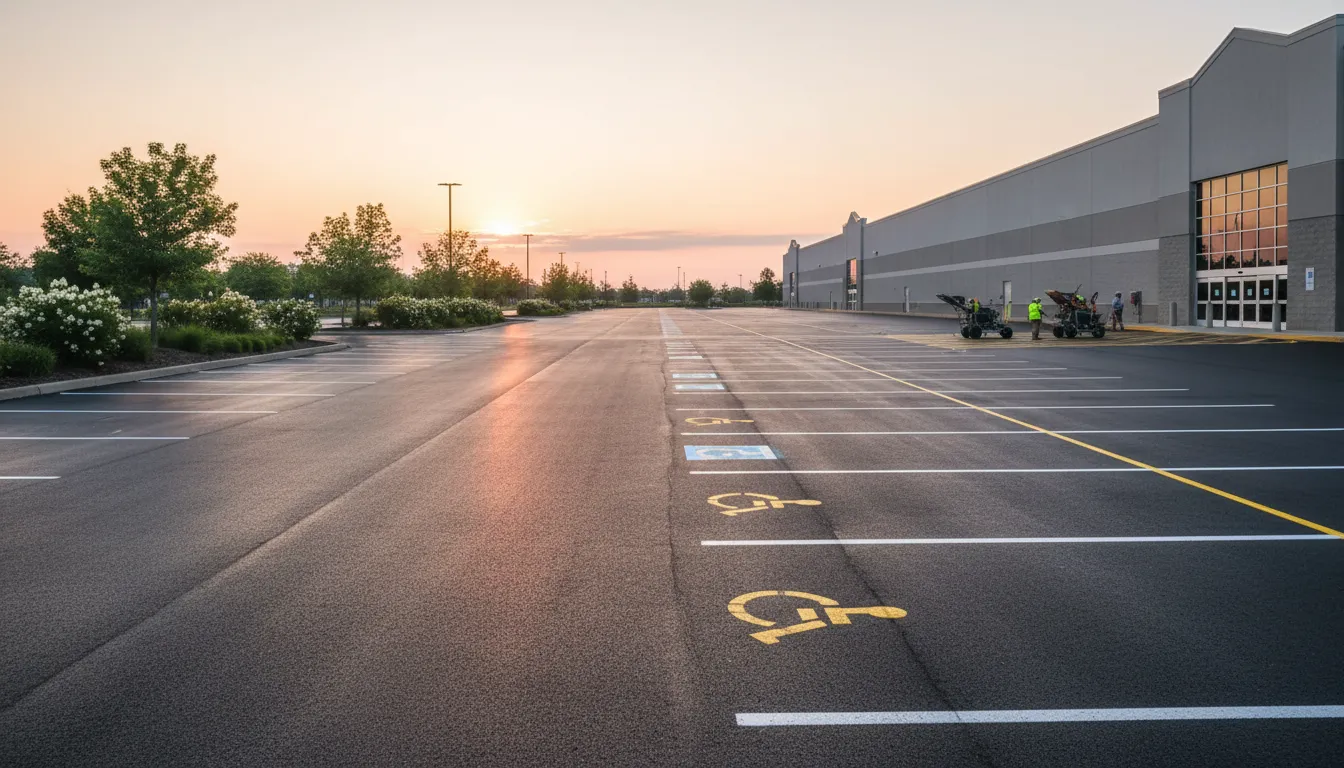
Find the Best Parking Lot Striping Companies for Your Business
No obligation • Fast responses • Nationwide coverage

Why you can trust Tidy Parking
Tidy Parking is a leading U.S. source for parking lot maintenance services, including striping, sealcoating, sweeping, paving, resurfacing, and repairs. Our content is created independently, and providers cannot pay to influence ratings or recommendations.
Search providers near you
Top Parking Lot Striping Companies in Tacoma, Washington Ranked
Maintaining a clearly marked parking lot is a critical aspect of property management, safety, and legal compliance in Tacoma. Proper parking lot striping and pavement marking guide traffic, maximize space, and ensure accessibility for all. In Tacoma, this work is governed by a specific set of local codes and federal ADA regulations that dictate everything from stall dimensions to fire lane markings. This guide explains the key requirements and considerations for parking lot line painting in Tacoma, helping property owners and managers understand what's needed to keep their lots functional, safe, and compliant.
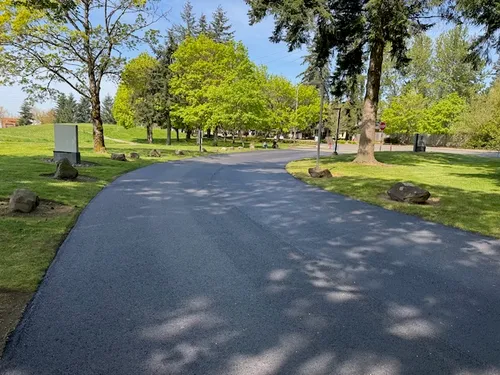
Statewide Parking Lot Services Inc
33920 211th Pl SE, Auburn, WA 98092
Statewide Parking Lot Services Inc is a parking lot maintenance and paving company based in Kent, WA. Founded in 1972 by Dwayne McGraw, the company offers services including parking lot striping, sealcoating, sweeping, paving, and repair. With a team of skilled operators and contractors, they serve Kent and surrounding communities such as Seattle, Federal Way, Bellevue, Tacoma, Olympia, Everett, Lynnwood, and Bremerton. Their capabilities include comprehensive parking lot maintenance and asphalt paving to help extend the life of pavement surfaces. The company has a long history of family leadership and experienced management, with over 50 years in the industry.
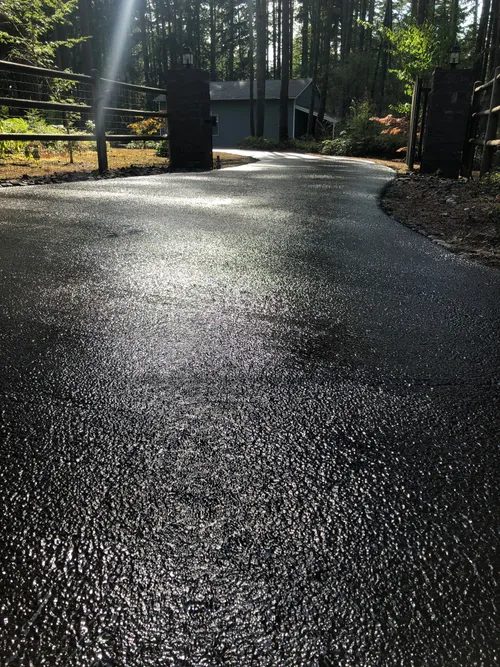
Spadoni Asphalt Maintenance
Tacoma, WA
Spadoni Asphalt Maintenance is a family-owned asphalt maintenance company based in Tacoma, WA. They provide commercial and residential services including parking lot sealcoating, crack sealing, asphalt repair, line striping, and concrete and curb repair. Serving Pierce and Kitsap counties, they focus on smaller-scale repairs and preventative maintenance to extend pavement life and reduce the need for costly replacements. With over 20 years of experience, Spadoni Asphalt Maintenance offers flexible scheduling and thorough documentation to keep clients informed throughout the process.
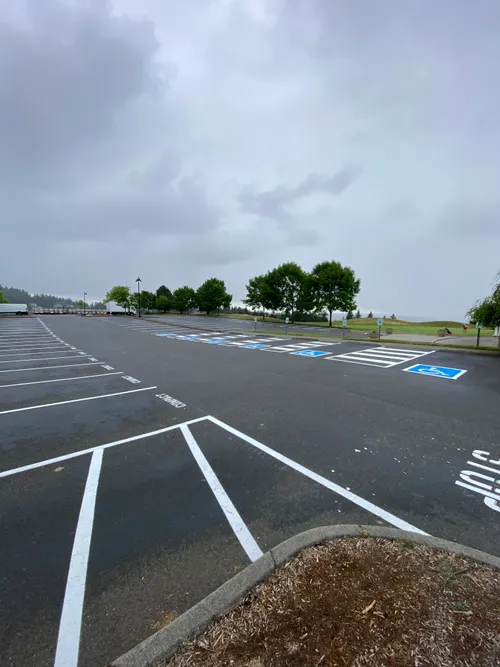
Rain City Striping, LLC
21729 148th Ave SE, Kent, WA 98042
Rain City Striping, LLC is a parking lot striping company based in Seattle, WA. They provide parking lot striping and maintenance services throughout the Pacific Northwest. The company is equipped to handle projects of any size, ensuring clear and professional markings for parking areas.
Tacoma Paving
Tacoma, WA
Tacoma Paving is a locally owned paving company serving Tacoma, WA, and nearby communities including Lakewood, Parkland, and Puyallup. They specialize in asphalt and concrete paving for residential and commercial properties, offering services such as parking lot installation, driveway paving, sealcoating, resurfacing, and line striping. Their capabilities include grading and excavation to ensure stable and well-drained surfaces. With over 10 years of experience, Tacoma Paving supports a variety of clients from businesses to community organizations.
Summit Asphalt Solutions
Seattle, WA
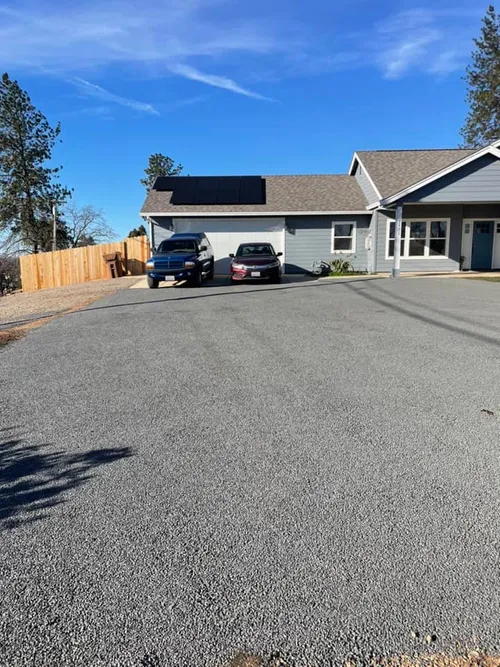
Summit Asphalt Solutions is an asphalt contractor based in Seattle, WA, providing a full range of asphalt services including paving, patching, striping, sealcoating, and driveway installation. They serve both residential and commercial clients, using premium materials and advanced techniques to deliver durable and long-lasting pavement solutions. Their expertise includes asphalt patching to repair cracks and potholes, helping to extend the life of existing surfaces. Summit Asphalt Solutions has years of hands-on experience and focuses on completing projects efficiently while meeting client needs.
Understanding Tacoma's Parking Lot Marking Codes
Before any paint hits the pavement, it's essential to understand the local framework. The City of Tacoma enforces strict compliance with both the Americans with Disabilities Act (ADA) and its own municipal ordinances 1. These regulations are not mere suggestions; they are legal requirements designed to ensure safety and accessibility. The Tacoma Permits department provides specific "tip sheets" that outline the standards for accessible parking, fire lanes, and overall parking lot changes.
Failing to adhere to these codes can result in fines, liability issues, and a parking area that is unsafe or unusable for people with disabilities. Whether you're planning a new layout or simply refreshing faded lines, consulting the latest Tacoma Permits guidelines is the mandatory first step 2.
ADA-Compliant Accessible Parking Requirements
Creating accessible parking is a core component of compliant lot striping. The ADA sets federal minimums, which Tacoma's codes incorporate and enforce.
Stall and Aisle Dimensions: Each standard accessible parking space must be at least 96 inches wide. This space must be marked to clearly define its boundaries. Adjacent to the stall, a 60-inch wide access aisle is required. This aisle provides room for wheelchair lifts and ramps and must connect to an accessible route to the building entrance 3. For van-accessible spaces, the access aisle must be a minimum of 96 inches wide. These aisles are typically marked with diagonal hash marks to discourage parking.
Location and Slope: Accessible spaces must be located on the shortest accessible route from the parking area to the building entrance. The path cannot have a slope exceeding 1:48 (less than 2%) to ensure it is navigable 4.
Signage: Vertical signage is a crucial, non-negotiable part of an accessible stall. A "No Parking" sign identifying it as an accessible space must be posted at the head of each access aisle. The bottom of the sign must be at least 60 inches above the ground.
Ratios: The number of required accessible spaces depends on the total number of spaces in the lot. A key rule is that at least one out of every six accessible spaces must be van-accessible. For example, a new 50-space lot requires at least two accessible stalls, one of which must be van-accessible with the wider 96-inch aisle.
Fire Lane Marking Specifications
Fire lane markings are critical for life safety, ensuring emergency vehicles have unobstructed access. Tacoma follows guidelines, such as those from Puget Sound Fire, which specify clear, uniform markings.
Curb Painting: Any curb within a designated fire lane must be painted red on both the top and the side facing the lane 5.
Stenciling: The words "NO PARKING FIRE LANE" must be stenciled in 4-inch high white block letters on the vertical face of the curb at regular intervals.
Striping: The fire lane itself on the pavement is defined by angled stripes. These are typically 6 inches wide, painted at a 30 to 60-degree angle, and spaced 24 inches apart 6. This distinctive pattern immediately signals a no-parking zone to drivers.
Standards for General Stall Striping and Layout
Beyond accessible spaces and fire lanes, general parking lot layout has its own best practices and code considerations.
Stall Dimensions and Layout: While local codes dictate minimums, efficient layouts use standard stall sizes (often 9 feet wide by 18 feet deep for angled parking) and aisle widths (e.g., 24 feet for two-way traffic) to maximize capacity and flow. The Washington State Department of Transportation provides design guidance that is often referenced 7.
Line Specifications: Standard parking stall lines are typically 4 inches wide. For angled parking, these lines are usually spaced 24 inches apart where they meet the curb or wheel stop. Using high-quality, durable traffic paint is essential for longevity in Tacoma's wet climate.
Crosswalks and Pedestrian Safety: Marked crosswalks are vital. They should use highly visible double-bar markings that are aligned with traffic lane lines to avoid vehicle wheel paths. The bars should be parallel to the direction of traffic and aligned with any curb ramps for accessibility 8.
Find the perfect parking lot striping companies for your needs
Get personalized recommendations and expert advice
When Do You Need a Permit for Striping?
A common question is whether refreshing faded lines requires a permit. In Tacoma, a permit is generally not required for simple maintenance re-striping that exactly replicates the existing, compliant layout. However, a permit is required for any parking lot change. This includes re-striping that adds, removes, or changes the size of parking stalls or drive aisles, or any reconfiguration of the parking layout 9. If you are adjusting the lot to improve traffic flow or add spaces, you must secure a permit from Tacoma Permits before work begins.
Cost Considerations for Parking Lot Striping
The cost of line painting in Tacoma varies significantly based on the scope of work, lot size, layout complexity, and compliance needs.
- Standard Stall Restriping: Refreshing lines for existing standard stalls is often the most cost-effective, typically ranging from $3 to $10 per stall.
- Accessible Stall Striping: Marking an ADA-compliant stall, including painting the space, the access aisle hash marks, and the international symbol of accessibility, is more labor-intensive. Costs can range from $100 to $250 per accessible stall.
- Fire Lane Marking: Painting fire lanes involves curb painting, stenciling, and pavement striping. This is often priced by the linear foot, with curb painting estimated between $2 and $5 per linear foot 10.
Remember, these are estimates. The condition of the pavement, the need for extensive layout planning, and the specific products used will all affect the final price. Investing in proper, compliant work from the outset avoids costly corrections and legal penalties later.
The Importance of Professional Pavement Marking
While it may seem straightforward, professional parking lot striping requires expertise in local code interpretation, precise layout planning, and the use of commercial-grade equipment. Professionals ensure:
- Accuracy: Layouts are measured and chalked precisely before painting to avoid wasted space or non-compliant dimensions.
- Durability: They use high-performance traffic paint or thermoplastic materials designed to withstand heavy traffic and Pacific Northwest weather.
- Efficiency: Commercial spray systems apply crisp, even lines quickly, minimizing lot downtime for your business or property.
- Compliance: A knowledgeable contractor will be familiar with Tacoma's specific requirements for ADA spaces, fire lanes, and crosswalks, reducing your risk of non-compliance 11 12.
Maintaining Your Parking Lot Striping
Even the best paint job will fade over time. A proactive maintenance schedule is key. It's recommended to evaluate your parking lot markings annually. If lines have faded by more than 25%, or if there is visible wear from snow plows or traffic, it's time for a refresh. Regular maintenance re-striping is far less expensive than a complete reconfiguration and helps maintain safety and order year-round.
Frequently asked questions
Sources
Footnotes
-
How to Stripe ADA-Compliant Parking Lots - https://theasphaltpro.com/wp-content/uploads/2020/09/How-to-Stripe-ADA-Parking-Lots-V2.pdf ↩
-
Parking Standards and Variances - Tacoma Permits - https://www.tacomapermits.org/tip-sheet-index/parking-standards-and-variances ↩
-
ADA Compliance Brief: Restriping Parking Spaces - https://www.ada.gov/resources/restriping-parking-spaces/ ↩
-
Accessible Parking | Tacoma Permits - https://www.tacomapermits.org/wp-content/uploads/2020/11/B-110-Accessible-Parking.pdf ↩
-
Fire Lane Requirements - https://www.eastsidefire-rescue.org/DocumentCenter/View/113 ↩
-
Fire Lane Markings - https://pugetsoundfire.org/wp-content/uploads/2016/12/Fire-Lane-Markings.pdf ↩
-
630 Parking Area Design - WSdot.com - https://www.wsdot.wa.gov/publications/manuals/fulltext/M25-30/630.pdf ↩
-
NOTES - Tacoma.gov - https://cms.tacoma.gov/PublicWorks/Engineering/DesignManual/Plans/CH-02%20final%20signed.pdf ↩
-
Parking Lot Changes - Tacoma Permits - https://www.tacomapermits.org/tip-sheet-index/parking-lot-changes ↩
-
Parking Lot Line Striping Requirements | ABC Paving & Sealcoating - https://pavingandsealcoating.com/parking-lot-line-striping-requirements/ ↩
-
ADA Compliance Guide for Parking Lot Line Striping - https://www.pavementsolutions.org/ada-compliance-guide-for-parking-lot-line-striping/ ↩
-
The Importance of ADA-Compliant Parking Lot Striping - Rose - https://www.rosepaving.com/blog/the-importance-of-ada-compliant-parking-lot-striping/ ↩