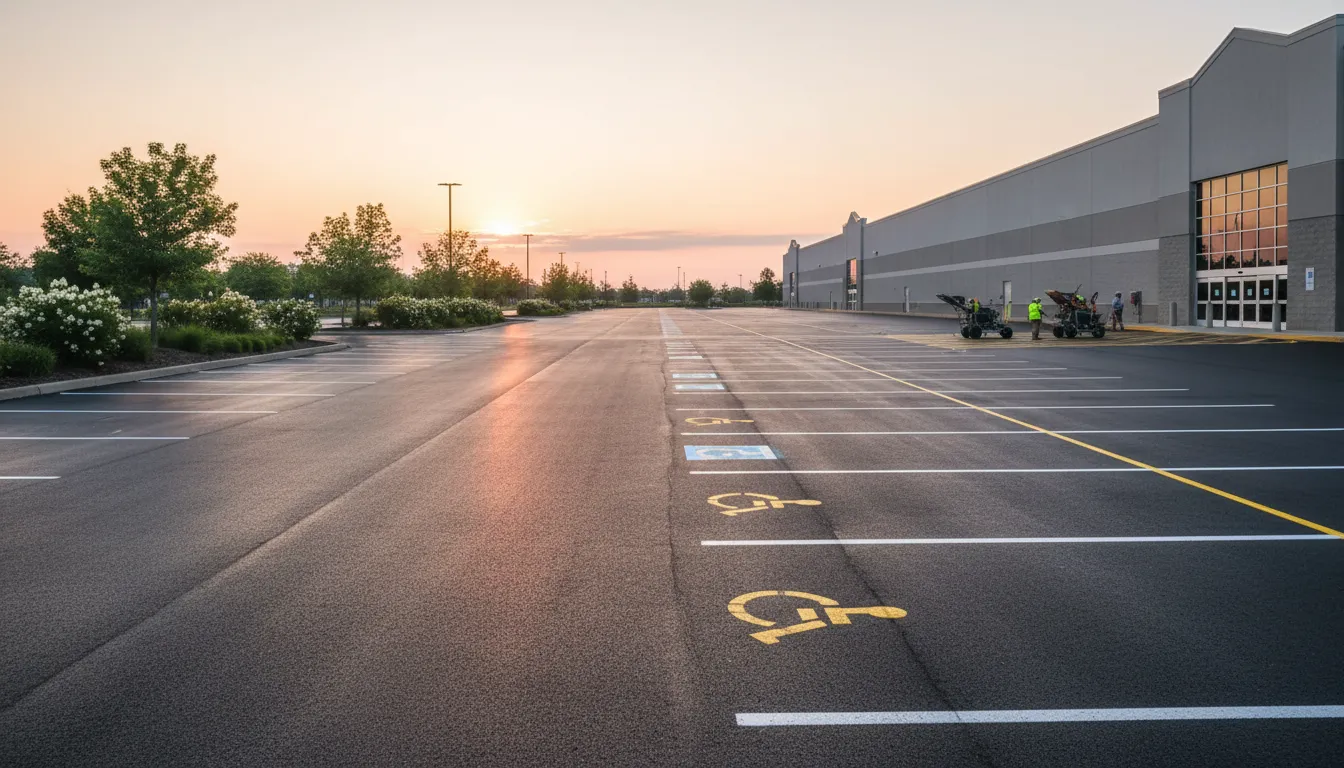
Find the Best Parking Lot Striping Companies for Your Business
No obligation • Fast responses • Nationwide coverage
Why you can trust Tidy Parking
Tidy Parking is a leading U.S. source for parking lot maintenance services, including striping, sealcoating, sweeping, paving, resurfacing, and repairs. Our content is created independently, and providers cannot pay to influence ratings or recommendations.
Search providers near you
Top Parking Lot Striping Companies in Lacey, Washington Ranked
Clear, compliant parking lot striping is a critical component of property safety, accessibility, and traffic flow in Lacey. This pavement marking service involves applying durable paint or thermoplastic to define stalls, directional arrows, crosswalks, and other essential guides. Proper line striping not only ensures your property meets strict federal and state regulations but also enhances safety for drivers and pedestrians while maximizing the efficient use of your space. This guide will help you understand the specific requirements and best practices for parking lot marking in Lacey, empowering you to maintain a safe and legally compliant property.
Spadoni Asphalt Maintenance
Tacoma, WA
Spadoni Asphalt Maintenance is a family-owned asphalt maintenance company based in Tacoma, WA. They provide commercial and residential services including parking lot sealcoating, crack sealing, asphalt repair, line striping, and concrete and curb repair. Serving Pierce and Kitsap counties, they focus on smaller-scale repairs and preventative maintenance to extend pavement life and reduce the need for costly replacements. With over 20 years of experience, Spadoni Asphalt Maintenance offers flexible scheduling and thorough documentation to keep clients informed throughout the process.
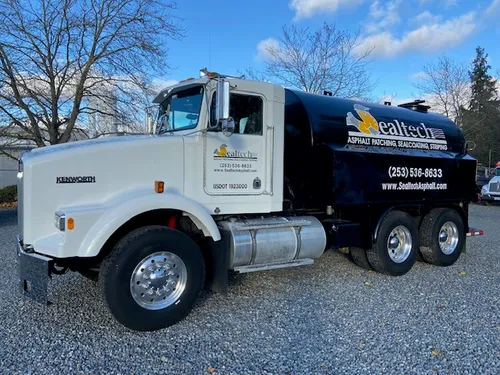
Sealtech Asphalt Inc
Tacoma, WA
Sealtech Asphalt Inc is a parking lot maintenance company based in Tacoma, WA. They provide services including sealcoating, striping, sweeping, resurfacing, and repair for commercial and industrial properties. The company is experienced in thorough cleaning before sealcoating and uses high-quality Armor Seal products to ensure durable results. Sealtech Asphalt Inc has been serving the area since at least 1997, demonstrating a long history of consistent and professional work. They focus on minimizing disruption during projects and maintaining neat, precise striping and sealcoating applications.
Ashers Asphalt and Sealcoating
Tacoma, WA
Ashers Asphalt and Sealcoating is a full-service asphalt contractor based in Tacoma, WA. The company provides a range of parking lot services including striping, sealcoating, paving, resurfacing, and repairs for commercial and industrial clients. With 20 years of experience, Ashers Asphalt and Sealcoating uses modern equipment and skilled staff to complete projects on time and within budget. The family-owned business focuses on creating professional and attractive parking areas that improve the first impression of properties.
Apex Asphalt Solutions
Tacoma, WA
Apex Asphalt Solutions is a family-owned asphalt contractor serving Tacoma, WA, and nearby Lakewood neighborhoods. They provide a range of services including asphalt paving, patching, striping, sealcoating, and driveway installation for residential and commercial properties. Their work focuses on creating durable, smooth surfaces using quality materials and precise techniques. The company emphasizes craftsmanship and customer satisfaction, managing projects from initial grading to final sealant application.
Hi Grade Asphalt & Seal Coat Inc
113 Meridian Ave E, Edgewood, WA 98371
Hi Grade Asphalt & Seal Coat Inc is a family-owned company based near Tacoma, WA, offering a wide range of asphalt services. They provide asphalt paving, parking lot striping, sealcoating, patching, resurfacing, and repair for residential, commercial, and industrial clients. Their work includes grading with crushed rock and gravel, overlays, water berms, speed bumps, and ramps. Serving the greater Puget Sound, Central and Eastern Washington, and Southwest Washington, they have nearly four decades of experience delivering custom solutions for projects of all sizes.
Understanding Local Striping Regulations in Lacey
Parking lot line painting in Lacey is governed by a combination of federal, state, and local codes. Property owners and managers are legally responsible for maintaining these markings to ensure they are clearly visible. The primary federal law is the Americans with Disabilities Act (ADA), which sets the baseline for accessible parking. Washington State law (RCW 46.61.581) and local Lacey ordinances, such as Ordinance 1539, provide additional layers of regulation, particularly concerning fire lanes and general safety.
The rainy Pacific Northwest climate in Lacey accelerates the wear and fading of pavement markings. Industry professionals typically recommend a restriping frequency of every 12 to 24 months to maintain compliance and visibility1 2. The optimal striping season in Washington is from April to October, when pavement surfaces are consistently dry and temperatures are above 50 degrees Fahrenheit, ensuring proper paint adhesion and curing3.
ADA-Compliant Accessible Parking Standards
A core element of any parking lot striping project is the correct layout and marking of accessible spaces. Failure to comply can result in significant liability and fines.
Space Dimensions and Layout:
- Standard Accessible Spaces: Must be at least 96 inches (8 feet) wide. Each standard accessible space must be paired with a 60-inch (5-foot) wide access aisle.
- Van-Accessible Spaces: These require more room. Options include a 132-inch (11-foot) wide space with a 60-inch aisle, or a 96-inch wide space with a 96-inch wide access aisle. Van-accessible spaces also require a minimum vertical clearance of 98 inches along the vehicular route and within the space itself 4.
- Access Aisle Marking: The access aisle, which is crucial for deploying ramps and lifts, must be marked with diagonal hatch marks (striping) to clearly indicate it is not a parking space5 6.
- Location: Accessible spaces must be located on the shortest accessible route from the parking area to an accessible building entrance7.
Signage and Symbols: The pavement markings must be accompanied by proper signage. A vertical sign displaying the International Symbol of Accessibility (white on blue) must be posted at each accessible space. For van-accessible spaces, the sign must include the additional text "Van Accessible." These signs must be mounted so the bottom edge is at least 60 inches above the parking surface8 9.
Critical Safety Markings: Fire Lanes and Pedestrian Crossings
Beyond parking stalls, specific pavement markings are mandated for life safety.
Fire Lane Requirements: Fire lanes must be kept clear at all times to ensure emergency vehicle access. Lacey follows strict standards for their designation10:
- Markings: The curb or pavement edge of a fire lane must be painted with a 6-inch wide solid yellow stripe. The surface must also be stenciled in white or yellow block letters, at least 18 inches high, reading "NO PARKING - FIRE LANE"11 12.
- Signage: "No Parking - Fire Lane" signs (minimum 12" x 18") must be posted at intervals not exceeding 50 feet, or as specified by the local fire authority13.
- Width: Fire lanes typically require a minimum unobstructed width of 20 feet14.
Pedestrian Safety Markings: Protecting pedestrians is a key function of pavement striping.
- Crosswalks: These must be clearly marked, often with high-visibility continental (zebra) stripes, which are highly effective in alerting drivers in high-traffic areas.
- Stop Lines: Thick white lines, typically 12 to 24 inches wide, are painted to indicate where vehicles must come to a complete stop at intersections or stop signs.
- Directional Arrows and Symbols: White arrows, words (like "STOP"), and symbols are used to control the flow of traffic within the lot, reducing confusion and potential accidents.
Find the perfect parking lot striping companies for your needs
Get personalized recommendations and expert advice
Loading Zones and Traffic Flow Markings
Efficient traffic management within a parking lot depends on clear markings for different types of use.
- Loading Zones: These areas are strictly for the active loading and unloading of passengers or merchandise. Regulations, such as those in Washington Administrative Code (WAC 308-330-442), often limit parking in these zones to 30 minutes15. Markings are crucial to distinguish them from standard parking.
- Commercial vs. Passenger Zones: White curb zones or markings often indicate short-term passenger loading where the driver must remain with the vehicle. Commercial loading zones are designed for quicker turnover of delivery and service vehicles16.
- Aisle Markings and Traffic Arrows: Clearly painted directional arrows on the pavement are essential for creating one-way aisles, guiding drivers safely through the lot, and preventing head-on conflicts17.
Pavement Marking Materials and Application
The longevity and visibility of your markings depend on the materials used and the preparation of the surface.
- Paint: Water-based or oil-based traffic paint is the most common material for parking lot striping. It is cost-effective and suitable for most asphalt surfaces when applied correctly during ideal weather conditions.
- Thermoplastic: This is a more durable, melted plastic material that is applied hot. It provides longer-lasting markings with higher reflectivity, making it a good choice for high-traffic areas or where extended longevity is desired.
- Surface Preparation: For the best results, the pavement should be clean, dry, and free of debris, oil, and loose material. For a truly long-lasting job, sealcoating the asphalt before restriping is highly recommended. A fresh sealcoat provides a smooth, uniform surface for the paint to adhere to, significantly extending the life of the markings18.
Understanding Project Costs
Costs for parking lot striping and related services in the Lacey area vary based on the scope of work, surface condition, and materials used19 20.
- Standard Restriping (Paint Refresh): Typically ranges from $0.15 to $0.40 per linear foot.
- ADA Stall Package: Creating a new compliant accessible space, including painting, hatching the access aisle, and often installing a sign, can cost approximately $150 to $300 per stall.
- Fire Lane Marking: Painting the curb and stenciling "FIRE LANE" on the pavement generally costs $2.00 to $4.00 per linear foot.
- Symbols and Stop Bars: Painting directional arrows, stop bars, or handicap symbols usually ranges from $50 to $100 per element.
- Sealcoating: As a preparatory or maintenance step, sealcoating adds $0.20 to $0.50 per square foot to a project but is a key investment in preserving both the pavement and its markings.
Frequently asked questions
Sources
Footnotes
-
Parking Lot Painting vs. Striping vs. Pavement Markings - https://1800striper.com/parking-lot-painting/ ↩
-
Parking Regulations - MRSC - https://mrsc.org/explore-topics/planning/zoning/parking-regulations ↩
-
Striping | WSDOT - | WA.gov - https://wsdot.wa.gov/travel/traffic-safety-methods/striping ↩
-
Parking Spaces - RCO - Recreation and Conservation Office - https://rco.wa.gov/recreation-and-conservation-office-grants/grant-requirements/making-accessible-projects/parking-spaces/ ↩
-
ADA Compliance Brief: Restriping Parking Spaces - https://archive.ada.gov/restriping_parking/restriping2015.pdf ↩
-
ADA Business Brief: Restriping Parking Lots - https://archive.ada.gov/restribr.htm ↩
-
Accessible Parking Spaces | ADA.gov - https://www.ada.gov/topics/parking/ ↩
-
Accessible Parking - ADA National Network - https://adata.org/factsheet/parking ↩
-
Accessible Parking for People with Disabilities | ADANW - https://nwadacenter.org/factsheet/accessible-parking ↩
-
Ordinance 1539 - City of Lacey - https://cityoflacey.org/wp-content/uploads/sites/3/2022/04/Ordinance-1539-Code-Development-Audit-01.17.19-PG-25-CORRECTED-03.21.2022-.pdf ↩
-
Fire Lane Requirements - https://www.eastsidefire-rescue.org/DocumentCenter/View/113 ↩
-
Chapter 8.55 FIRE LANES - General Code - https://www.codepublishing.com/WA/FederalWay/html/FederalWay08/FederalWay0855.html ↩
-
Chapter 2.46 FIRE LANES - General Code - https://www.codepublishing.com/WA/Omak/html/Omak02/Omak0246.html ↩
-
FIRE LANE STANDARDS - https://cdnsm5-hosted.civiclive.com/UserFiles/Servers/Server_16494932/File/Government/Departments/Public%20Works%20and%20Utilities/Engineering%20Codes%20&%20Design/Fire_Lane_Standards_EDM_2018.pdf ↩
-
WAC 308-330-442: - | WA.gov - https://app.leg.wa.gov/wac/default.aspx?cite=308-330-442 ↩
-
Operations & Support - LADOT Parking - https://ladotparking.org/operations-support/ ↩
-
Article 07 Off-street Parking & Loading - - http://augustaks.citycode.net/articleOffStreetParkingLoading.htm ↩
-
Striping | The Pacific Northwest - All Seal - https://www.allsealnw.com/striping ↩
-
Houston Facility Maintenance: Expert Parking Lot Striping Guide - myshyft.com - https://www.myshyft.com/blog/parking-lot-striping-services-houston-texas/ ↩
-
Parking Lot & Pavement Line Striping| ADA Compliant Marking and Inspections | Louisiana - https://www.powersweepservices.com/pavement-striping/ ↩