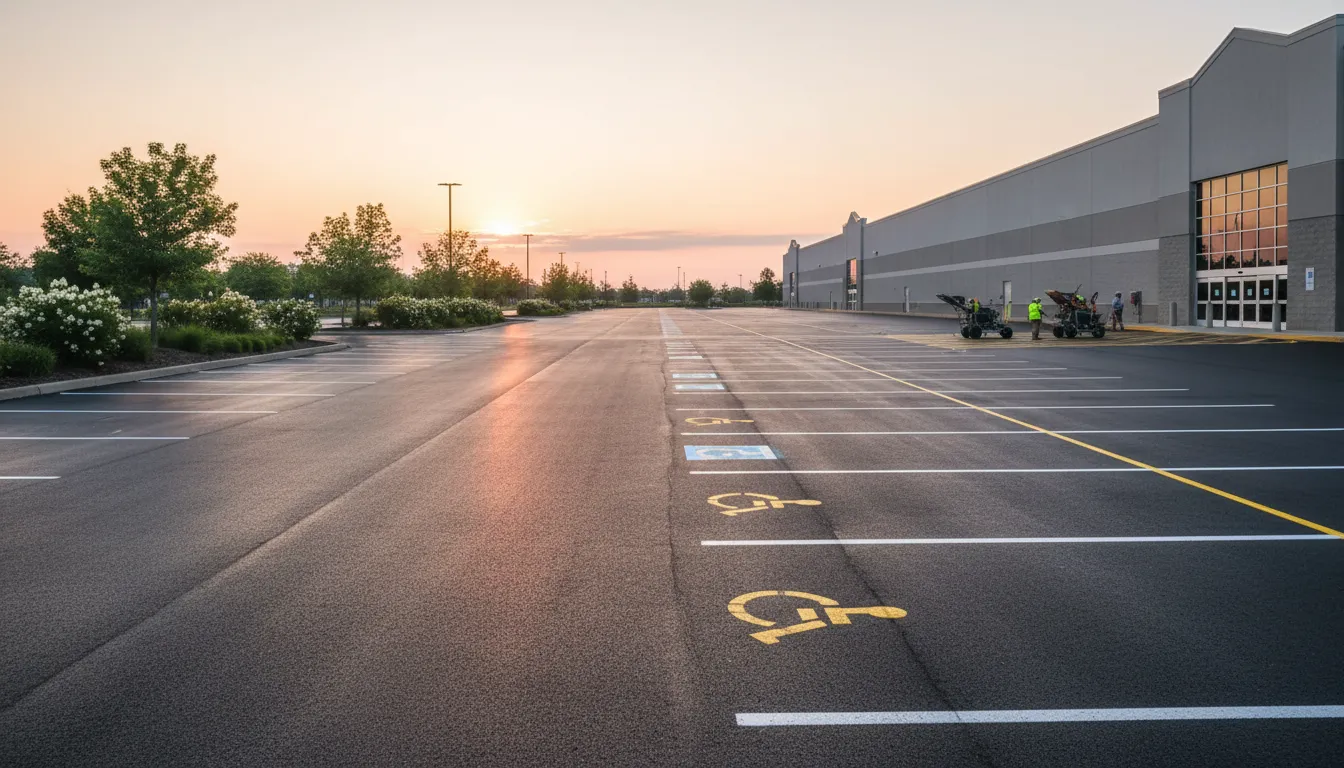
Find the Best Parking Lot Striping Companies for Your Business
No obligation • Fast responses • Nationwide coverage
Why you can trust Tidy Parking
Tidy Parking is a leading U.S. source for parking lot maintenance services, including striping, sealcoating, sweeping, paving, resurfacing, and repairs. Our content is created independently, and providers cannot pay to influence ratings or recommendations.
Search providers near you
Top Parking Lot Striping Companies in Reading, Pennsylvania Ranked
A well-marked parking lot is essential for safety, efficiency, and legal compliance. Parking lot striping, or line marking, involves applying highly visible paint to define stalls, traffic flow, and safety zones. In Reading, this service is critical for property owners to meet strict federal, state, and local codes, ensuring accessibility for all and avoiding potential fines. This guide explains the key regulations and best practices for line striping in Reading, helping you understand what to look for when evaluating local service providers.
SealMaster
6853 Ruppsville Rd, Allentown, PA 18106
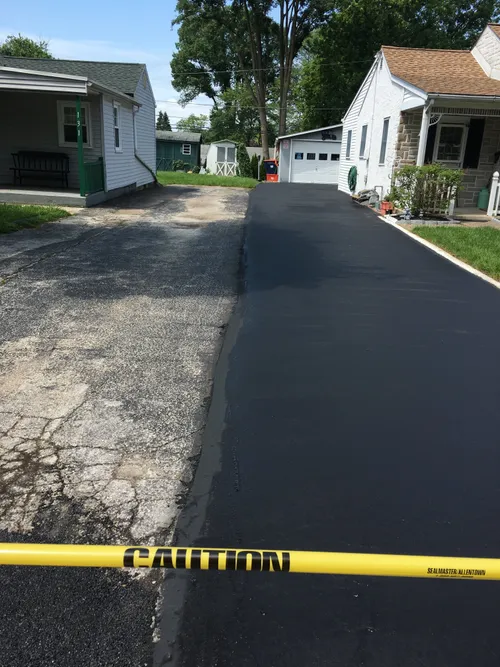
SealMaster in Allentown, PA, offers a range of pavement maintenance products and services including parking lot sealcoating, striping, crack filling, and asphalt repair. They provide equipment, tools, and materials for contractors, along with expert recommendations and full application services through a nationwide network of trained professionals. SealMaster supports projects with specialized capabilities such as crack filling and sealcoating to help preserve asphalt surfaces.
Burke Asphalt
Allentown, PA
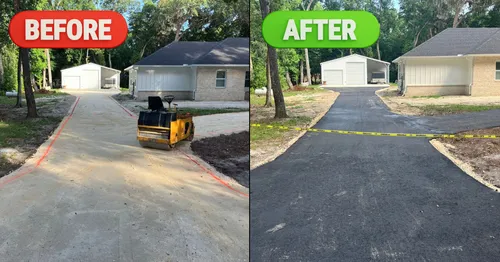
Burke Asphalt is a full-service asphalt maintenance contractor located in Allentown, PA. They specialize in asphalt paving, sealcoating, parking lot striping, and general parking lot repairs for both professionally managed and privately owned properties. With over 40 years of experience, Burke Asphalt offers a range of services to maintain and improve asphalt surfaces.
Proper parking lot marking is more than just fresh paint; it's a detailed system of communication that guides drivers and pedestrians safely. For business and property owners in Reading, maintaining clear pavement markings is a non-negotiable responsibility that impacts liability, accessibility, and the first impression of your property.
Understanding Local Striping Regulations
In Reading, parking lot layout and marking must adhere to a layered set of rules. The Americans with Disabilities Act (ADA) sets federal standards for accessible parking, which are enforced in Pennsylvania. The Pennsylvania Department of Transportation (PennDOT) provides additional technical guidelines for traffic control markings on private property open to public use. Finally, the City of Reading and local fire marshals enforce ordinances regarding fire lanes and other safety markings.
Failure to comply can result in significant fines and open a property owner to lawsuits. For instance, an improperly marked or missing accessible parking space is a direct violation of the ADA. Regular restriping by knowledgeable contractors is the best way to ensure your lot remains compliant and safe.
ADA Compliance: Accessible Parking Requirements
ADA-compliant parking is a major focus of any striping project. The rules are specific and must be followed precisely:
- Space Dimensions: A standard accessible car space must be at least 96 inches (8 feet) wide. Van-accessible spaces require either a 132-inch wide space or a 96-inch wide space paired with a 96-inch wide access aisle 1.
- Access Aisles: Every accessible space must have an adjacent access aisle. For cars, this aisle must be at least 60 inches (5 feet) wide. These aisles, which provide room for wheelchair lifts and ramps, must be marked with diagonal stripes to discourage parking in them 2 3.
- Marking and Signage: The access aisle must be marked, typically with blue or white diagonal stripes. Most importantly, each accessible space must be accompanied by a vertical sign featuring the International Symbol of Accessibility. This sign must be positioned so it is not obscured by a parked vehicle 4 5.
These requirements are designed to remove barriers for individuals with disabilities, as mandated by the ADA. A professional striping contractor will know how to integrate these spaces correctly into your lot's layout.
Safety Markings: Fire Lanes and Crosswalks
Beyond parking stalls, specific markings are required for life safety and traffic flow.
- Fire Lanes: Designated fire lanes must be clearly identifiable. In Pennsylvania, it is standard to paint the curb or the edge of the pavement along the fire lane red. The words "NO PARKING - FIRE LANE" are often stenciled in white within the lane or on the curb at regular intervals. These areas must be kept clear at all times to allow emergency vehicle access.
- Crosswalks and Pedestrian Paths: Safe pedestrian movement is crucial. Crosswalks are typically marked with solid white parallel lines or high-visibility zebra stripes. PennDOT guidelines note that crosswalk lines can range from 6 to 24 inches in width depending on the location and speed of traffic. Clear crosswalks protect pedestrians and demonstrate a property owner's commitment to safety.
Find the perfect parking lot striping companies for your needs
Get personalized recommendations and expert advice
Standard Parking Layout and Traffic Flow
An efficient parking lot maximizes space while minimizing confusion and conflict points. Standard parking stall dimensions are typically 9 feet wide by 18 feet deep, though compact spaces may be smaller. Aisles between rows of stalls must be wide enough to accommodate traffic flow; one-way aisles are often 12-14 feet wide, while two-way aisles require 22-24 feet.
Arrows, stop bars, and directional symbols are painted in yellow or white to guide drivers. Loading zones, often marked with yellow lines and specific signage, have defined rules for permissible stopping times 6. A well-planned layout, executed with precise line striping, reduces congestion and the risk of accidents.
Choosing the Right Striping Materials
The longevity and visibility of your parking lot markings depend heavily on the materials used. Pennsylvania's climate, with its freeze-thaw cycles, summer heat, and snowplowing, demands durable solutions.
- Paint Types: The two most common types are water-based latex and oil-based traffic paint. Thermoplastic is a premium option where plastic granules are heated and applied, creating an extremely durable and reflective marking. The choice depends on your budget, traffic volume, and how often you are willing to restripe.
- Reflectivity: Adding reflective glass beads to wet paint is a standard practice. These beads create retroreflection, making lines highly visible at night and in rainy conditions, which is a critical safety feature.
- Color Codes: Colors are not arbitrary. White is used for standard parking stall lines and crosswalks. Yellow designates no-parking zones, loading areas, and traffic flow directions. Blue is reserved for the outlines of accessible parking stalls and their adjacent access aisles. Red is used exclusively for fire lanes 7 8 9.
A reputable contractor will advise on the best material for your specific lot, balancing initial cost with long-term performance and compliance needs.
The Professional Striping Process
Hiring a professional ensures the job is done correctly, efficiently, and safely. The typical process involves:
- Site Assessment and Layout Planning: The contractor will review your existing lot, note compliance issues, and plan a new layout if necessary. This includes counting and correctly placing ADA spaces based on your lot's total stall count.
- Surface Preparation: For a long-lasting result, the pavement must be clean and dry. Professional crews often use power blowers and sweepers to remove all dirt, debris, and loose gravel. Existing faded lines may need to be removed or clearly covered.
- Precise Application: Using specialized equipment like airless striping machines, stencils, and measuring tools, the crew applies the paint according to the planned layout. Accuracy in spacing and straight lines is paramount.
- Curing and Reopening: The paint needs adequate time to dry and cure before vehicles can drive over it. A professional will provide a clear timeline for when the lot can be reopened.
Regular maintenance, including sweeping and sealcoating, will extend the life of your pavement markings. Sealcoating a newly striped lot requires a contractor who understands how to apply the sealant without obscuring the fresh lines.
The Importance of Regular Maintenance and Restriping
Faded, worn parking lines are more than an eyesore; they are a liability. They create driver confusion, reduce parking efficiency, and can render important safety and accessibility markings legally non-compliant 10 11.
It's generally recommended to restripe a parking lot every 1-2 years, depending on traffic volume and material used. Proactive maintenance through restriping is far less costly than dealing with an accident, a lawsuit, or a fine from a code enforcement inspection. Clear markings demonstrate responsible property management and care for the safety of your customers, employees, and visitors 12.
Frequently asked questions
Sources
Footnotes
-
How to Stripe ADA-Compliant Parking Lots - https://theasphaltpro.com/wp-content/uploads/2020/09/How-to-Stripe-ADA-Parking-Lots-V2.pdf ↩
-
ADA Resource Reference Materials - DCNR eLibrary - https://elibrary.dcnr.pa.gov/PDFProvider.ashx?action=PDFStream&docID=1742298&chksum=&revision=0&docName=ct+Sheet+2015&nativeExt=pdf&PromptToSave=False&Size=795943&ViewerMode=2&overlay=0 ↩
-
Americans with Disabilities Act (ADA) - PA Lottery - https://www.palottery.pa.gov/about-pa-lottery/americans-with-disabilities-act/pa-lottery-retailers-accessibility-standards.aspx ↩
-
Parking Lot Line Striping Requirements | ABC Paving & Sealcoating - https://pavingandsealcoating.com/parking-lot-line-striping-requirements/ ↩
-
The Americans with Disabilities Act (ADA) and - https://www.parking.org/wp-content/uploads/2016/02/TPP-2015-11-The-Americans-with-Disabilities-Act-ADA-and-Parking.pdf ↩
-
Fire Lane Marking Requirements Pittsburgh PA | Compliance Guide - https://restripeit.com/blog/fire-lane-marking-requirements-pittsburgh ↩
-
Parking Lot Striping Standards & Specifications | Linex | PA - https://www.linexstriping.com/parking-lot-striping-standards-and-specifications ↩
-
PennDOT LTAP - technical - https://gis.penndot.gov/BPR_pdf_files/Documents/LTAP/TechSheets/TS_155.pdf ↩
-
PennDOT LTAP - technical - https://gis.penndot.gov/BPR_PDF_FILES/Documents/LTAP/TechSheets/TS_193.pdf ↩
-
NJ & PA Line Striping Laws & ADA Compliance (2025) - https://www.stanleypaving.com/blog/line-striping-laws-and-ada-compliance-in-new-jersey-pennsylvania-what-you-need-to-know ↩
-
ADA Parking Striping Services in Philadelphia, PA | G-FORCE - https://www.gogforce.com/philadelphia-pa/service/ada-parking-striping-services/ ↩
-
How to Properly Stripe a Parking Facility for ADA Compliance - https://www.floridasealcoating.com/blog/2023/how-to-properly-stripe-parking-facility-for-ada-compliance.html ↩