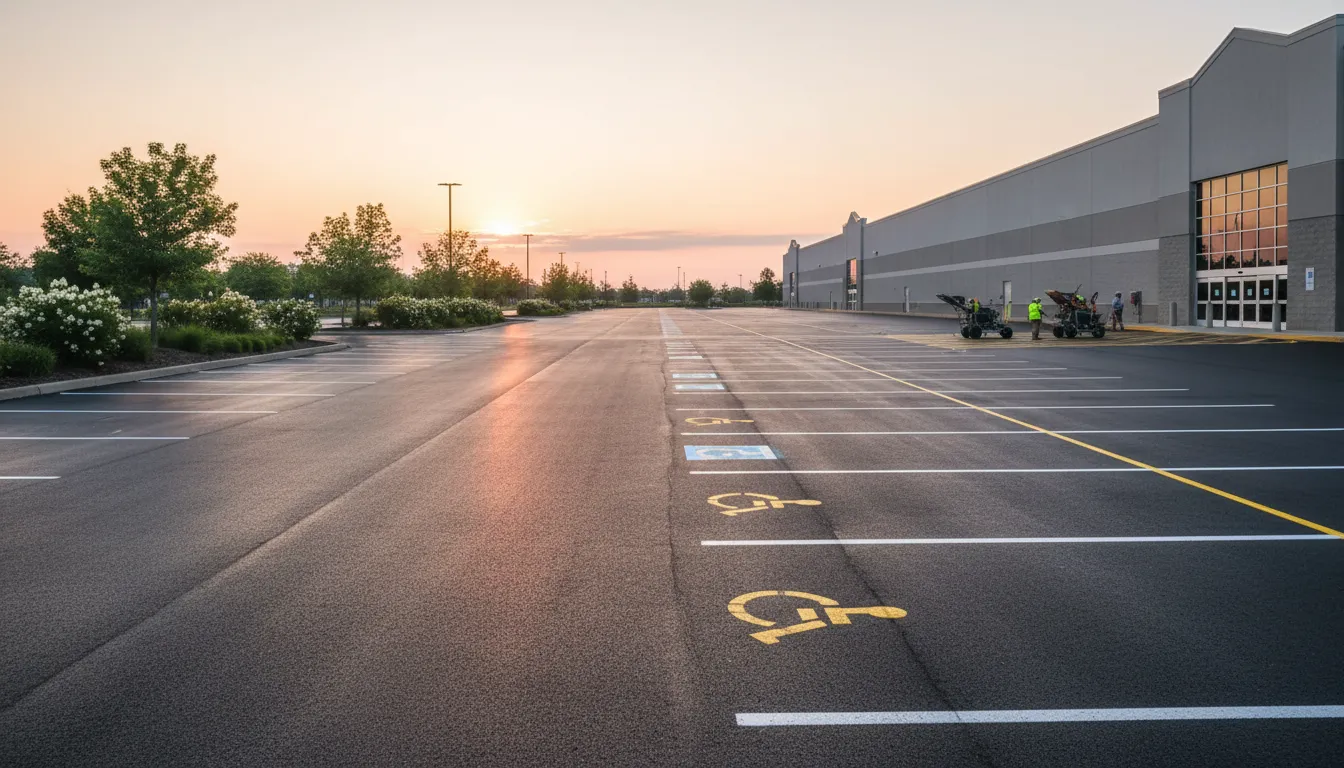
Find the Best Parking Lot Striping Companies for Your Business
No obligation • Fast responses • Nationwide coverage

Why you can trust Tidy Parking
Tidy Parking is a leading U.S. source for parking lot maintenance services, including striping, sealcoating, sweeping, paving, resurfacing, and repairs. Our content is created independently, and providers cannot pay to influence ratings or recommendations.
Search providers near you
Top Parking Lot Striping Companies in Quincy, Massachusetts Ranked
A well-marked parking lot is essential for safety, efficiency, and legal compliance. In Quincy, Massachusetts, pavement marking is governed by a specific set of state and federal regulations, including the Massachusetts Architectural Access Board (MAAB) 521 CMR and the Americans with Disabilities Act (ADA). Proper line striping, handicap space painting, and fire lane designation are not just about aesthetics-they guide traffic flow, ensure accessibility for all, and keep your property safe from liability. This guide explains the key requirements for parking lot markings in Quincy and how you can connect with qualified local professionals to ensure your project meets all codes.
Baystate Sealcoating & Paving
166 Cross St, Winchester, MA 01890
Baystate Sealcoating & Paving is a parking lot striping, sealcoating, paving, and repair company serving Boston, MA. They provide a full range of asphalt maintenance services including driveway sealcoating, crack filling, pothole repair, parking lot maintenance, and line striping. Their capabilities include professional asphalt paving and protective sealant application designed to extend the life of asphalt surfaces and improve safety and appearance. Baystate Sealcoating & Paving serves multiple cities across Massachusetts and is known for using top-grade materials and thorough preparation to ensure durable results.
Standard Sealcoating
250 Turnpike Rd, Southborough, MA 01772
Standard Sealcoating is a parking lot and driveway maintenance company based in Worcester, MA. They offer a range of services including sealcoating, parking lot striping, asphalt repair, crack filling, pothole repair, paving, and pressure washing. Serving multiple counties in Massachusetts, they use modern equipment and high-quality materials to prepare and protect asphalt surfaces effectively. Established in 2005, Standard Sealcoating has over 15 years of experience in residential and commercial asphalt maintenance projects.

Fortune Asphalt Taunton
5 Parkin Ave, Taunton, MA 02780
Fortune Asphalt Taunton provides a range of asphalt services including paving, patching, striping, sealcoating, and driveway installation in Providence, RI. The company focuses on durable and visually appealing asphalt surfaces tailored to client needs, using high-quality materials and eco-friendly methods. They specialize in asphalt paving and maintenance, ensuring smooth and safe parking lots and driveways. Fortune Asphalt Taunton is locally owned with extensive experience and a proven track record in the region.
Absolute Asphalt
Boston, MA
Absolute Asphalt is an asphalt contractor serving Boston, MA, specializing in residential and commercial asphalt paving, patching, striping, sealcoating, and driveway installation. They provide comprehensive asphalt services including parking lot resurfacing and repair, using high-quality materials and advanced techniques to ensure durable and visually appealing surfaces. The company is fully licensed and insured, prioritizes safety, and operates with a skilled team experienced in delivering tailored asphalt solutions. Absolute Asphalt is based in Waltham, MA, and focuses on meeting customer needs with transparent pricing and detailed project estimates.
Oasis Asphalt
Boston, MA
Oasis Asphalt is a parking lot paving contractor based in Boston, MA, specializing in asphalt installations, repairs, sealcoating, and line striping. They provide customized solutions for various surfaces including driveways, parking lots, and walkways, focusing on quality materials and precise craftsmanship. The company emphasizes thorough project assessment and uses advanced techniques to ensure durable and visually appealing results. Oasis Asphalt also offers ongoing maintenance and support to extend the lifespan of asphalt surfaces.
Understanding Quincy's Parking Lot Marking Regulations
Navigating the rules for pavement markings in Quincy requires an understanding of overlapping jurisdictions. While federal ADA standards provide a baseline, Massachusetts enforces its own, often more stringent, accessibility codes through 521 CMR. Furthermore, the City of Quincy has local ordinances, particularly concerning fire safety. Non-compliance can result in fines, lawsuits, and increased liability, making it crucial to get the details right from the start.
The core purpose of these regulations is to create a safe and accessible environment. Faded, incorrect, or missing markings can lead to traffic confusion, blocked emergency access, and inaccessible parking for individuals with disabilities.
Key Requirements for Accessible Parking Spaces
Creating compliant accessible parking is one of the most critical aspects of lot striping. In Quincy, spaces must adhere to both ADA and the specific dimensions outlined in 521 CMR 23.00 1.
Space and Aisle Dimensions:
- Standard Accessible Space: Must be at least 8 feet (96 inches) wide.
- Access Aisle: A 5-foot (60-inch) wide access aisle must be placed adjacent to the space. This aisle must be marked with diagonal hatch marks to indicate it is a no-parking zone 2.
- Shared Aisles: Two accessible spaces may share one common 5-foot access aisle.
- Van-Accessible Spaces: At least one in every six accessible spaces must be van-accessible. This requires either an 8-foot (96-inch) wide access aisle or an 11-foot wide parking space with a standard 5-foot aisle 3.
Markings and Signage:
- Blue Markings: The parking space itself must be outlined in blue paint. The access aisle must also be marked with blue diagonal stripes. It's vital that this blue contrasts clearly with the asphalt for visibility 4.
- International Symbol: The International Symbol of Accessibility must be painted within each accessible parking space, typically in white.
- Vertical Signage: A sign displaying the accessibility symbol must be mounted for each space, positioned at least 5 feet above the ground 5 6.
- Surface Slope: The surface of the space and access aisle must be nearly level, with a maximum slope of 1:48 (about 2%) in all directions to ensure safe use of mobility devices 7 8.
Fire Lane Striping and Safety Markings
Quincy's fire codes mandate clear, unambiguous markings for fire lanes to guarantee unimpeded access for emergency vehicles 9. These markings are non-negotiable for public safety.
Curb and Pavement Markings:
- Curb Painting: All curbs bordering a designated fire lane must be painted a solid, bright red.
- Stenciling: The words "FIRE LANE" must be stenciled in white, using 4-inch uppercase letters, on both the top and the vertical face of the red curb 10.
- Pavement Lettering: On the pavement surface of the fire lane itself, "NO PARKING FIRE LANE" is often stenciled in large white letters.
Supporting Signage:
- Posted "NO PARKING - FIRE LANE" signs are required at both ends of the lane and at intervals not exceeding 50 feet along its length 11. It is crucial that fire lanes are only marked as such if they are officially designated by local authorities to prevent public confusion 12.
Standard Traffic and Pedestrian Markings
Beyond accessible and fire lanes, general traffic control markings organize the flow of vehicles and protect pedestrians.
- Crosswalks: In Quincy, crosswalks are typically defined by two parallel white lines, each 12 inches wide. They should be placed at all logical pedestrian crossing points.
- Stop Lines & Yield Lines: White stop lines (also called stop bars), 12 to 24 inches wide, should be painted 4 feet before a crosswalk to indicate where vehicles must stop 13.
- Directional Arrows: One-way lanes and turn lanes should be clearly marked with large white directional arrows.
- Standard Stall Lines: Parking stall lines are usually 4 inches wide and white. Proper dimensions (often 9 feet by 18 feet for standard stalls) are important for maximizing space and preventing door dings.
Find the perfect parking lot striping companies for your needs
Get personalized recommendations and expert advice
Material Choices and Maintenance Schedules
The longevity and visibility of your markings depend heavily on the material used.
- Water-Based Traffic Paint: The most common and economical option. It's quick-drying and suitable for most applications but requires more frequent re-application, typically every 12-18 months in high-traffic areas.
- Thermoplastic: A melted plastic material that is extruded onto the pavement. It is significantly more durable and reflective than paint, lasting 3-5 years or more. It has a higher upfront cost but can be more cost-effective over time due to its longevity and superior night visibility.
- Preformed Thermoplastic Tape: A less common but effective option for symbols like handicap logos or arrows, offering durability and crisp edges.
For lots in the Norfolk County area with regular use, a general re-striping schedule of every 18-24 months is recommended to maintain clarity and compliance 14. Faded markings are a common cause of ADA violations and safety issues 15.
Cost Considerations for Striping Projects
Costs for parking lot line striping can vary based on the scope, materials, and condition of the pavement. Below are general estimates to help with budgeting:
- Standard Stall Striping: $0.30 - $0.75 per linear foot.
- Handicap Symbol (Painted): $50 - $150 per symbol.
- Fire Lane Curb Painting & Stenciling: $2.00 - $5.00 per linear foot.
- Crosswalk Installation: $150 - $400 per crosswalk.
These are ballpark figures. The final price will depend on the total square footage, the complexity of the layout (requiring more measurement and setup), the type of paint or thermoplastic selected, and the current state of the asphalt. A clean, recently sealcoated surface will yield better results and may simplify the job.
Planning Your Striping Project: A Checklist
Before contacting a professional, you can prepare by gathering some key information:
- Current Layout: Have a site plan or a simple sketch of your existing parking lot.
- Space Count: Know the total number of parking spaces you have and wish to maintain.
- Accessible Space Calculation: Determine the required number of standard and van-accessible spaces based on your total parking count.
- Designated Areas: Identify locations for fire lanes, loading zones, and crosswalks.
- Surface Condition: Note any cracks, potholes, or recent sealcoating. Striping is most effective on a sound, clean surface.
- Budget & Timeline: Consider your budget for materials (paint vs. thermoplastic) and your ideal project timeline.
By understanding these requirements and preparing your property details, you can have a more productive conversation with a local striping specialist. They can provide a precise quote, ensure the design meets all Quincy and Massachusetts codes, and execute the work with the right materials for lasting results.
Frequently asked questions
Sources
Footnotes
-
HANDICAPPED PARKING REGULATIONS - Mass.gov - https://www.mass.gov/doc/disability-parking-regulations-0/download ↩
-
Accessible Parking - ADA National Network - https://adata.org/factsheet/parking ↩
-
Chapter 5: Parking Spaces - Access-Board.gov - https://www.access-board.gov/ada/guides/chapter-5-parking/ ↩
-
ADA Parking Lot Blue Markings: Ensure Compliance & Safety - https://foxvalleypaint.com/is-your-parking-lot-ada-compliant-why-blue-markings-matter/ ↩
-
521 CMR: ARCHITECTURAL ACCESS BOARD - Mass.gov - https://www.mass.gov/doc/521cmr23pdf/download ↩
-
ADA Compliance Brief: Restriping Parking Spaces - https://www.ada.gov/resources/restriping-parking-spaces/ ↩
-
The ADA and Parking - https://northeastada.org/resource/the-ada-and-parking ↩
-
ADA Requirements for Parking: Standards, Compliance, and Penalties - https://www.accessibilitychecker.org/blog/ada-requirements-for-parking-standards-compliance-and-penalties/ ↩
-
Fire Lane Striping | Unlimited Line Striping Massachusetts - https://unlimitedlinestriping.com/fire-lane-striping-2/ ↩
-
§ 150.191 FIRE LANE REQUIREMENTS. - https://codelibrary.amlegal.com/codes/anthonynm/latest/anthony_nm/0-0-0-3281 ↩
-
FIRE LANE REQUIREMENTS | epcesd1 - https://www.epcesd1.com/wp-content/uploads/2022/03/Fire-Lane-Requirements.pdf ↩
-
ADA Compliance Guide for Parking Lot Line Striping - https://www.pavementsolutions.org/ada-compliance-guide-for-parking-lot-line-striping/ ↩
-
SIGN AND PAVEMENT MARKING PLAN - https://cms7files1.revize.com/quincyma2024/TPAL/WASHINGTON-ELM-100PLANS.pdf ↩
-
Basic Guide to Parking Lot Striping - https://www.trafficsafetystore.com/blog/guide-to-parking-lot-striping/ ↩
-
ADA Requirements for Parking: Compliance and Penalties - https://www.accessibilitychecker.org/blog/ada-requirements-for-parking-standards-compliance-and-penalties/ ↩