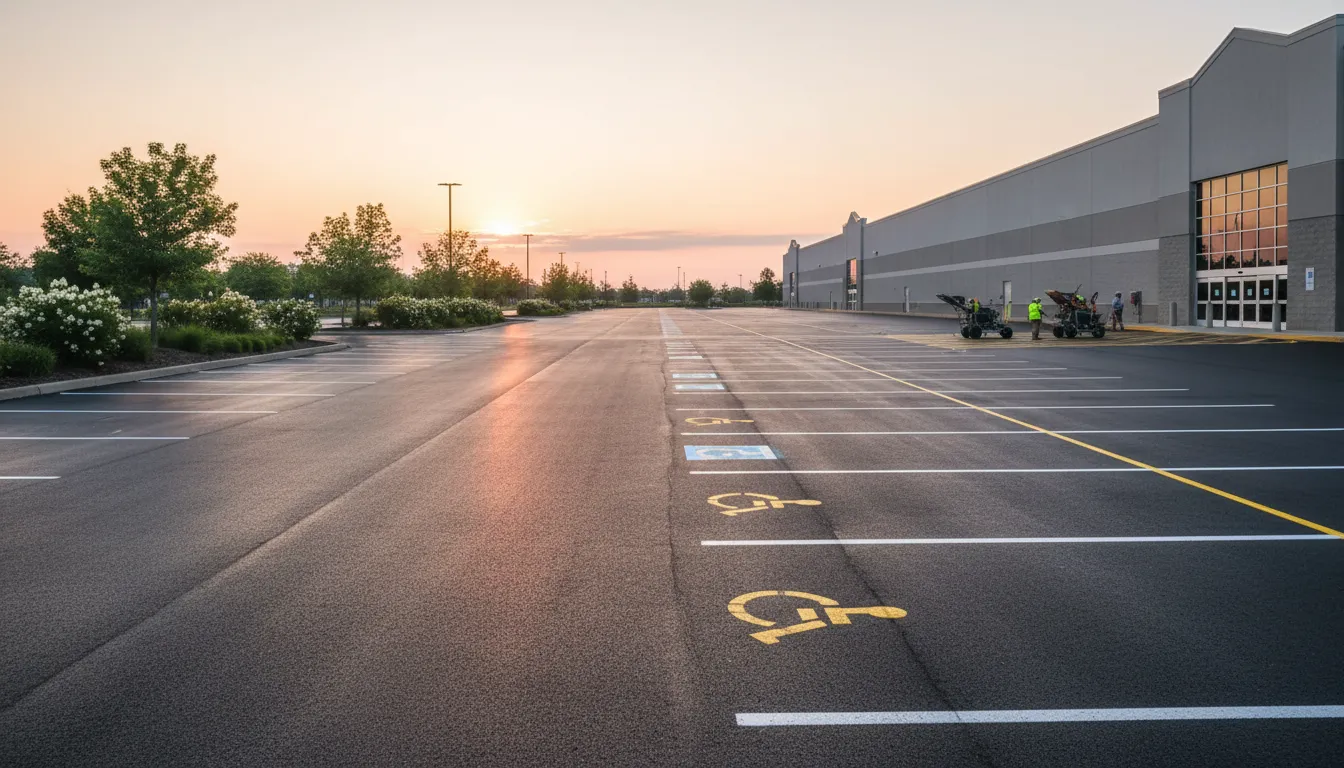
Find the Best Parking Lot Striping Companies for Your Business
No obligation • Fast responses • Nationwide coverage
Why you can trust Tidy Parking
Tidy Parking is a leading U.S. source for parking lot maintenance services, including striping, sealcoating, sweeping, paving, resurfacing, and repairs. Our content is created independently, and providers cannot pay to influence ratings or recommendations.
Search providers near you
Top Parking Lot Striping Companies in Brick, New Jersey Ranked
Maintaining clear, compliant parking lot markings is a critical aspect of property management in Brick, New Jersey. Proper line striping, pavement marking, and layout design are not just about aesthetics; they are essential for safety, maximizing space, and adhering to strict legal requirements. Faded or incorrect markings can lead to accidents, reduce parking efficiency, and expose property owners to significant liability and fines. This guide explains the key regulations, best practices, and local considerations for parking lot striping in Brick, helping you understand what's required to keep your property safe and compliant.
Three Sons Driveway Maintenance LLC
Philadelphia, PA
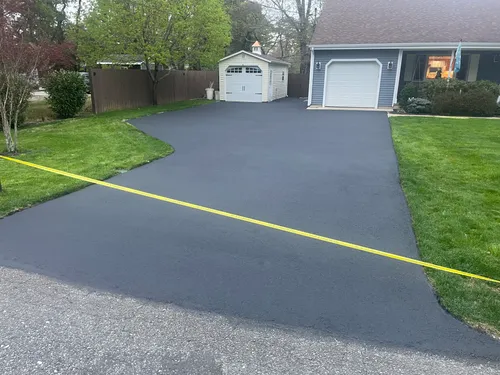
Three Sons Driveway Maintenance LLC is a family-owned business serving residential and commercial customers in Philadelphia, PA. They provide parking lot sealcoating, line striping, crack sealing, patching, and tar and chip services. The company specializes in maintaining and repairing parking lots and driveways with services such as hot crack filling and sport surface maintenance. Operating locally in South Jersey, they are licensed and insured, offering free estimates and price matching for reasonable local competitor quotes.
Cooper And Sons Paving
3010 Bordentown Ave, Parlin, NJ 08859
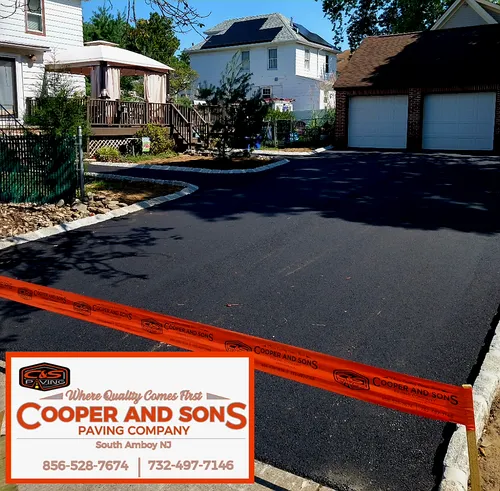
Cooper And Sons Paving is a family-owned asphalt paving contractor serving New York, NY, and surrounding areas. With over 50 years of experience, they provide a full range of residential and commercial paving services including parking lot paving, striping, sealcoating, resurfacing, and repair. Their expertise covers driveway paving, patching, crack filling, and installation of Belgian blocks and bumper posts. The company operates primarily in central New Jersey counties but extends services to nearby locations. Cooper And Sons uses quality materials and equipment to ensure durable pavement solutions tailored to each project.
Custom Striping and Sealcoating LLC
Philadelphia, PA
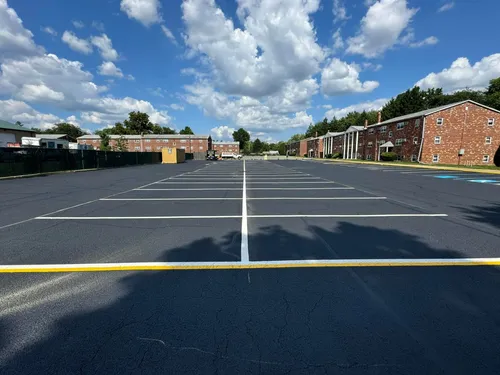
Custom Striping and Sealcoating LLC is a parking lot striping, sealcoating, and repair company serving Philadelphia, PA, and surrounding counties. They provide asphalt maintenance services including seal coating, crack sealing, line striping, asphalt repair, traffic sign installation, snow plowing, and salting. With over seven years of experience, they offer a two-year warranty on their work and ensure ADA-compliant parking lot lines. The company also provides emergency availability and seasonal contracts for snow services.
Quality Line Striping
Lakewood, NJ
Quality Line Striping is a family-owned parking lot striping company based in Lakewood, NJ. They provide expert pavement marking services designed to improve curb appeal and maximize parking space efficiency. Serving Ocean County, Monmouth County, and surrounding areas, they specialize in layout optimization and accessible parking compliance to meet ADA standards. The company uses premium Sherwin-Williams® traffic marking paint for durable results and offers flexible scheduling to minimize business downtime.
Crown Paving, LLC
32 Cross St Suite 302, Lakewood, NJ 08701
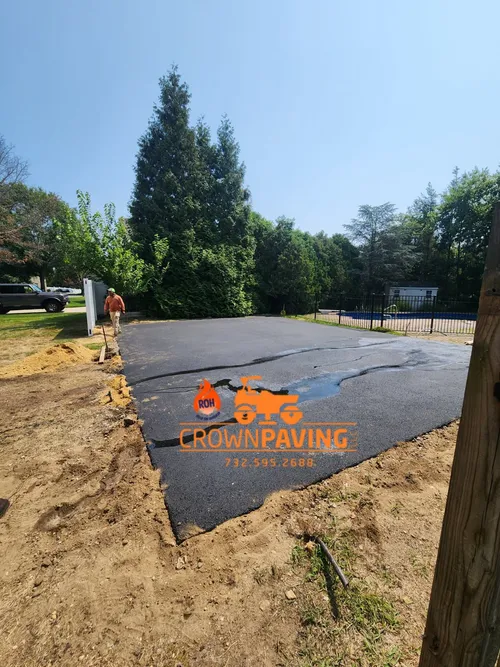
Crown Paving, LLC is a paving contractor based in Lakewood, NJ, offering a range of services including parking lot striping, sealcoating, paving, and repair. They serve residential, commercial, and industrial clients throughout New Jersey, handling projects from single driveways to large shopping mall parking lots. Their capabilities include grading, base preparation, milling, patchwork, sealcoating, and line striping, ensuring durable surfaces suited for various traffic demands.
Understanding Brick's Regulatory Landscape
Parking lot striping in Brick is governed by a combination of federal, state, and local ordinances. At the federal level, the Americans with Disabilities Act (ADA) sets the baseline for accessible parking. New Jersey state law often adds specific, and sometimes more stringent, requirements, particularly regarding signage and fines 1. Finally, the Township of Brick enforces these rules at the municipal level, with specific codes covering fire lanes, parking distances, and overall lot layout 2.
A core responsibility for property owners is maintaining at least 75% visibility of all striping. Faded lines are considered non-compliant. Industry best practices suggest planning a restriping project every 18-24 months for high-traffic lots to ensure continuous compliance and avoid liability 3.
Detailed Requirements for Accessible Parking Spaces
Accessible parking, often called handicap parking, has precise specifications that must be followed. The number of required spaces is typically a minimum of 1% of the total parking spaces in the lot, with no fewer than two spaces required in most cases.
- Dimensions: A standard accessible space must be at least 8 feet wide. It must be paired with a 5-foot wide access aisle-the striped zone next to the space that allows for wheelchair ramps and maneuvering.
- Van-Accessible Spaces: At least one of every six accessible spaces must be designated as "van accessible." These require a wider, 8-foot access aisle 4.
- Markings: The access aisle is just as important as the space itself. It must be marked with diagonal blue or white stripes to create a visible "buffer zone" that discourages parking.
- Signage: Each accessible space must have a sign displaying the International Symbol of Accessibility. In New Jersey, this sign must be mounted 5 to 7 feet high and include a penalty plate stating the fine for illegal parking, which can range from $250 to $500. The space and aisle must be located on the shortest accessible route to the building entrance.
For example, a retail parking lot in Brick with 200 total spaces would need at least four accessible spaces (using a common 2% ratio), with one designated as van-accessible, complete with blue-striped aisles and proper signage 5 6 7.
Fire Lane Striping and Marking Regulations
Fire lane marking is a major focus of local enforcement in Brick. These zones must be kept clear at all times to ensure emergency vehicle access.
- Marking: Fire lanes are identified by red painted curbing or red painted stripes on the pavement itself 8.
- Text: The words "FIRE LANE" in white, at least 12 inches high, must be painted on the pavement within the lane. This text must be repeated every 25 to 50 feet for continuous visibility.
- Dimensions: A fire lane must be a minimum of 20 feet wide, with 24 feet being the preferred width to accommodate larger fire apparatus.
- Signage: "No Parking Fire Lane" signs must be posted at all entrances to the lane. For properties with loading docks, red fire lane curbing typically extends along these areas 9.
Optimizing Layout: Stall Dimensions, Aisles, and Safety Zones
Effective parking lot layout and pavement marking go beyond compliance to improve traffic flow and safety.
- Standard Stall Sizes: For commercial and industrial lots, a common stall dimension is 10 feet wide by 18 feet long.
- Aisle Width: Aisles must accommodate traffic flow. For two-way traffic, a 25-foot aisle is standard. For one-way traffic, an 18-foot aisle may be sufficient.
- Row Separation: A minimum of 5 feet of separation is recommended between rows of 90-degree parking to prevent vehicle overhang and improve pedestrian safety.
- Crosswalks: High-visibility crosswalks, typically marked with white thermoplastic or paint, are crucial for pedestrian safety. They should connect accessible routes from parking areas to building entrances. New Jersey law prohibits parking within 25 feet of a crosswalk 10.
- Loading Zones: Specific areas should be clearly marked for loading and unloading, ensuring they are not blocked by general parking.
Find the perfect parking lot striping companies for your needs
Get personalized recommendations and expert advice
Cost Considerations for Striping in Brick, NJ
Understanding potential costs helps in budgeting for your parking lot maintenance. Pricing can vary based on the size of the lot, the complexity of the layout, and the condition of the existing pavement. It's important to get detailed quotes for your specific project.
- Minimum Site Charge: Due to mobilization costs (transporting equipment, setup), most contractors in New Jersey charge a minimum fee of $500 to $750 to take on a job.
- Per-Stall Cost: Restriping standard parking stalls typically ranges from $4 to $8 per stall.
- Specialty Markings:
- Handicap symbols (including paint and stencil work): $75 to $125 per symbol.
- Fire lane striping: $1.50 to $3.00 per linear foot.
The Risks of Non-Compliant Lot Markings
Operating a parking facility with faded, incorrect, or missing markings carries substantial risk.
- Liability: In the event of an accident or injury, non-compliant striping can be used as evidence of negligence, potentially leading to costly lawsuits.
- Fines: Municipal code enforcement officers can issue fines for violations, particularly for blocked fire lanes or improperly marked accessible parking. Fines for parking in a handicap space without a permit in New Jersey are severe.
- Reduced Efficiency: Faded lines lead to chaotic parking, reducing the usable capacity of your lot and frustrating customers or tenants.
- Safety Hazards: Poorly defined traffic patterns, crosswalks, and fire lanes increase the risk of vehicle collisions and pedestrian accidents.
Planning Your Next Striping Project
When it's time to refresh your parking lot markings, proper planning ensures a smooth process.
- Assessment: Walk your lot in daylight and at night. Note all faded lines, cracked symbols, and areas where water pooling may have degraded the paint.
- Compliance Check: Use this guide to audit your current accessible spaces, fire lanes, and signage against current Brick Township and NJ state codes.
- Surface Preparation: For the longest-lasting results, line striping should be done on a clean, dry, and well-maintained surface. Crack sealing and sealcoating are often recommended before restriping.
- Material Selection: Discuss options with your provider. While standard paint is common, thermoplastic markings offer much greater durability and longevity, which can be cost-effective for high-traffic areas.
- Scheduling: Plan the work for a period of minimal lot usage, often requiring temporary closure or phased work to minimize disruption.
Frequently asked questions
Sources
Footnotes
-
Understanding New Jersey Parking Lot Striping Regulations - https://randysealcoatingandstriping.com/blog/nj-parking-lot-striping-regulations-2025 ↩
-
Parking, Loading and Vehicular Access - Township of Brick, NJ - https://ecode360.com/6899613 ↩
-
Basic Guide to Parking Lot Striping - https://www.trafficsafetystore.com/blog/guide-to-parking-lot-striping/ ↩
-
ADA Compliance Checkup for New Jersey Parking Lots - https://www.gspavement.com/ada-compliance-checkup-for-new-jersey-parking-lots/ ↩
-
NJ Parking Lot Striping Regulations 2025 | Compliance Guide - https://randysealcoatingandstriping.com/learning-center/nj-parking-lot-striping-regulations-2025 ↩
-
New Jersey Guide to Accessible Parking - NJ.gov - https://www.nj.gov/humanservices/dds/documents/BROCHURES/2024/Guide-to-Accessible-Parking.pdf ↩
-
Fixasphalt.com NJ Parking Lot Striping - https://www.fixasphalt.com/blog/fixasphalt.com-nj-parking-lot-striping ↩
-
Chapter 306: Parking - Township of Brick, NJ - eCode360 - https://ecode360.com/6901067 ↩
-
17.56.030 Parking space minimum requirements. - https://codelibrary.amlegal.com/codes/casagrande/latest/casagrande_az/0-0-0-17698 ↩
-
Know the distances when parking... In New Jersey, you ... - Facebook - https://www.facebook.com/mountlaurelpd/posts/know-the-distances-when-parkingin-new-jersey-you-cannot-park-within-10-feet-of-a/1146781714160513/ ↩
-
Understanding New Jersey Parking Lot Striping Regulations - https://randysealcoatingandstriping.com/blog/nj-parking-lot-striping-regulations-2025 ↩
-
NJ Parking Lot Striping Costs - Fix Asphalt - https://www.fixasphalt.com/blog/nj-parking-lot-striping-costs-0 ↩