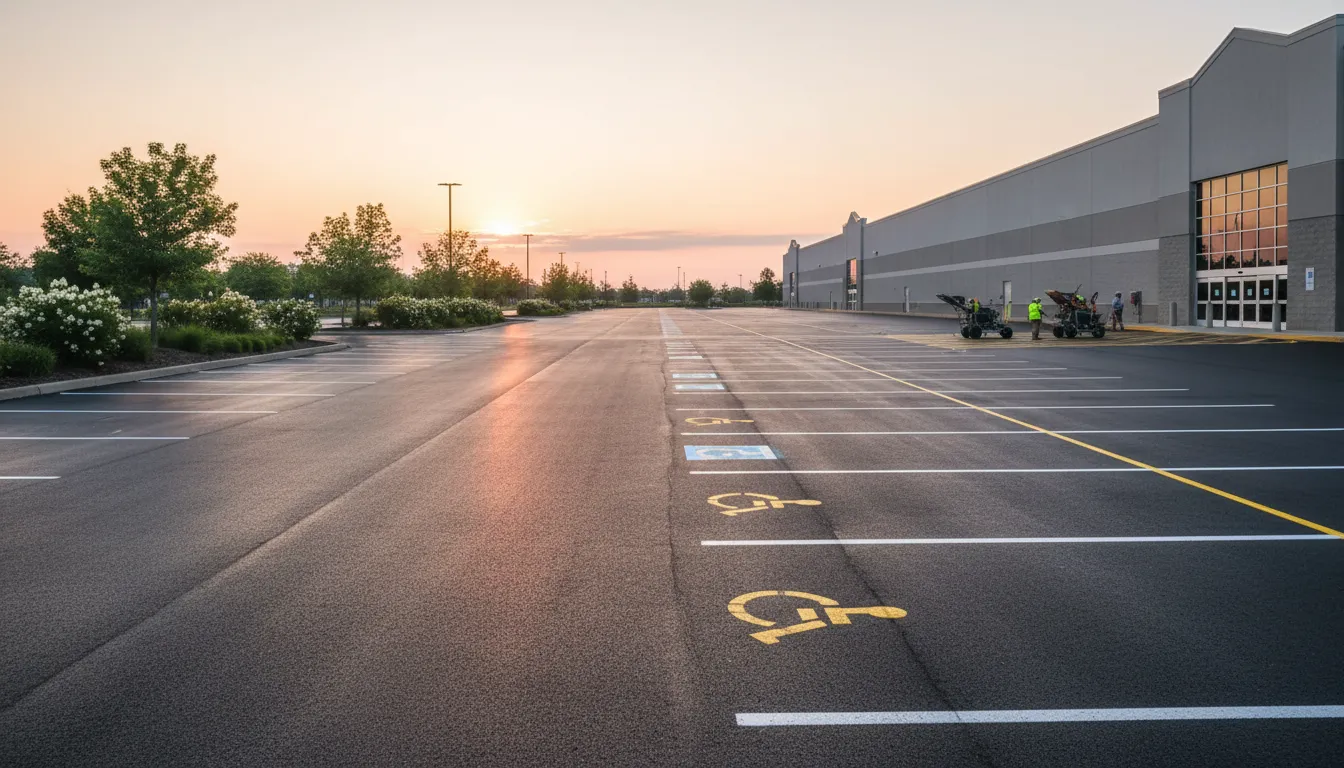
Find the Best Parking Lot Striping Companies for Your Business
No obligation • Fast responses • Nationwide coverage
Why you can trust Tidy Parking
Tidy Parking is a leading U.S. source for parking lot maintenance services, including striping, sealcoating, sweeping, paving, resurfacing, and repairs. Our content is created independently, and providers cannot pay to influence ratings or recommendations.
Search providers near you
Top Parking Lot Striping Companies in St Louis Park, Minnesota Ranked
A well-maintained parking lot is more than just a place to leave your car; it's a critical component of property safety, accessibility, and curb appeal. Parking lot striping, the process of applying clear, durable pavement markings, is essential for directing traffic, maximizing space, and ensuring compliance with local and federal regulations. For property owners and managers in St Louis Park, understanding the specific requirements for line painting and pavement marking is key to maintaining a functional and legally sound lot. This guide will help you navigate the standards, costs, and best practices for professional striping services in the area.
Doctor Asphalt, LLC
1949 Atlantic St, Maplewood, MN 55109
Doctor Asphalt, LLC is a parking lot paving and repair company based in St Paul, MN. They provide services including parking lot striping, sealcoating, crack filling, patching, and asphalt replacement. The company is known for working across the Twin Cities Metro Area and offers detailed proposals tailored to customer needs. Their team handles projects efficiently, often working around business schedules to minimize disruption. Doctor Asphalt has built a reputation for solid workmanship and clear communication, with a focus on practical solutions and customer perspectives.
The Asphalt Company, Inc.
3680 Kent St, Shoreview, MN 55126
The Asphalt Company, Inc. is a parking lot paving and repair contractor based in Minneapolis, MN. They provide a range of asphalt services including driveway paving, parking lot resurfacing, patching, and pavement striping for commercial and residential clients in the Twin Cities metro area. Founded in 2006, the company has over 15 years of experience and offers personalized solutions with a focus on affordability and quality workmanship. Their service area includes Minneapolis and many surrounding communities in Minnesota.
ACT Asphalt Specialties
530 Shoreview Park Rd, Shoreview, MN 55126
ACT Asphalt Specialties is a paving and concrete company based in Shoreview, serving Minneapolis, MN, and the greater Twin Cities metro area. With over 40 years of experience, they provide residential and commercial asphalt and concrete services, including parking lot paving, striping, resurfacing, and repairs. The company offers capabilities such as driveway installation, crack filling, and ADA retrofits. ACT Asphalt Specialties is licensed, insured, and provides a 10-year warranty on new installations.

Asphalt Paving Company
2136 Ford Pkwy Unit 8104G, St Paul, MN 55116
Asphalt Paving Company provides commercial asphalt paving, sealcoating, striping, and repair services in Minneapolis, MN. They specialize in durable asphalt solutions designed for high-traffic commercial properties, including parking lots, driveways, curbs, and drains. The company uses professional-grade materials suited for commercial equipment and offers services such as pothole repair and asphalt crack filling to maintain pavement integrity. Their expertise includes commercial asphalt paving that resists weather damage and heavy use, helping extend the lifespan of paved surfaces. Asphalt Paving Company serves the Minneapolis area with a focus on commercial clients and offers warranties on their work to ensure long-term durability.
Understanding St Louis Park Striping Regulations
Parking lot maintenance in St Louis Park is governed by a combination of Minnesota state accessibility codes and local city ordinances. These rules are designed to ensure safety for all users and accessibility for individuals with disabilities. A fundamental requirement is that any parking lot with four or more spaces must have painted lines that are at least 4 inches wide. This baseline ensures basic visibility and organization.
The city's regulations, such as those outlined in Ordinance No. 2578-19, provide the framework for parking standards, including dimensions and layouts 1. However, the most detailed specifications come from the Minnesota Accessibility Code, which is based on the International Building Code (IBC). Adherence to these codes is not optional; it's a legal necessity to avoid fines and, more importantly, to provide equal access.
Standard Parking Space Dimensions and Layout
For efficient use of space and safe vehicle maneuverability, standard parking stall dimensions are crucial. While local codes can have slight variations, the generally accepted standard for a 90-degree parking stall is 8 feet 6 inches in width 2. Aisles between rows of stalls must be wide enough to allow for safe entry and exit. Proper layout planning by a professional can maximize your lot's capacity while maintaining smooth traffic flow, preventing congestion and potential accidents.
ADA Compliance: Accessible Parking Requirements
Creating accessible parking is one of the most regulated aspects of lot striping. In St Louis Park, as throughout Minnesota, accessible stalls must be 8 feet wide with an adjacent 8-foot wide access aisle 3. This combined 16-foot zone is mandatory. For van-accessible spaces, the access aisle must also be 8 feet wide. Furthermore, for every six accessible spaces provided, at least one must be van-accessible 3.
The markings for these spaces are distinct:
- Color: The entire stall, including the access aisle, must be painted blue. White lines and symbols are then applied on top.
- Symbol: The International Symbol of Accessibility (the wheelchair symbol) must be painted within the stall.
- Signage: Each accessible space must be accompanied by a proper sign mounted 60 to 66 inches above the ground, displaying the accessibility symbol and any relevant wording like "Van Accessible" 4 5.
Painting an ADA-compliant stall, including the blue background and white symbol, typically carries an additional cost, often estimated between $50 and $100 per stall due to the extra materials and precision required.
Critical Safety Markings: Fire Lanes and No-Parking Zones
Safety markings are non-negotiable. Fire lanes must be clearly and consistently marked to ensure emergency vehicle access is never blocked. St Louis Park requirements align with standard best practices, which include:
- Curb Painting: Fire lane curbs are to be painted red.
- Pavement Markings: The pavement itself within the fire lane should be marked with 6-inch wide red paint.
- Lettering: The words "FIRE LANE-NO PARKING" must be stenciled on the pavement in white lettering, repeated at intervals of no more than every 15 feet for continuous visibility 6.
It is highly recommended to confirm specific fire lane placement and marking details directly with the St Louis Park fire marshal, as local interpretations can vary. The cost for fire lane painting, which includes curb work and stenciling, is often estimated at $2 to $4 per linear foot 7.
Other vital safety markings include crosswalks and no-parking zones. Minnesota law prohibits parking within 20 feet of a marked or unmarked crosswalk, so clear striping helps drivers identify these restricted areas 8. No-parking zones are typically indicated with yellow paint or yellow diagonal stripes within the stall 9.
Find the perfect parking lot striping companies for your needs
Get personalized recommendations and expert advice
The Striping Process: From Layout to Application
Professional parking lot striping is a multi-step process that begins long before the paint is applied. It starts with a detailed assessment of your existing pavement. A contractor will evaluate the surface for cracks, potholes, and fading old lines. Surface preparation, which may include cleaning and patching, is essential for paint adhesion and longevity.
Next, the layout is planned. Using the precise dimensions required by code, professionals will measure and chalk out the entire lot. This step ensures optimal space count, proper traffic flow angles (like 45°, 60°, or 90° parking), and correct placement of all required elements like accessible stalls, fire lanes, and directional arrows. Finally, high-quality, fast-drying traffic paint or more durable thermoplastic is applied using specialized equipment to create crisp, straight lines that will withstand weather and tire wear.
Choosing the Right Materials: Paint vs. Thermoplastic
The longevity of your stripes depends heavily on the material used. Latex or oil-based traffic paint is the most common and cost-effective option, suitable for lots with moderate traffic. For high-traffic areas or properties seeking longer-lasting results, thermoplastic is a superior choice. This material is heated and applied as a molten liquid that solidifies into a thick, highly reflective, and extremely durable marking. While more expensive upfront, thermoplastic can last several times longer than paint, reducing the frequency of restriping.
Cost Factors for Parking Lot Striping in St Louis Park
The cost to stripe or restripe a parking lot is not a flat fee; it depends on several variables. The primary metric is the total linear footage of paint required. For standard line painting and pavement marking on an existing layout, you can expect a general price range of $0.30 to $0.60 per linear foot 10 11.
Key factors that influence the final estimate include:
- Lot Size and Complexity: A simple rectangular lot costs less per space than one with angled parking, multiple islands, and complex traffic patterns.
- Condition of Existing Lines: A lot that needs extensive grinding or removal of old thermoplastic will cost more to prepare.
- Number of Special Markings: Each ADA stall (with blue paint), fire lane, handicap symbol, directional arrow, or custom stencil (like "LOADING ONLY") adds to the material and labor cost.
- Material Selection: As mentioned, thermoplastic application carries a higher material cost than standard paint.
- Surface Preparation: Any necessary cleaning, crack filling, or patching will be included in the project scope and price.
Maintaining Your Parking Lot Striping
Fresh stripes won't last forever. Sun exposure, snow plowing, salt, oil drips, and constant tire friction will cause even the best markings to fade. A good rule of thumb is to inspect your lot's striping annually. If lines are significantly faded, cracked, or missing, it's time for a refresh. Proactive maintenance, including sealcoating the asphalt before restriping, can significantly extend the life of your pavement markings. Regular restriping is not just an aesthetic choice; it's a safety and compliance necessity that protects your liability and ensures your property remains functional and welcoming.
Frequently asked questions
Sources
Footnotes
-
Ordinance No. 2578-19 An ordinance regarding parking standards - https://laserfiche.stlouispark.org/WebLink/edoc/531627/2578-19%20-%20ADMIN%20Ordinance%20-%20City%20Council%20-%2020191216.pdf?dbid=0&repo=SLP ↩
-
What You Need to Know About Creating the Perfect Parking Lot ... - https://aciasphalt.com/what-you-need-to-know-about-creating-the-perfect-parking-lot-striping-layout/ ↩
-
2020 MN Accessibility Code Summary - https://www.dli.mn.gov/sites/default/files/pdf/bc_accessibility_summary_IBC.pdf ↩ ↩2
-
MN Handicap Sign Requirements - Traffic Signs Minnesota - https://trafficsignsminnesota.com/Minnesota-Handicap-Sign-Requirements.html ↩
-
Minnesota Handicap Parking Sign R7-8mn - Trafficsigns - https://trafficsigns.com/r7-8-mn-minnesota-handicapped-sign ↩
-
All You Need To Know About Fire Lane Striping - https://www.ppm.us/all-you-need-to-know-about-fire-lane-striping/ ↩
-
Fire Lane Striping: Guide to Safety, Compliance & Regulations - https://everlinecoatings.com/us/fire-lane-striping-guide-to-safety-compliance-regulations/ ↩
-
Parking & Vehicle | St. Louis Park, MN - https://www.stlouisparkmn.gov/our-city/getting-around/parking-vehicle ↩
-
Basic Guide to Parking Lot Striping - Traffic Safety Store - https://www.trafficsafetystore.com/blog/guide-to-parking-lot-striping/ ↩
-
Commercial Parking Lot Striping: Costs, Standards + Pro Tips - https://www.getonecrew.com/post/commercial-parking-lot-striping ↩
-
Parking Lot Striping Standards: Dimensions, Colors, and ADA Rules - https://www.getonecrew.com/post/parking-lot-striping-standards ↩