Find the Best Parking Lot Striping Companies for Your Business
No obligation • Fast responses • Nationwide coverage

Why you can trust Tidy Parking
Tidy Parking is a leading U.S. source for parking lot maintenance services, including striping, sealcoating, sweeping, paving, resurfacing, and repairs. Our content is created independently, and providers cannot pay to influence ratings or recommendations.
Search providers near you
Top Parking Lot Striping Companies in Normal, Illinois Ranked
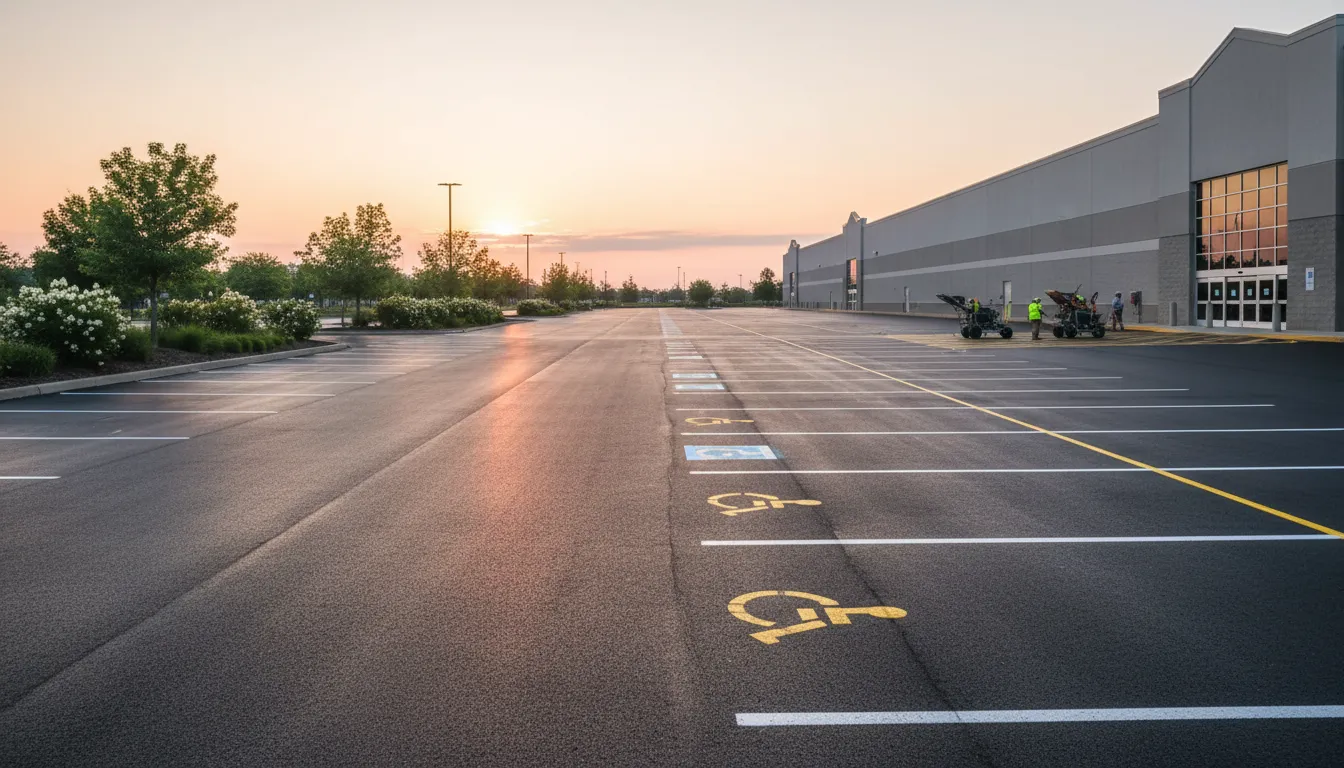
Maintaining clear, compliant pavement markings is a critical part of property management for any business or institution in Normal. Proper parking lot striping and line painting ensure safety, maximize space, and keep your property in line with state and local regulations. This guide explains the key requirements for parking lot markings in Normal, helping you understand what's needed for ADA compliance, fire safety, and efficient traffic flow. Use this information to evaluate your current lot and communicate effectively with local pavement marking professionals.
Local Pavement
1285 County Rd 700 N, Eureka, IL 61530
Local Pavement is a parking lot striping, sealcoating, and repair company based near Peoria, IL. They provide a variety of asphalt maintenance services including sealcoating, crack sealing, spray patch pothole repair, chip sealing, and striping for commercial and municipal projects. Serving customers across Illinois and Wisconsin, Local Pavement uses advanced equipment and experienced staff to manage projects of all sizes efficiently.

Pete George & Son Blacktop
981 N Pleasant Hill Rd, East Peoria, IL 61611
Pete George & Son Blacktop is a family-operated asphalt paving and sealcoating contractor based in Peoria, IL. Serving Peoria and surrounding counties, they provide a range of services including asphalt paving, sealcoating, resurfacing, patching, crack filling, parking lot striping, concrete work, and dirt hauling. With over 60 years of experience since 1960, they have extensive knowledge of local communities and permit requirements. The company is fully licensed, bonded, insured, and holds an A+ rating with the Better Business Bureau.
Clear and durable pavement markings are not just about aesthetics; they are a fundamental component of site safety and legal compliance. Faded lines, incorrect dimensions, or missing symbols can lead to confusion, accidents, and significant liability issues. In Illinois, the rules governing these markings are specific and mandatory, blending federal ADA standards with state accessibility codes and local municipal ordinances. For property owners and managers in Normal, understanding these requirements is the first step toward a safe, functional, and legally sound parking facility.
Understanding ADA & Illinois Accessibility Code Requirements
The most stringent and detailed regulations for parking lot striping involve accessible parking for people with disabilities. In Normal, as throughout Illinois, these spaces must comply with the Illinois Accessibility Code, which aligns with the federal Americans with Disabilities Act (ADA). Non-compliance isn't just a minor oversight; it can result in fines and legal action.
Key Dimensions for Accessible Spaces:
- Standard Accessible Space: Must be at least 16 feet wide total. This consists of an 8-foot wide parking stall adjacent to an 8-foot wide access aisle.
- Access Aisle Marking: The 8-foot access aisle is crucial. It must be marked with diagonal stripes or a cross-hatch pattern, typically in yellow paint, to clearly indicate it is a no-parking zone for vehicles not displaying proper placards or plates 1.
- Van-Accessible Spaces: For every six accessible spaces, at least one must be van-accessible. While the stall can be the standard 8 feet wide, the access aisle must be 8 feet wide. Alternatively, a van space can be designed with a 132-inch (11-foot) wide stall and a standard 5-foot aisle. The wider configuration is often preferred to accommodate side-loading ramps.
Mandatory Signage: The paint on the ground is only half the requirement. Each accessible space must be identified with a vertical sign. This sign must:
- Display the International Symbol of Accessibility.
- Be mounted at the front of the space, centered.
- Be positioned at least 4 feet above the parking surface to ensure visibility.
- State the legal penalty for unauthorized use, which in Illinois is a minimum fine of $2502.
Location & Path: Accessible spaces must be located on the shortest accessible route to the building entrance, free of curbs or obstacles. The path from the space to the entrance must be stable, firm, and slip-resistant 3.
Essential Markings for Safety and Traffic Flow
Beyond accessible spaces, a well-marked lot uses color and pattern to direct traffic and designate specific zones, preventing accidents and congestion.
Fire Lanes: These are lifelines for emergency responders. Fire lanes must be unobstructed at all times. Striping plays a key role by:
- Outlining the lane with red or yellow paint, often accompanied by painted curbs.
- Including large, stenciled "NO PARKING FIRE LANE" or similar legends on the pavement itself.
- Being supplemented with vertical "No Parking" signs posted at regular intervals. Properly marked fire lanes ensure fire trucks and ambulances can reach any part of your building quickly.
Traffic Arrows & Directional Flow: One-way lanes, stop bars at intersections, and directional arrows are vital for preventing head-on conflicts in tight areas. These markings, usually in white, guide drivers intuitively through the lot, reducing the risk of side-swipe collisions and confusion at exits 4.
Loading Zones & Special Use Areas: Designated areas for loading, unloading, or specific vehicle types (like compact cars) should be clearly outlined. Loading zones are typically marked with a white or yellow border and the words "LOADING ZONE" stenciled within. These zones keep passenger pick-up and commercial deliveries away from main traffic lanes.
Crosswalks & Pedestrian Safety: Protecting pedestrians is paramount. Marked crosswalks channel foot traffic across drive lanes in predictable locations. Standards typically call for 4-inch to 6-inch wide solid white lines, though some high-visibility designs use zebra stripes or thermoplastic markings. They should always be paired with adequate signage and, where possible, located in well-lit areas 5 6.
Find the perfect parking lot striping companies for your needs
Get personalized recommendations and expert advice
Materials, Longevity, and Maintenance
The longevity of your parking lot markings depends on the paint quality, surface preparation, and traffic volume. Understanding these factors helps in planning and budgeting for maintenance.
Common Line Painting Materials:
- Water-Based Acrylic Traffic Paint: The most common choice for parking lots. It's durable, cost-effective, dries quickly, and is available in standard colors (white, yellow, red, blue). Its lifespan is typically 12-24 months with normal traffic.
- Thermoplastic: A melted plastic material applied hot that solidifies into an extremely durable, thick marking. It offers superior reflectivity and longevity (3-5+ years) but is more expensive and requires specialized equipment. It's often used for high-traffic areas like stop bars and crosswalks.
- Preformed Thermoplastic Tape: A less common but effective option for symbols and legends. These are pre-cut shapes melted onto the pavement with a heat torch.
Expected Restriping Frequency: In a climate like Illinois, with freeze-thaw cycles, snow plowing, and UV exposure, restriping every 18 to 24 months is standard practice for maintaining visibility and compliance. High-traffic areas like entrances, exits, and accessible spaces may wear faster and need more frequent touch-ups.
The Restriping Process: A professional service will typically:
- Clean the Surface: Power blow or wash the area to remove dirt, oil, and debris for proper paint adhesion.
- Layout & Stencil: Use chalk lines, measuring tapes, and stencils to lay out all spaces, symbols, and legends according to the plan and code.
- Apply Paint: Use airless striping machines for long lines and hand-roll or spray for details and stencils.
- Install Signage: For accessible spaces, this includes installing or verifying compliant vertical signs.
Cost Considerations for Parking Lot Markings
Budgeting for parking lot striping involves several variables. While prices can fluctuate with material costs and contractor rates, here are general guidelines based on industry standards 7 8 9:
- Per Linear Foot Cost: Painting standard 4-inch lines typically ranges from $0.30 to $0.60 per linear foot. This covers the paint and labor for straightforward line work.
- Per Space Cost: Repainting a standard 9' x 18' parking stall can cost $20 to $40.
- Accessible Space Cost: Repainting a full, compliant 16-foot wide accessible space, including the stall, 8-foot aisle, and diagonal cross-hatching, is more labor and paint-intensive. This can range from $150 to $300 or more per space.
- Symbols & Legends: Stenciled symbols like the handicap logo, arrows, or "NO PARKING" text add cost due to the detailed labor, often $50 to $150 each.
- Signage: The cost for compliant accessible parking signs, including the post, sign, and installation, can add $100 to $300 per sign to the project total.
The total project cost depends entirely on the size of your lot, the number of spaces, the complexity of the layout, and the condition of the existing asphalt. A detailed measurement and quote from a local professional is essential.
Local Permits and Compliance in Normal
A common question is whether a permit is required for restriping. Generally, a building permit is not required for routine repainting of existing lines that follows the previously approved site plan. However, there are critical caveats:
- Changes to Layout: If you are reconfiguring the number of spaces, changing the traffic flow, or altering the location of accessible spaces, you may need site plan review and approval from the Town of Normal's Community Development or Building Department.
- Mandatory Compliance: Even without a permit, the work must result in full compliance with the Illinois Accessibility Code, ADA Standards, and local fire codes. Inspections can occur based on complaints or routine checks, and non-compliant markings can lead to orders to correct and potential fines 10.
- Best Practice: It is always wise to consult with the Town of Normal's relevant department or your pavement marking contractor to confirm local requirements before beginning any significant re-striping project.
Frequently asked questions
Sources
Footnotes
-
§ 157.145 HANDICAP ACCESSIBLE PARKING SPACES. - https://codelibrary.amlegal.com/codes/ofallon/latest/ofallon_il/0-0-0-12353 ↩
-
Accessible Parking For People with Disabilities - https://illinoisattorneygeneral.gov/Page-Attachments/accesspkg_brochure_english.pdf ↩
-
Accessible Parking Spaces - ADA.gov - https://www.ada.gov/topics/parking/ ↩
-
Understanding Parking Lot Striping Standards & Traffic Markings - https://www.allsourcebuildingservices.com/understanding-parking-lot-striping-standards-traffic-markings/ ↩
-
Understanding Your Parking Lot Line Striping Requirements - https://www.ppm.us/parking-lot-striping-requirements/ ↩
-
typical mini-skip pavement markings - Lake County, Illinois - https://www.lakecountyil.gov/DocumentCenter/View/1918/LC7800_Typical-Pavement-Markings-for-County-Highways-PDF ↩
-
Parking Lot Striping Resource Guide | Schaumburg, IL - https://www.villageofschaumburg.com/government/community-development/permit-services/commercial-permits/parking-lot-striping-resource-guide ↩
-
11-12-4: ACCESSIBLE PARKING: - American Legal Publishing - https://codelibrary.amlegal.com/codes/sugargroveil/latest/sugargrove_il/0-0-0-8639 ↩
-
Parking Lot Striping and ADA Compliance: Everything You Need to ... - https://theparkinglotpro.com/parking-lot-striping-and-ada-compliance-everything-you-need-to-know/ ↩
-
5A-11-2-3: ACCESSIBLE PARKING REQUIREMENTS: - https://codelibrary.amlegal.com/codes/darienil/latest/darien_il/0-0-0-4622 ↩