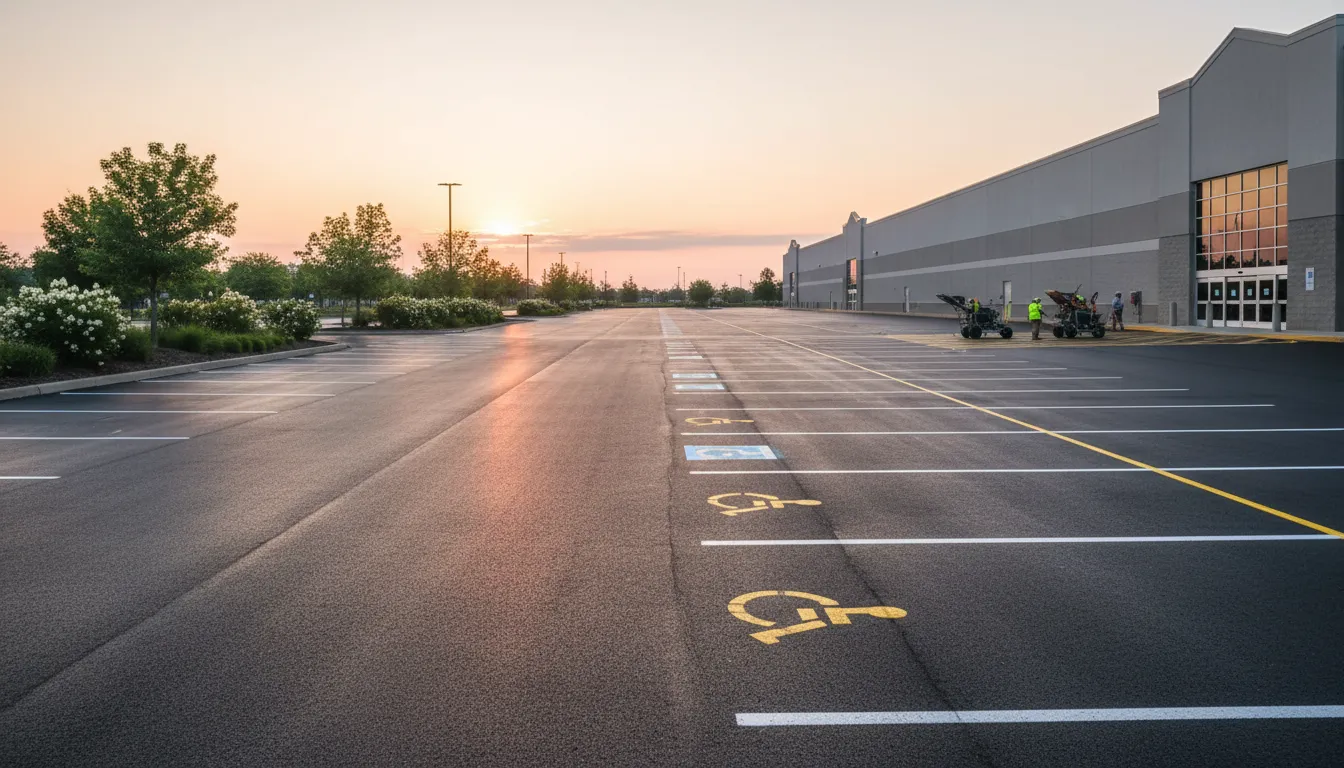
Find the Best Parking Lot Striping Companies for Your Business
No obligation • Fast responses • Nationwide coverage
Why you can trust Tidy Parking
Tidy Parking is a leading U.S. source for parking lot maintenance services, including striping, sealcoating, sweeping, paving, resurfacing, and repairs. Our content is created independently, and providers cannot pay to influence ratings or recommendations.
Search providers near you
Top Parking Lot Striping Companies in Chicago, Illinois Ranked
Clear, compliant, and durable pavement markings are essential for the safety, organization, and legal operation of any commercial or public property in Chicago. Parking lot striping, also known as line painting or pavement marking, does more than just define spaces; it directs traffic flow, designates critical zones for accessibility and safety, and protects property owners from liability. In a city with strict local codes and Illinois Accessibility standards, proper striping is a non-negotiable aspect of property maintenance. This guide will help you understand the key regulations, best practices, and considerations for ensuring your Chicago property's markings are up to code and effectively serve their purpose.
Big Joe's Sealcoating
6563 Fernwood Dr, Lisle, IL 60532
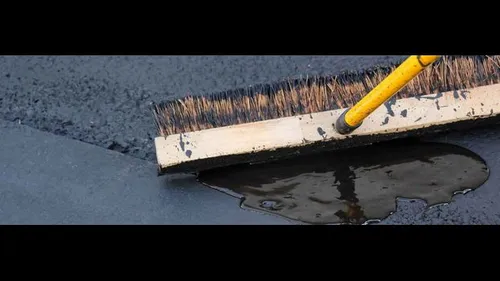
Big Joe's Sealcoating is a parking lot striping, sealcoating, and repair company serving Chicago, IL, and the Western Suburbs. They specialize in residential and commercial asphalt maintenance, using soft brushes for thicker sealant application to protect driveways and parking lots from weather damage. The company also offers line striping for parking lots and basketball courts with high-quality paint products. Since 2010, Big Joe's Sealcoating has built a reputation for adhering to strict industry standards and providing durable, long-lasting asphalt protection. They provide follow-up support around the clock.
Kingdom Sealcoating
15324 Le Claire Ave, Oak Forest, IL 60452
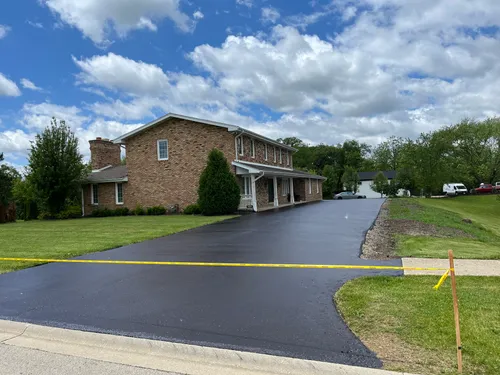
Kingdom Sealcoating is a parking lot striping, sealcoating, and repair company serving Chicago, IL. Established in 2001 as a second-generation business, it provides asphalt maintenance services including sealcoating, crack filling, pothole patching, and striping for both residential driveways and commercial parking lots. With over 20 years of experience in the Chicagoland area, Kingdom Sealcoating focuses on protecting and enhancing asphalt surfaces to extend their lifespan and improve appearance.
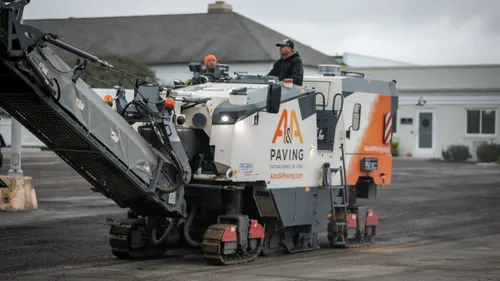
A&A Paving
251 N Garden Ave, Roselle, IL 60172
A&A Paving is a parking lot paving and repair company based in Chicago, IL. They provide services including asphalt paving, sealcoating, striping, resurfacing, and basin repair. The company is known for managing projects with clear communication and minimal disruption to business operations. A&A Paving has a history that traces back to its founder's early work in parking lot striping, growing over six decades into a well-established paving contractor. Their crews are highly trained and experienced, delivering quality workmanship across the Chicago area.
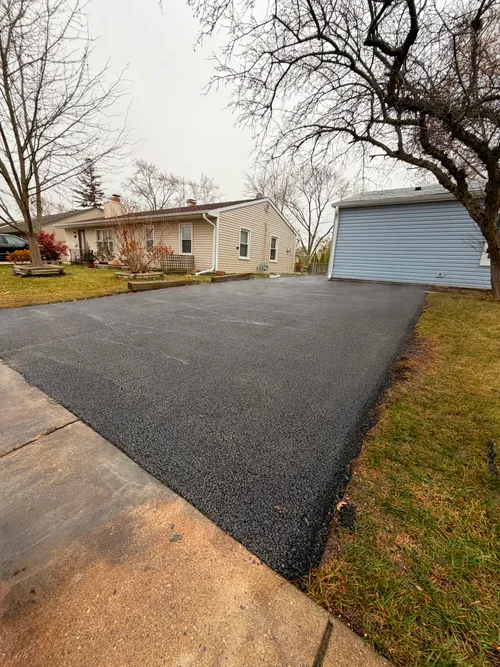
JJ's Seal Coating & Striping Inc.
Chicago, IL
JJ's Seal Coating & Striping Inc. is a parking lot contractor based in Chicago, IL, offering services for both residential and commercial clients. They specialize in seal coating, crack filling, parking lot striping, asphalt paving, and patching to maintain and extend the lifespan of asphalt surfaces. With over 25 years of experience, the company uses premium materials and focuses on quality workmanship to deliver lasting value. Their services help improve curb appeal, safety, and organization of parking areas.
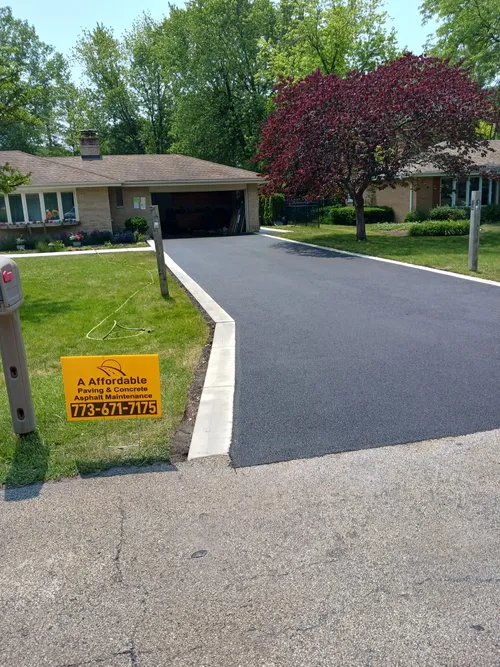
A Affordable Paving & Sealcoating
Chicago, IL
A Affordable Paving & Sealcoating is a parking lot paving and maintenance company based in Chicago, IL. They provide a range of services including asphalt paving, sealcoating, crack filling, striping, milling, patching, and concrete repairs for commercial and industrial parking lots. The company also handles concrete flatwork, curbs, stairs, patios, and resurfacing. With over 10 years of experience, they use professional equipment and quality materials to ensure durable and long-lasting results. Their sealcoating service protects pavement from sun damage and moisture, helping to extend the life of paved surfaces. A Affordable Paving & Sealcoating serves Chicago and surrounding suburbs, including areas like Des Plaines, Mount Prospect, Park Ridge, and more.
Understanding Chicago and Illinois Striping Regulations
Navigating the regulatory landscape is the first step in any striping project. In Chicago, you must comply with both the federal Americans with Disabilities Act (ADA) and the Illinois Accessibility Code, which often incorporates and sometimes expands upon federal rules. Local municipal codes, including specific ordinances from the Chicago building department, also apply and can vary. Failure to comply can result in fines, liability issues, and a lack of accessibility for visitors and customers.
The core purpose of these regulations is to ensure safe, equitable access. This means your pavement marking plan must go beyond simple white lines for standard stalls. It encompasses the precise layout and identification of accessible parking, clear designation of fire lanes and loading zones, and the creation of safe pedestrian pathways.
ADA-Compliant Accessible Parking Standards
Accessible parking is one of the most regulated aspects of lot striping. The requirements are detailed and non-negotiable.
Space Count and Designation: The number of required accessible spaces is based on your lot's total parking capacity. For lots with 1 to 25 total spaces, at least one must be accessible. For 26 to 50 spaces, two are required, and for 51 to 75, three are needed. One out of every six accessible spaces must be van-accessible.
Dimensions and Layout: A standard accessible car space must be at least 8 feet wide with an adjacent 5-foot-wide access aisle. Alternatively, it can be an 11-foot-wide space with the aisle included in the width. Van-accessible spaces require an 8-foot-wide space with an 8-foot-wide aisle, or an 11-foot-wide space with a 5-foot aisle. These access aisles, which provide room for wheelchair lifts and ramps, must be marked with diagonal yellow stripes to clearly indicate they are not for parking.
Location and Slope: Accessible spaces must be located on the shortest possible accessible route to the building's accessible entrance. Furthermore, both the parking space and its access aisle must be nearly level, with a maximum slope of 1:48 (approximately 2%) in any direction1 2.
Signage and Markings: Each accessible space must be identified with the International Symbol of Accessibility painted on the pavement within the stall. Crucially, a permanent sign featuring the symbol must also be installed. This sign must be mounted so that its bottom edge is at least 5 feet (60 inches) above the ground to ensure visibility3 4. Van-accessible spaces require additional "Van Accessible" text on the sign.
Essential Safety Markings Beyond Parking Stalls
A fully compliant and safe parking area requires several other critical markings.
Fire Lanes: These zones must be kept clear at all times for emergency vehicle access. Chicago fire code mandates they be clearly marked, typically with bold red or yellow paint, and labeled with the words "NO PARKING FIRE LANE" stenciled directly on the pavement at regular intervals. The specific color and wording can be dictated by local fire marshals.
Loading Zones: Areas designated for commercial loading and unloading or passenger pick-up/drop-off should be marked with yellow paint and often include stenciled text like "LOADING ZONE" or "NO PARKING." Properly marked zones prevent these activities from obstructing traffic flow in main drive aisles5.
Crosswalks and Pedestrian Pathways: Protecting pedestrians is paramount. Clearly painted crosswalks, using solid white or zebra-style stripes, indicate safe paths from parking areas to building entrances. These should be paired with adequate signage and, in some cases, curb ramps that meet ADA standards for accessibility6 7.
Traffic Flow Arrows and Stop Bars: Directional arrows painted in drive aisles guide one-way traffic and prevent conflicts. Stop bars (thick white lines) at intersections with sidewalks or other aisles indicate where vehicles must come to a complete halt, enhancing safety for both drivers and pedestrians.
Find the perfect parking lot striping companies for your needs
Get personalized recommendations and expert advice
The Striping Process: Materials and Professional Application
A durable, professional result depends on the right materials and expert application.
Paint vs. Thermoplastic: The two most common marking materials are water-based latex paint and thermoplastic. Paint is cost-effective and suitable for many applications but typically lasts 1-3 years before needing reapplication. Thermoplastic is a melted plastic material that is applied hot and cools to form an extremely durable, long-lasting mark (5+ years) that is highly resistant to traffic and weather. The choice depends on your budget, traffic volume, and long-term maintenance plans.
Surface Preparation: This is a critical step often overlooked. The pavement must be thoroughly cleaned of all dirt, oil, grease, and debris. Existing faded lines may need to be removed or covered. For the new markings to adhere properly and last, the surface must be completely dry. Professionals often use power brooms, blowers, and pressure washers for this task.
Stenciling and Layout: Before any paint is applied, a detailed layout is chalked or measured out on the pavement. This ensures all spaces are the correct size, aisles are straight, and all required elements (accessible stalls, fire lanes, etc.) are accurately placed. Stencils are used for symbols like the accessibility icon, handicap lettering, and fire lane warnings.
Professional Application: Professional contractors use specialized airless or striping rigs to apply paint in crisp, uniform lines. They understand how weather conditions like temperature and humidity affect drying times and final adhesion. Their expertise ensures efficiency, compliance, and a high-quality finish that reflects well on your property.
Cost Considerations for Parking Lot Line Painting in Chicago
Project costs can vary widely based on the scope, materials, and condition of your lot. For a small lot requiring a basic restriping of standard spaces, you might expect costs to range from $1,000 to $2,500. For larger commercial lots with complex layouts, multiple access aisles, and extensive safety markings, costs can range from $5,000 to $10,000 or more.
Specific ADA-compliant installations, which include the precise layout, diagonal aisle striping, and pavement symbols, can add approximately $300 to $600 per accessible stall to the project cost8 9. It's important to view this not just as an expense, but as a necessary investment in compliance, safety, and inclusivity. When requesting estimates, ensure they include a detailed breakdown of labor, materials (specify paint type), surface prep, and all required regulatory markings.
Maintaining Your Pavement Markings
Striping is not a one-time task. Over time, markings will fade due to sunlight (UV exposure), weather, snow plowing, and tire friction. Proactive maintenance is key.
Regular Inspection: Conduct visual inspections of your lot at least twice a year, ideally in spring and fall. Look for faded lines, worn symbols, and damaged signage. Pay special attention to high-traffic areas and accessible space markings.
Scheduled Restriping: Most properties need a full restriping every 18 to 24 months to maintain clarity and compliance. Using more durable thermoplastic can extend this cycle. Budgeting for this regular maintenance prevents last-minute emergencies and ensures your property is always safe and code-compliant.
Prompt Repairs: Address specific issues like a single faded fire lane marking or a scraped-off handicap symbol promptly. Many contractors offer spot-repair services to maintain overall lot integrity between major restriping projects.
Frequently asked questions
Sources
Footnotes
-
17-10-0900 Accessible parking (for people with disabilities). - https://codelibrary.amlegal.com/codes/chicago/latest/chicagozoning_il/0-0-0-50790 ↩
-
ADA Compliance in Striping: Stalls, Aisles, Signs - - https://asphaltinc.com/ada-parking-striping-stalls-aisles-signs/ ↩
-
Parking Lot Striping and ADA Compliance: Everything You ... - https://theparkinglotpro.com/parking-lot-striping-and-ada-compliance-everything-you-need-to-know/ ↩
-
Parking Lot Striping Resource Guide | Schaumburg, IL - https://www.villageofschaumburg.com/government/community-development/permit-services/commercial-permits/parking-lot-striping-resource-guide ↩
-
ADA Compliance Brief: Restriping Parking Spaces - https://www.ada.gov/resources/restriping-parking-spaces/ ↩
-
Parking Lot Striping & ADA Compliance: What to Know - https://brixco.co/parking-lot-striping-ada-compliance/ ↩
-
ADA Compliance: Parking Lots, Ramps, Entrances & More - https://smoothpaving.com/services/concrete-ada-compliance/ ↩
-
ADA Compliance Guide for Parking Lot Line Striping - https://www.pavementsolutions.org/ada-compliance-guide-for-parking-lot-line-striping/ ↩
-
Understanding Your Parking Lot Line Striping Requirements - https://www.ppm.us/parking-lot-striping-requirements/ ↩