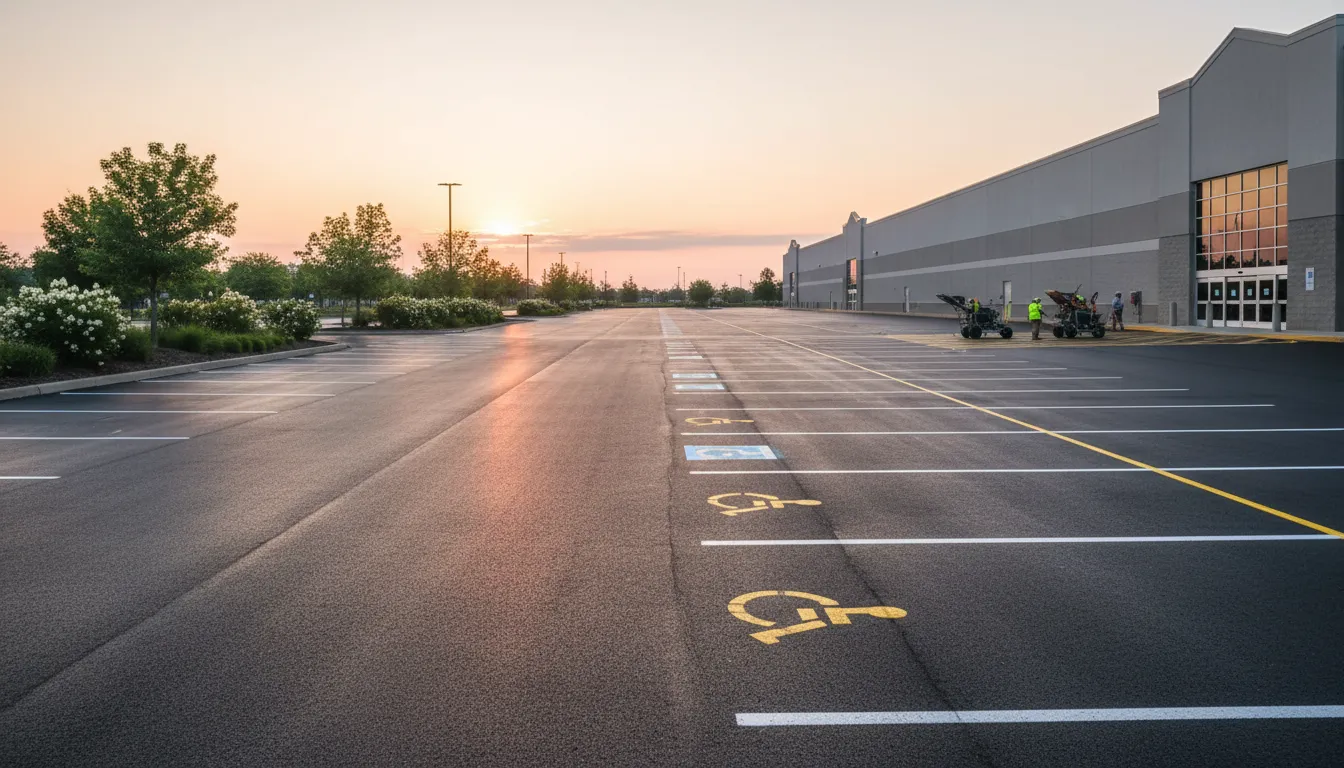
Find the Best Parking Lot Striping Companies for Your Business
No obligation • Fast responses • Nationwide coverage

Why you can trust Tidy Parking
Tidy Parking is a leading U.S. source for parking lot maintenance services, including striping, sealcoating, sweeping, paving, resurfacing, and repairs. Our content is created independently, and providers cannot pay to influence ratings or recommendations.
Search providers near you
Top Parking Lot Striping Companies in Glenview, Illinois Ranked
Clear, compliant, and durable pavement markings are essential for the safety, organization, and legal operation of any commercial or public parking area in Glenview. Proper parking lot striping and pavement marking not only guide drivers and pedestrians efficiently but also ensure adherence to strict state and federal accessibility laws. This guide explains the key standards, costs, and considerations for line striping projects in Glenview, helping property managers and business owners understand what's required to maintain a functional and compliant lot.
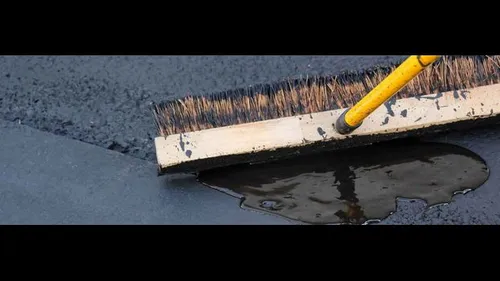
Big Joe's Sealcoating
6563 Fernwood Dr, Lisle, IL 60532
Big Joe's Sealcoating is a parking lot striping, sealcoating, and repair company serving Chicago, IL, and the Western Suburbs. They specialize in residential and commercial asphalt maintenance, using soft brushes for thicker sealant application to protect driveways and parking lots from weather damage. The company also offers line striping for parking lots and basketball courts with high-quality paint products. Since 2010, Big Joe's Sealcoating has built a reputation for adhering to strict industry standards and providing durable, long-lasting asphalt protection. They provide follow-up support around the clock.
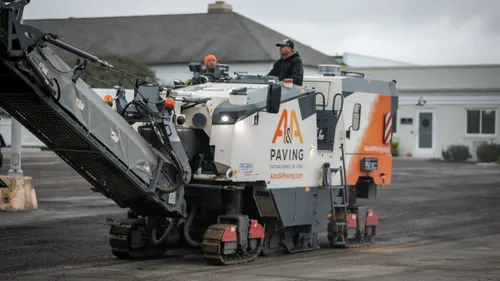
A&A Paving
251 N Garden Ave, Roselle, IL 60172
A&A Paving is a parking lot paving and repair company based in Chicago, IL. They provide services including asphalt paving, sealcoating, striping, resurfacing, and basin repair. The company is known for managing projects with clear communication and minimal disruption to business operations. A&A Paving has a history that traces back to its founder's early work in parking lot striping, growing over six decades into a well-established paving contractor. Their crews are highly trained and experienced, delivering quality workmanship across the Chicago area.
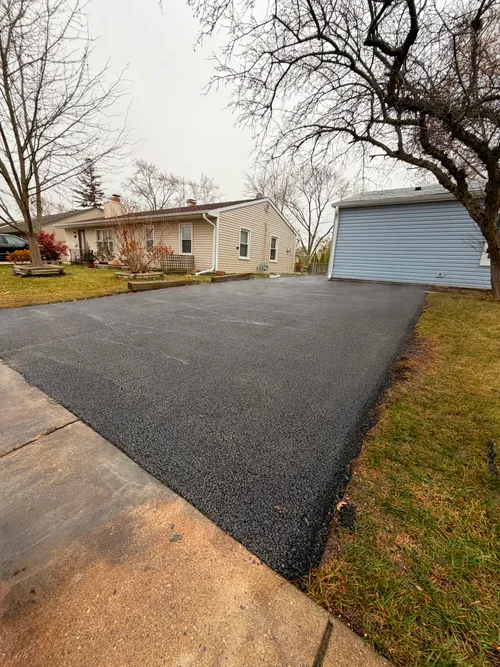
JJ's Seal Coating & Striping Inc.
Chicago, IL
JJ's Seal Coating & Striping Inc. is a parking lot contractor based in Chicago, IL, offering services for both residential and commercial clients. They specialize in seal coating, crack filling, parking lot striping, asphalt paving, and patching to maintain and extend the lifespan of asphalt surfaces. With over 25 years of experience, the company uses premium materials and focuses on quality workmanship to deliver lasting value. Their services help improve curb appeal, safety, and organization of parking areas.
A Affordable Paving & Sealcoating
Chicago, IL
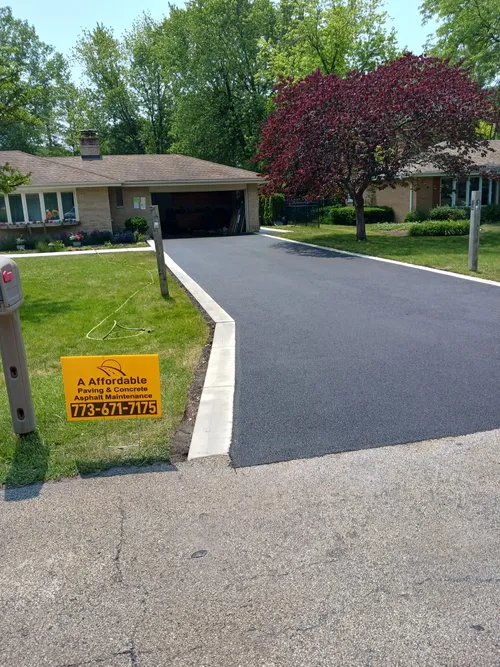
A Affordable Paving & Sealcoating is a parking lot paving and maintenance company based in Chicago, IL. They provide a range of services including asphalt paving, sealcoating, crack filling, striping, milling, patching, and concrete repairs for commercial and industrial parking lots. The company also handles concrete flatwork, curbs, stairs, patios, and resurfacing. With over 10 years of experience, they use professional equipment and quality materials to ensure durable and long-lasting results. Their sealcoating service protects pavement from sun damage and moisture, helping to extend the life of paved surfaces. A Affordable Paving & Sealcoating serves Chicago and surrounding suburbs, including areas like Des Plaines, Mount Prospect, Park Ridge, and more.
D & M Striping
3636 W 115th St, Chicago, IL 60655
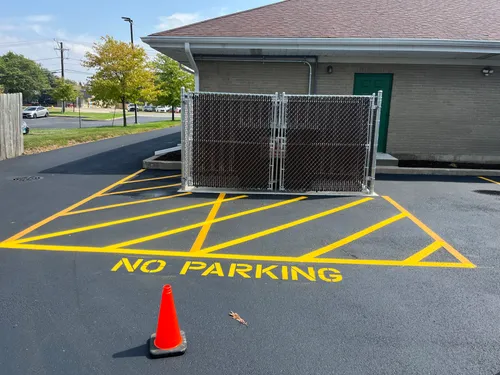
D & M Striping is a parking lot striping company based in Chicago, IL. Founded in 1985 by David McVey, the company offers custom professional striping services that go beyond traditional parking facilities. With a strong client portfolio and over 50 repeat customers, D & M Striping is experienced in delivering quality striping and numbering for both parking garages and outdoor lots.
Understanding Local and State Striping Requirements
In Glenview, all parking lot marking projects must comply with the Illinois Accessibility Code and the federal Americans with Disabilities Act (ADA). These regulations are not mere suggestions; they are enforceable standards designed to guarantee safe access for all. The Village of Glenview's Building Division is the final authority, and it is always recommended to consult with them to confirm any local ordinances that may amend state-wide rules.
Failing to meet these standards can result in significant fines, liability issues, and a negative experience for customers and visitors. A professionally executed striping job using the correct materials and layouts is an investment in your property's safety, usability, and legal standing.
ADA Compliance: Accessible Space Specifications
ADA-compliant stall marking is one of the most critical aspects of parking lot layout. The rules are precise and non-negotiable.
Space and Aisle Dimensions:
- Standard Accessible Spaces: Must be at least 8 feet wide.
- Access Aisle: An adjacent access aisle of at least 5 feet wide is required beside the accessible space. This aisle must be kept clear at all times for wheelchair lifts and ramps.
- Van-Accessible Spaces: For van-accessible spaces, the access aisle must be a minimum of 8 feet wide.
Markings and Layout:
- The access aisle must be marked with diagonal hatch lines, almost always in yellow paint, to discourage parking.
- The entire accessible parking space, including the access aisle, should be as level as possible, with a slope not exceeding 2% in any direction1.
Required Signage:
- Each accessible space must be identified with a posted sign. The standard is the R7-8 "International Symbol of Accessibility" sign.
- In Illinois, an additional R7-1101 sign stating "$250 FINE" is typically required2 3.
- These signs must be mounted on a post at least 5 feet above the ground at the head of the parking space 4.
Quantity and Ratios:
- The required number of accessible spaces is based on the total number of spaces in the lot. For example:
- 1 to 25 total spaces: 1 accessible space.
- 26 to 50 total spaces: 2 accessible spaces 5 6.
- Furthermore, at least one out of every six accessible spaces must be designated as van-accessible 7.
Standard Parking Lot Markings and Colors
Beyond accessible stalls, a coherent color and marking system organizes traffic flow and designates specific zones.
Color Codes:
- White: The standard color for most line striping. It is used for general parking space lines, directional arrows, stop lines, and crosswalks.
- Yellow: Designates areas where parking is prohibited or to highlight hazards. It is used for no-parking zones, fire lanes (in some jurisdictions), loading zones, and the diagonal lines in accessible aisles.
- Blue: Reserved exclusively for the outlines of accessible parking spaces8.
- Red: Commonly used to denote fire lanes, often accompanied by the stenciled words "FIRE LANE" repeated at regular intervals (e.g., every 25 feet).
Line Widths:
- A 4-inch line width is the standard for most parking lot applications.
- In areas requiring higher visibility, such as near crosswalks or in complex traffic patterns, 6-inch lines may be used or required.
Special Designations: Fire Lanes and Loading Zones
Properly marking these critical areas is vital for safety and emergency access.
- Fire Lane Marking: Fire lanes must be clearly identifiable. This is often achieved by painting the curb and the pavement of the lane red. The words "FIRE LANE" are typically stenciled in white on the red pavement at regular intervals to ensure visibility 9. Local fire codes dictate the exact specifications.
- Loading Zone Marking: Loading zones are crucial for businesses to receive deliveries safely and efficiently. These areas are usually marked with yellow painted curbs or yellow-striped pavement sections. Clear stenciling (e.g., "LOADING ZONE") and appropriate signage prevent these areas from being used for general parking.
Find the perfect parking lot striping companies for your needs
Get personalized recommendations and expert advice
The Cost of Parking Lot Striping in Glenview
The price for professional line striping services can vary based on the project's scale, complexity, and materials used. Understanding the cost factors can help in budgeting.
Primary Pricing Model:
- The most common way contractors price striping work is by the linear foot. In the Glenview area, costs typically range from $0.15 to $0.50 per linear foot. This range depends heavily on the type of paint or material used and the condition of the existing pavement.
Project-Based Estimates:
- For a small project, such as re-striping a lot with 20-30 spaces, total costs might range from $500 to $1,00010 11.
- Large, complex projects involving extensive new layouts, numerous ADA-compliant spaces, and extensive signage will naturally cost more.
Key Cost Factors:
- Material: Standard traffic paint is the most economical. More durable (and more expensive) options include thermoplastic, epoxy, or pre-formed tape, which last longer but have a higher upfront cost.
- Surface Preparation: If the old lines need to be removed or the pavement requires extensive cleaning, this adds labor and time.
- Layout Complexity: A simple grid is faster to stripe than a lot with angled spaces, multiple traffic islands, crosswalks, and numerous regulatory stencils.
- ADA Compliance: Installing the correct number of accessible spaces with proper signage and markings is a non-negotiable cost that must be factored into every project.
The Professional Striping Process
A quality striping job follows a systematic process:
- Consultation & Plan Review: A professional will survey your lot, discuss needs, and verify compliance with Glenview and ADA requirements.
- Surface Preparation: The pavement is thoroughly cleaned of dirt, oil, and debris. Old, faded lines may need to be removed or covered.
- Layout & Measurement: Using precise tools, the technician lays out the entire parking lot design with chalk or a chalk line, ensuring all spaces are the correct size and alignment.
- Application: Using professional-grade spray equipment, the paint is applied evenly to create crisp, sharp lines. Stencils are used for symbols, letters, and numbers.
- Signage Installation: Posts and signs for accessible spaces, fire lanes, and other regulations are installed at the required height and location.
- Curing: The new markings need time to dry and cure before the lot can be reopened to traffic.
Maintaining Your Parking Lot Markings
Pavement markings degrade over time due to traffic wear, weather, and UV exposure. To maintain safety and compliance:
- Re-stripe Regularly: Most lots require re-striping every 12 to 24 months, depending on traffic volume and material used.
- Quick Touch-Ups: Address faded symbols or crosswalks promptly.
- Annual Inspection: Conduct a walk-through each spring to assess the condition of all lines, symbols, and signage, especially before winter weather arrives.
Frequently asked questions
Sources
Footnotes
-
ADA Compliance: Parking Lots, Ramps, Entrances & More - https://smoothpaving.com/services/concrete-ada-compliance/ ↩
-
Parking Lot Striping Resource Guide | Schaumburg, IL - https://www.villageofschaumburg.com/government/community-development/permit-services/commercial-permits/parking-lot-striping-resource-guide ↩
-
Accessible Parking For People with Disabilities - https://illinoisattorneygeneral.gov/Page-Attachments/accesspkg_brochure_english.pdf ↩
-
§ 157.145 HANDICAP ACCESSIBLE PARKING SPACES. - https://codelibrary.amlegal.com/codes/ofallon/latest/ofallon_il/0-0-0-12353 ↩
-
Parking Lot Striping and ADA Compliance: Everything You ... - https://theparkinglotpro.com/parking-lot-striping-and-ada-compliance-everything-you-need-to-know/ ↩
-
ADA Compliance Guide for Parking Lot Line Striping - https://www.pavementsolutions.org/ada-compliance-guide-for-parking-lot-line-striping/ ↩
-
How to Stripe ADA-Compliant Parking Lots - https://theasphaltpro.com/wp-content/uploads/2020/09/How-to-Stripe-ADA-Parking-Lots-V2.pdf ↩
-
Basic Guide to Parking Lot Striping - Traffic Safety Store - https://www.trafficsafetystore.com/blog/guide-to-parking-lot-striping/ ↩
-
Curb Painting and Fire Lane Designations in Line Striping | 1-800-STRIPER® - https://1800striper.com/curb-painting-and-fire-lane-designations-in-line-striping/ ↩
-
Commercial Parking Lot Striping: Costs, Standards + Pro Tips - https://www.getonecrew.com/post/commercial-parking-lot-striping ↩
-
Parking Lot Striping Guide: Cost, Process, & More - https://mclean-company.com/blog/parking-lot-striping/ ↩