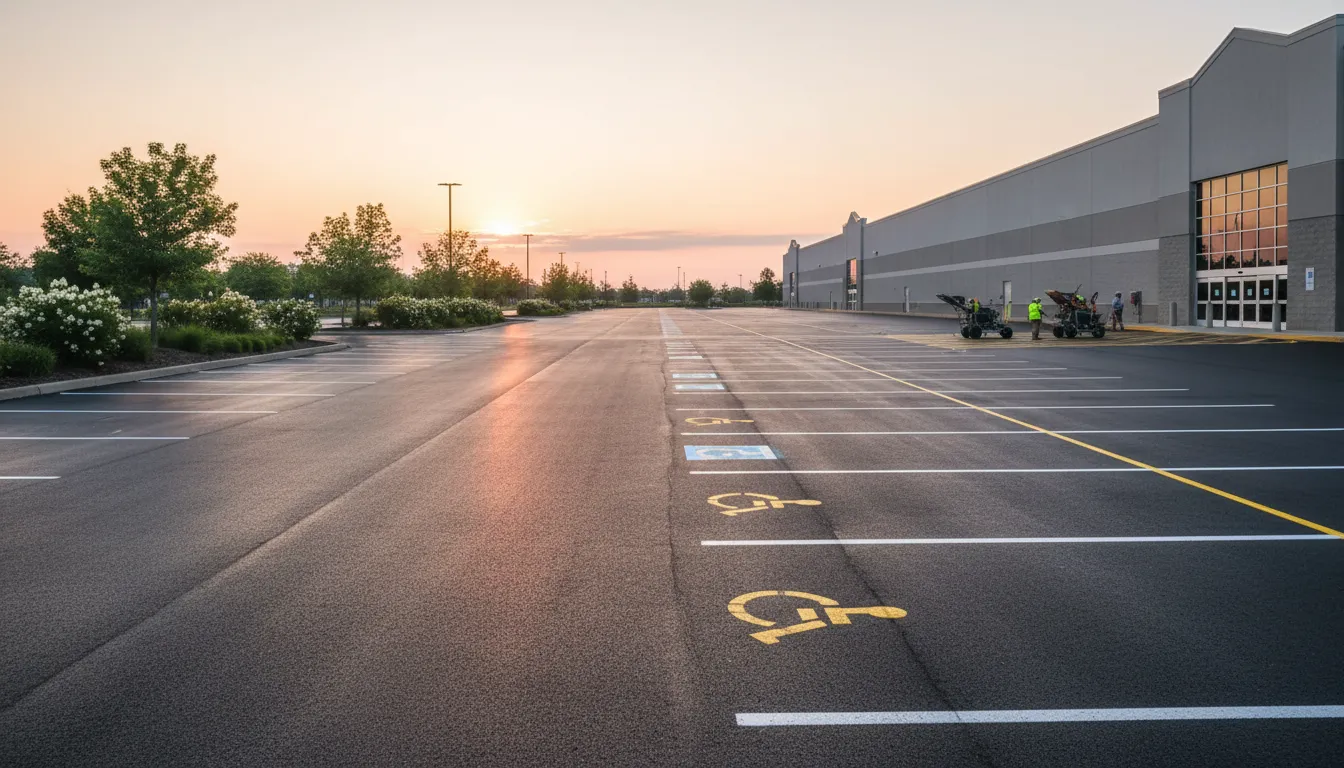
Find the Best Parking Lot Striping Companies for Your Business
No obligation • Fast responses • Nationwide coverage
Why you can trust Tidy Parking
Tidy Parking is a leading U.S. source for parking lot maintenance services, including striping, sealcoating, sweeping, paving, resurfacing, and repairs. Our content is created independently, and providers cannot pay to influence ratings or recommendations.
Search providers near you
Top Parking Lot Striping Companies in Middletown, Connecticut Ranked
Clear, durable parking lot striping is essential for safety, efficiency, and legal compliance for any property with a paved lot. In Connecticut, this work is governed by strict state and federal regulations, most notably the Americans with Disabilities Act (ADA). Proper line painting and pavement marking ensure orderly traffic flow, maximize space, and provide safe, accessible parking for all visitors. This guide details the key requirements, costs, and best practices for parking lot striping in Connecticut, helping property owners and managers understand their obligations and connect with qualified local professionals for their marking projects.
CDS Asphalt Services
44 Glendale Rd, South Windsor, CT 06074
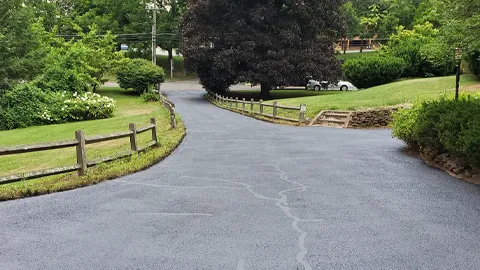
CDS Asphalt Services is a parking lot striping, sealcoating, and repair company based in Hartford, CT. They provide services for both commercial and residential projects, including seal coating, crack filling, line striping, and catch basin maintenance. With over 20 years of experience, CDS Asphalt Services is fully insured and equipped to handle projects of various sizes.
Crossroads Paving CT | Driveway Paving - Commercial Paving - Driveway Sealing
679 Main St, Plymouth, CT 06782
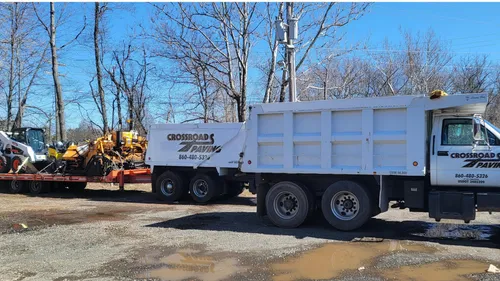
Crossroads Paving CT | Driveway Paving - Commercial Paving - Driveway Sealing is a paving contractor based in Waterbury, CT. They offer a range of services including driveway paving, commercial paving, asphalt repair, sealcoating, and concrete installation. The company has expertise in handling both residential and commercial projects, using modern equipment and quality materials to ensure durable results. With three generations of asphalt contractors behind them, Crossroads Paving CT has over 30 years of experience in the industry. The owner is actively involved on every job site, ensuring attention to detail and quality workmanship.
Paving by Custom Construction
309 rear E Center St, Manchester, CT 06040
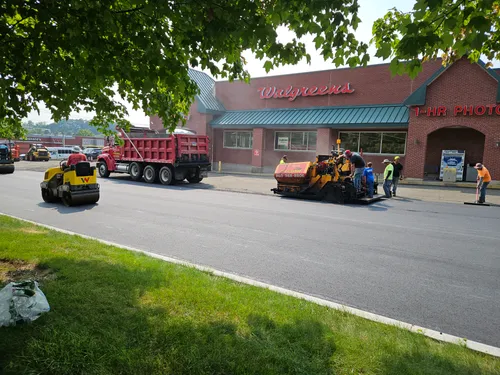
Paving by Custom Construction is a paving contractor based in Hartford, CT, with 22 years of experience. They offer a variety of services including asphalt paving, parking lot striping, sealcoating, parking lot repair, concrete work, drainage solutions, and stone work. The company provides warranties on complete paving projects and focuses on meeting client goals for cost, schedule, and quality.
GWS Paving
Bridgeport, CT
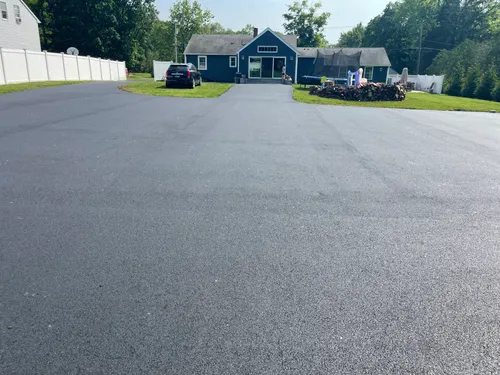
GWS Paving is a third-generation asphalt paving contractor based in Bridgeport, CT, serving most of Connecticut. They offer a wide range of services including driveway paving, parking lot striping, sealcoating, resurfacing, and more, using state-of-the-art equipment to ensure efficient project completion. With over 15 years of experience, GWS Paving handles both residential and commercial projects, specializing in driveway paving and parking lot maintenance.
Premier Sealcoating and Paving
400 Chapel Rd #1C, South Windsor, CT 06074
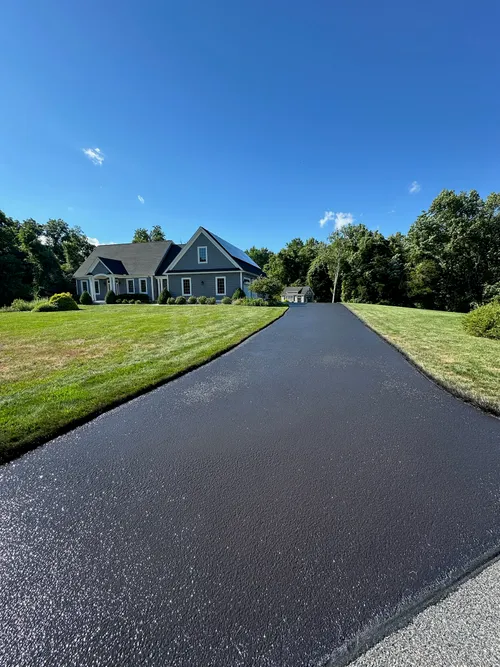
Premier Sealcoating and Paving is a woman-owned business based in Hartford, CT, offering a full range of asphalt services including sealcoating, crack filling, line striping, sweeping, curb repair, asphalt patching, and general maintenance. With over 45 years of industry experience, they serve both commercial and residential clients across Connecticut. Their team uses state-regulated asphalt emulsion sealer, a safer and environmentally friendly alternative to traditional coal tar, to protect and extend the life of asphalt surfaces. Premier Sealcoating and Paving complies with FAA, DOT, and state regulations, ensuring quality and safety in all projects.
Understanding ADA Compliance for Connecticut Parking Lots
The ADA sets the national standard for accessible design, and its requirements are rigorously enforced in Connecticut. Non-compliance can result in significant fines, legal liability, and barriers for individuals with disabilities. The core of ADA compliance in parking involves the number, design, and marking of accessible parking spaces.
Key ADA Requirements:
- Quantity: The required number of accessible spaces is based on the total number of spaces in the lot. For example, lots with 1 to 25 spaces must have at least one van-accessible space. For larger lots, a percentage is required (e.g., 2% of spaces for lots with 501 to 1000 spaces) 1.
- Location: Accessible spaces must be located on the shortest accessible route from the parking area to the accessible building entrance. The path must be stable, firm, and slip-resistant.
- Slope: The surface of accessible spaces and their access aisles must have a slope no greater than 1:48 (2.08%) in any direction to ensure stability for wheelchairs and mobility devices 2 3.
Specifications for Accessible Parking Spaces and Markings
Proper striping and signage for accessible spaces are non-negotiable. Faded paint or incorrect dimensions can render a space non-compliant.
Space and Aisle Dimensions
- Standard Accessible Space: Must be at least 8 feet wide with an adjacent 5-foot wide access aisle 4.
- Van-Accessible Space: Must be at least 11 feet wide with a 5-foot aisle, or 8 feet wide with an 8-foot aisle (the 8-foot aisle is preferred for easier access). Van-accessible spaces also require a minimum vertical clearance of 98 inches for the access aisle, route to the entrance, and the space itself 5.
- Access Aisle Markings: The access aisle must be marked with high-contrast diagonal hatch lines (typically white or yellow on asphalt). This aisle is part of the accessible space and cannot be used for parking or standing by other vehicles 6 7.
Striping Color and Layout
While the ADA does not mandate a specific color, the markings must contrast with the pavement. In Connecticut and nationally, it is a widely accepted standard to use blue paint for the lines defining accessible parking spaces. This provides a clear visual cue. White or yellow paint may be used if it provides sufficient contrast against the existing pavement.
The layout must be clear, with lines repainted regularly to maintain visibility. Faded lines are a common violation.
Required Signage
Striping must be accompanied by proper signage. Each accessible space requires a sign that is:
- Mounted at least 60 inches (5 feet) from the ground to the bottom of the sign 8.
- Displayed the International Symbol of Accessibility.
- Labeled with "Reserved Parking" and state that a permit is required, along with the fine amount for illegal parking, as per Connecticut state law 9 10.
Connecticut-Specific Regulations for Fire Lanes and Safety Zones
Beyond ADA rules, Connecticut has specific state and local ordinances governing parking near fire hydrants and in safety zones.
- Fire Hydrants: It is illegal to park within 10 feet of a fire hydrant in Connecticut 11.
- Fire Lanes: Designated fire lanes must be clearly marked. Curbing in no-parking/fire lane areas is typically painted red or yellow. The words "NO PARKING FIRE LANE" are often stenciled in high-visibility white or yellow paint directly on the pavement 12.
- Safety Zones: Parking is prohibited within 25 feet of a stop sign, crosswalk, or pedestrian safety zone to maintain visibility and safety 13.
Cost Factors for Parking Lot Striping in Connecticut
The cost to stripe or restripe a parking lot in Connecticut depends on several variables. Understanding these can help in budgeting and planning.
- Basic Re-striping: For standard line repainting, costs typically range from $0.10 to $0.30 per linear foot. Individual parking stalls can cost between $5 and $10 each to repaint 14 15.
- ADA Stall Marking: Marking accessible spaces is more expensive due to the detailed work involved-painting the space lines, the diagonal hatch marks in the access aisle, and often the wheelchair symbol within the stall. This specialized work increases the per-stall cost 16.
- Key Cost Factors:
- Site Preparation: Extensive cleaning, crack filling, or removal of old paint (milling) adds to the cost.
- Paint Quality: High-performance, durable thermoplastic or epoxy paints cost more than standard traffic paint but last significantly longer.
- Lot Size and Layout: Complex layouts with many angles, compact spaces, or numerous ADA requirements increase labor time.
- Number of ADA Spaces: The more accessible spaces requiring detailed hatch marks and symbols, the higher the total project cost 17.
Find the perfect parking lot striping companies for your needs
Get personalized recommendations and expert advice
The Importance of Professional Maintenance and Re-striping
Regular maintenance of your parking lot markings is not just about aesthetics; it's a critical part of risk management and ongoing compliance.
- Maintaining Compliance: Over time, paint fades due to traffic, weather (especially Connecticut's freeze-thaw cycles), and UV exposure. Faded lines, particularly for ADA spaces, can lead to non-compliance notices and fines. Proactive restriping on a 1-2 year cycle (depending on traffic) is recommended 18.
- Safety and Liability: Clear markings direct traffic, prevent accidents, and designate safe pedestrian pathways. Faded or missing lines can contribute to vehicle collisions, slip-and-fall incidents, and increased liability for the property owner.
- Optimizing Space: Over time, old line layouts may become inefficient. A professional striping contractor can often suggest a new layout that maximizes the number of available spaces or improves traffic flow during a restriping project.
Choosing the Right Contractor for Your Project
Selecting a qualified contractor is crucial for a compliant and durable result.
- Verify Experience with ADA Regulations: Ask specifically about their process for ensuring ADA compliance in layout, dimensions, and markings.
- Check for Proper Insurance: Ensure the contractor carries general liability and workers' compensation insurance.
- Request References and Portfolios: Look at past work, particularly for lots similar in size and use to yours.
- Get Detailed Quotes: A professional quote should break down costs for layout, surface prep, materials (type of paint), labor, and a timeline for completion. It should also specify compliance with all relevant ADA and Connecticut state codes.
Frequently asked questions
Sources
Footnotes
-
The ADA and Parking - https://northeastada.org/resource/the-ada-and-parking ↩
-
ADA Compliance Guide for Parking Lot Line Striping - https://www.pavementsolutions.org/ada-compliance-guide-for-parking-lot-line-striping/ ↩
-
The Importance of ADA-Compliant Parking Lot Striping - Rose Paving - https://www.rosepaving.com/blog/the-importance-of-ada-compliant-parking-lot-striping/ ↩
-
ADA Parking Lot Requirements - The Pavement Network - https://pavementnetwork.com/ada-parking-lot-requirements/ ↩
-
ADA Compliance in Striping: Stalls, Aisles, Signs - - https://asphaltinc.com/ada-parking-striping-stalls-aisles-signs/ ↩
-
Parking Lot Striping & ADA Compliance: What to Know - https://brixco.co/parking-lot-striping-ada-compliance/ ↩
-
Follow ADA Guidelines for Striping and Marking Parking Lots - https://americanasphalt.com/follow-ada-guidelines-for-striping-and-marking-parking-lots/ ↩
-
Parking signs in Connecticut | MyParkingSign.com Blog - https://www.myparkingsign.com/blog/parking-signs-in-connecticut/ ↩
-
State of Connecticut Handicapped Parking Spaces and ... - Bristol, CT - https://www.bristolct.gov/DocumentCenter/View/22637/Handicapped-Parking-PDF?bidId= ↩
-
Connecticut Handicapped Parking Signs - StopSignsandMore.com - https://www.stopsignsandmore.com/c-70-connecticut-handicapped-parking-signs.aspx ↩
-
Accessible Parking Spaces | ADA.gov - https://www.ada.gov/topics/parking/ ↩
-
Parking Lot Stripping Requirements - Town of Perinton - https://perinton.gov/wp-content/uploads/Parking-Lot-Striping-Requirements-Town-Specs.pdf ↩
-
The Guide To Colored Curb Zones in Connecticut - YourMechanic - https://www.yourmechanic.com/article/the-guide-to-colored-curb-zones-in-connecticut-by-valerie-johnston ↩
-
Cost to Restripe a Parking Lot - Truline Striping Company - https://trulinestripingco.com/blog/cost-to-restripe-a-parking-lot/ ↩
-
Parking Lot Striping Pricing Salt Lake County | Cost Calculator - https://parkinglotstripingslc.com/pricing ↩
-
ADA Handicap Striping in Plano, TX | Accessible Parking Markings - https://www.parkinglotstripingplano.com/handicap-striping-plano-tx.html ↩
-
Parking Lot Striping Standards: Dimensions, Colors, and ADA Rules - https://www.getonecrew.com/post/parking-lot-striping-standards ↩
-
Parking Lot Restriping Benefits in California | Stay ADA-Compliant - https://adainspectionorangecounty.com/benefits-of-parking-lot-restriping-in-california/ ↩