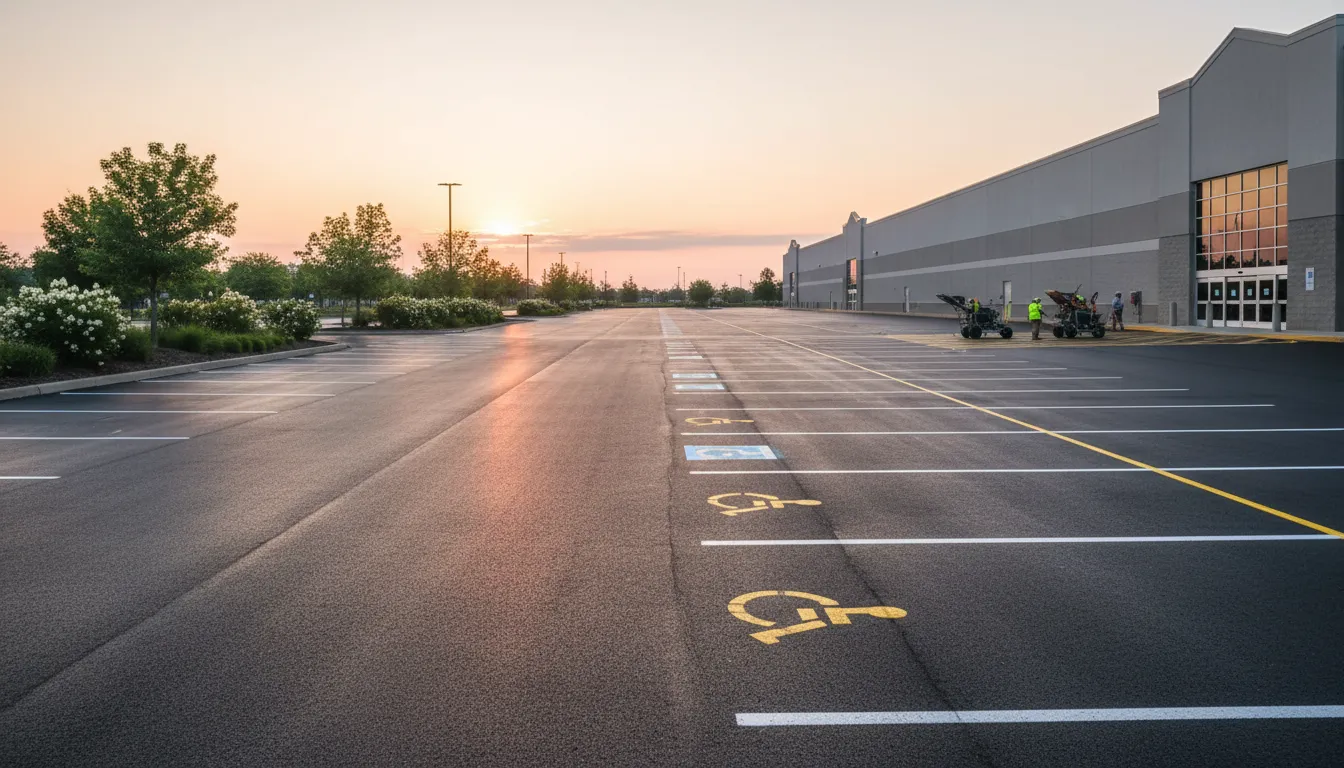
Find the Best Parking Lot Striping Companies for Your Business
No obligation • Fast responses • Nationwide coverage
Why you can trust Tidy Parking
Tidy Parking is a leading U.S. source for parking lot maintenance services, including striping, sealcoating, sweeping, paving, resurfacing, and repairs. Our content is created independently, and providers cannot pay to influence ratings or recommendations.
Search providers near you
Top Parking Lot Striping Companies in Palm Springs, California Ranked
A clearly marked parking lot is essential for safety, accessibility, and efficient use of space. In Palm Springs, professional parking lot striping is more than just painting lines; it's about ensuring compliance with strict California and ADA regulations to protect property owners from liability and fines. This guide explains the key requirements for line striping, pavement marking, and stall layout in the Coachella Valley, helping you understand what to look for when evaluating local service providers.
Cortez Paving Inc
Riverside, CA
Cortez Paving Inc provides asphalt, concrete, and sealcoating services in Riverside, CA. They handle residential, commercial, and industrial projects with expertise in parking lot paving, striping, and sealcoating to protect and maintain paved surfaces. The company also specializes in ADA compliance, including handicap parking stalls, signage, and accessible pathways. Cortez Paving uses advanced technology and premium materials to ensure durable and visually appealing results.
Asphalt Paving Palm Springs
Orlando, FL
Asphalt Paving Palm Springs is a family-owned company serving Palm Springs, FL, and the surrounding Palm Springs County. They specialize in residential and commercial asphalt paving, parking lot striping, sealcoating, resurfacing, and repair services. Their team handles projects ranging from driveway paving to large-scale commercial parking lots, ensuring safety and functionality for vehicles and pedestrians. With decades of experience, they focus on quality workmanship and customer satisfaction, maintaining up-to-date industry standards. The company is committed to minimizing business disruption during commercial projects and offers expert pothole and crack repair services.
Understanding Local Striping Regulations
In Palm Springs, all parking lot marking must comply with the California Building Code (CBC) Title 24 and the federal Americans with Disabilities Act (ADA). These codes dictate everything from stall dimensions and colors to signage placement. Non-compliance can result in significant fines and create safety hazards. The desert climate, with intense sun and heat, also demands the use of durable, high-visibility paints and thermoplastics that can withstand rapid degradation.
Local fire departments, including the San Bernardino County Fire Protection District, have additional mandates for marking fire lanes and access roads. Property owners and managers are responsible for ensuring their pavement markings are always clear, correct, and in good repair.
Key Requirements for Accessible Parking Spaces
ADA-compliant stall marking is a critical component of any parking lot layout. The rules are precise and must be followed exactly.
- Stall and Aisle Dimensions: A standard accessible car space must be at least 9 feet wide with an adjacent 5-foot-wide access aisle. For van-accessible spaces, the aisle must be at least 8 feet wide 1. These aisles are part of the accessible route and must be kept clear at all times.
- Markings and Symbols: Each accessible stall must display the International Symbol of Accessibility painted on the pavement. The symbol should be at least 36 inches by 36 inches and placed in the center of the space. The preferred color scheme is a white symbol on a blue field, though blue paint for the entire stall is also common.
- Aisle Markings: Access aisles are typically marked with diagonal blue or white lines to discourage parking within them. Some specifications call for cross-hatching.
- Signage: In addition to pavement symbols, each accessible space must be accompanied by a vertical sign mounted at least 60 inches above the ground. The sign must include the International Symbol of Accessibility and wording such as "Parking by Permit Only" or "Van Accessible" as required 2 3.
Fire Lane and Safety Markings
Clear designation of fire lanes is a non-negotiable safety requirement. In Palm Springs, fire apparatus access roads must be marked to prevent obstructions that could delay emergency response.
- Curb and Pavement Color: Fire lanes are universally marked with red curbs. The adjacent pavement is often painted red as well to enhance visibility.
- Stenciled Lettering: The words "NO PARKING - FIRE LANE - CVC 22500.1" must be stenciled in white letters at least 3 inches high along the length of the lane, typically with a 1-inch red border 4 5. The California Vehicle Code (CVC) reference informs drivers of the legal statute.
- Location: Markings must be placed at regular intervals so they are visible from any point along the fire lane.
Standards for General Stall Layout and Traffic Flow
Proper layout maximizes capacity and guides drivers safely. Standard parking stall sizes in California are typically 9 feet wide by 18-20 feet deep, though compact spaces can be smaller 6. Aisles between rows of stalls must be wide enough to accommodate vehicle turning radii, usually 24 feet for two-way traffic and 12-15 feet for one-way traffic.
- Line Visibility: All lines, including stall boundaries, directional arrows, stop bars, and crosswalks, must be painted in a high-contrast color, usually white or yellow. Reflective glass beads are often mixed into the paint or applied on top for nighttime visibility.
- Crosswalks: Pedestrian crosswalks should be prominently marked with solid white parallel lines or continental (zebra) stripes. Bright, reflective paint is crucial for safety in parking lots 7.
- Loading Zones: These areas are typically marked with yellow or white stripes and should be clearly signed. For accessible loading zones, blue markings may be used 8.
Find the perfect parking lot striping companies for your needs
Get personalized recommendations and expert advice
Material Selection and Application
The longevity of your pavement markings depends heavily on the materials used. In Palm Springs' harsh climate, choosing the right product is essential.
- Water-Based Traffic Paint: A common and cost-effective option for standard line striping. It dries quickly but may require more frequent reapplication, especially in high-traffic areas.
- Thermoplastic: A more durable material that is heated and applied to the pavement. It is highly reflective and resistant to weathering and tire wear, making it a preferred choice for high-visibility areas like crosswalks, symbols, and stop bars.
- Two-Component Epoxy: Extremely durable and chemical-resistant, epoxy is ideal for lots that experience heavy traffic or exposure to fuels and oils. It has a longer curing time but offers the longest service life.
- Preformed Thermoplastic Tape: Used for symbols like the accessibility icon or directional arrows, this tape provides a consistent, professional look and is very durable.
Professional applicators will prepare the surface by cleaning it thoroughly and may use a primer to ensure optimal adhesion. Proper application thickness and the inclusion of reflective beads are standard for a quality, long-lasting job.
Maintenance and Restriping Frequency
Parking lot markings fade over time due to UV exposure, weather, and tire friction. Regular maintenance is not just about aesthetics; it's a matter of compliance and safety.
- High-Traffic Lots: Shopping centers, medical facilities, and hotels in Palm Springs may need restriping every 1 to 2 years to maintain clarity and compliance.
- Moderate-Traffic Lots: Office parks or apartment complexes might extend to 2-3 years between full restriping projects.
- Spot Maintenance: Worn symbols, faded fire lane markings, or damaged crosswalks should be addressed immediately to avoid non-compliance issues. Many providers offer spot repair and re-stenciling services.
Scheduling a professional assessment annually can help you plan and budget for maintenance before markings become dangerously faint.
The Consequences of Non-Compliance
Failing to maintain compliant parking lot markings carries real risks for property owners and managers.
- Fines and Penalties: Local building officials and fire marshals can issue substantial fines for violations of ADA or fire lane regulations. These fines are often per violation, per day, until corrected 9.
- Civil Liability: In the event of an accident or injury that can be linked to poorly marked or non-compliant parking areas, property owners may face significant liability in civil lawsuits.
- Safety Hazards: Faded lines, missing symbols, and obscured fire lanes create confusion and increase the risk of vehicle collisions, pedestrian accidents, and blocked emergency access.
Investing in professional, code-compliant line striping is a proactive measure to mitigate these risks and ensure a safe environment for all users.
Frequently asked questions
Sources
Footnotes
-
California ADA Parking Requirements 2025 Guide - ADA Striping - https://ada-striping.com/ada-parking-requirements/ ↩
-
Parking Code Regulations California Building Code (CBC) Title 24 ... - https://www.dgs.ca.gov/-/media/Divisions/CCDA/Tabs/Meetings/Meetings-Before-2023/Checklist-Committee-Meetings/Checklist-Committee-Meetings-2020/Item-7A---Parking-Code-Regulations-Accessible.pdf ↩
-
ADA Parking Rules in California - Simple Guide for Property Owners - https://bowmanparkinglotstriping.com/ada-parking-compliance-in-california/ ↩
-
Fire Lane Striping in Palm Springs, California - https://www.parkinglotstripingpalmsprings.com/fire-lane-striping.html ↩
-
A - 2 - San Bernardino County Fire Protection District - https://sbcfire.org/wp-content/uploads/sites/46/2023/08/SBCOFPD-STANDARD-A-2-FIRE-APPARATUS-ACCESS-ROAD-DESIGNATION-AND-MARKING-7.1.23.pdf ↩
-
How Long Should A Parking Lot Stripe Be? - https://www.rpmpavement.com/blog/2024/how-long-should-a-parking-lot-stripe-be.html ↩
-
Parking Lot Line Striping Requirements | ABC Paving & Sealcoating - https://pavingandsealcoating.com/parking-lot-line-striping-requirements/ ↩
-
Parking Lot Striping Standards in California: Stall Sizes, Blue ... - https://www.retemple-painting.com/painting-articles/parking-lot-striping-standards-california-stall-sizes-blue-curb-fire-lanes ↩
-
Parking Lot Striping: Everything You Need To Know - Calvac Paving - https://www.calvacpaving.com/parking-lot-striping-need-to-know/ ↩