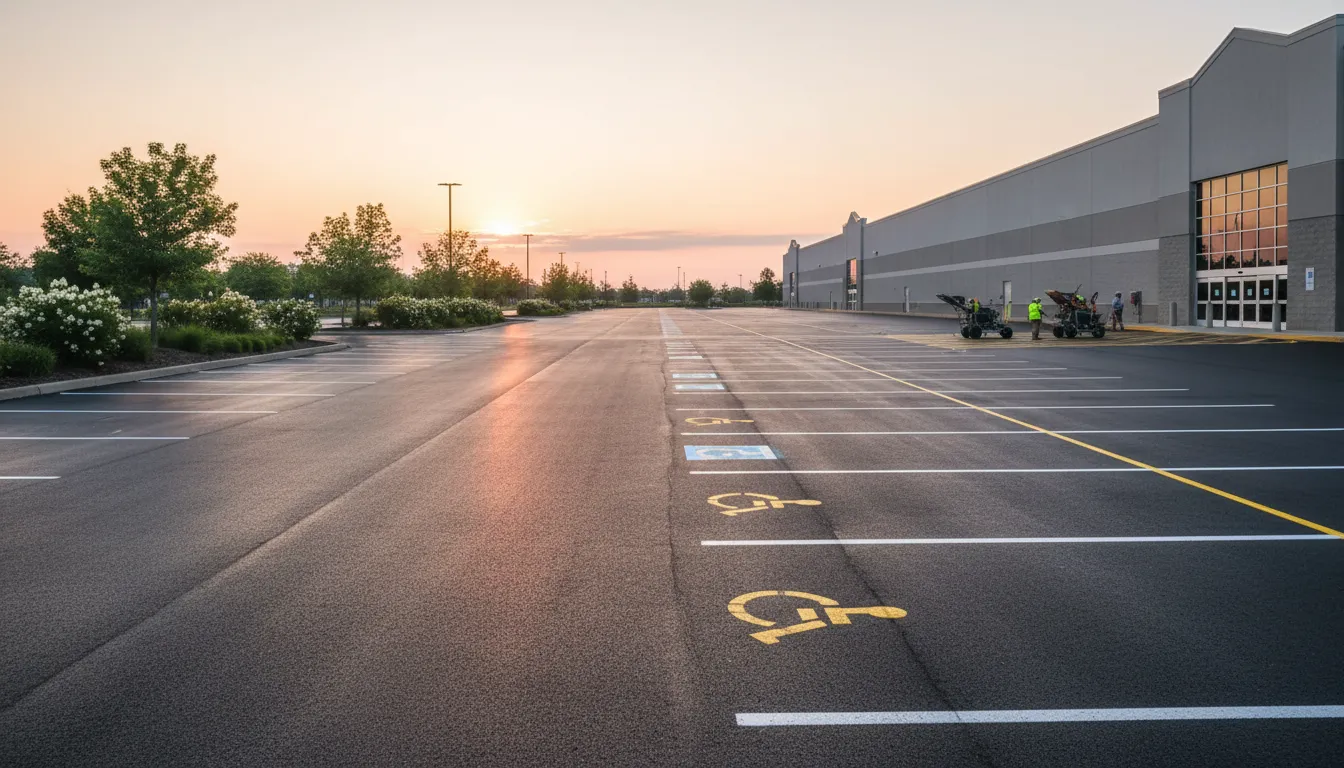
Find the Best Parking Lot Striping Companies for Your Business
No obligation • Fast responses • Nationwide coverage
Why you can trust Tidy Parking
Tidy Parking is a leading U.S. source for parking lot maintenance services, including striping, sealcoating, sweeping, paving, resurfacing, and repairs. Our content is created independently, and providers cannot pay to influence ratings or recommendations.
Search providers near you
Top Parking Lot Striping Companies in Oakland, California Ranked
Proper parking lot striping is far more than just painting lines on asphalt; it's a critical component of public safety, accessibility, and legal compliance for any property with a parking area. In Oakland, this task is governed by a complex web of state and local codes, including the California Building Code (CBC), California Fire Code (CFC), and specific Oakland Municipal Codes. Effective pavement marking ensures orderly traffic flow, designates accessible spaces for those with disabilities, and provides clear paths for emergency vehicles. This guide explains the key regulations and best practices for line striping in Oakland, helping property owners and managers understand their obligations and connect with qualified local professionals who can ensure their lots are safe, functional, and fully compliant.
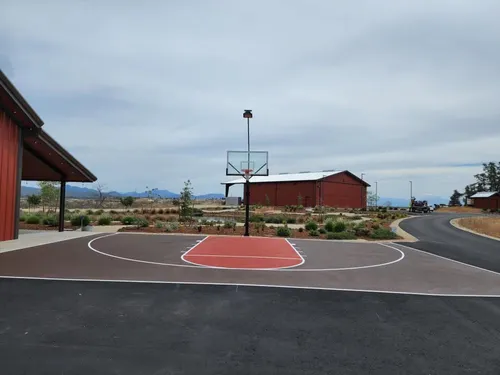
Progressive Asphalt Paving
San Jose, CA
Progressive Asphalt Paving is an asphalt contractor serving San Jose, CA, specializing in asphalt paving, patching, striping, sealcoating, and driveway installation. They provide services for residential, commercial, and municipal clients, using premium materials to ensure durable and long-lasting asphalt surfaces. Their expertise includes asphalt patching techniques that restore pavement strength and professional striping that meets regulatory standards. The company emphasizes tailored solutions and transparent pricing based on years of industry experience.
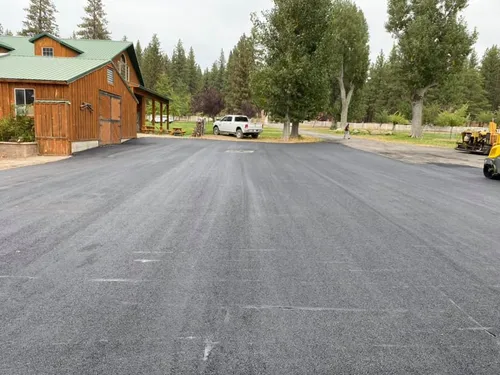
All Things Asphalt Inc
360 Portage Ave, Palo Alto, CA 94306
All Things Asphalt Inc is a locally owned asphalt contractor based in San Jose, CA, offering a full range of asphalt services including paving, patching, striping, sealcoating, and driveway installation. They serve both residential and commercial clients, providing durable and visually appealing asphalt surfaces tailored to the needs of the Palo Alto area. The company uses high-quality materials and advanced equipment to ensure long-lasting results and specializes in parking lot construction and repair with attention to grading and drainage. With years of industry experience, All Things Asphalt Inc focuses on delivering projects on schedule while maintaining quality standards.
A & A Paving
220 Solano Ave, Bay Point, CA 94565
A & A Paving is a parking lot paving and repair company based in Oakland, CA. They provide a range of asphalt services including parking lot striping, sealcoating, resurfacing, and reconstruction. Their work includes ADA-compliant accessible parking spaces and EV charging stall paving with clear striping. The company handles both routine maintenance and major repairs to improve safety and functionality. A & A Paving customizes solutions to meet specific project needs and emphasizes durability and affordability in their work.
El Camino General Engineering Inc
1212 Camellia Dr, Palo Alto, CA 94303
El Camino General Engineering Inc is a family-owned asphalt paving contractor based in San Jose, CA. They offer a range of services including parking lot striping, sealcoating, paving, resurfacing, and repair for residential, commercial, and municipal properties. Their team specializes in asphalt installation, maintenance, and ADA compliance improvements, using high-quality materials and equipment to ensure durable results. Founded by Israel, who brings over 30 years of local industry experience, the company also benefits from the civil engineering expertise of his son, Edgar. El Camino General Engineering provides innovative solutions tailored to client needs and operates with a focus on clear communication and project efficiency.
RF Sealcoating and Striping
Santa Rosa, CA
RF Sealcoating and Striping is a parking lot striping and sealcoating company based in Santa Rosa, CA. They offer services for commercial, residential, and HOA properties, including asphalt repairs, chipsealing, pothole repairs, asphalt paving, maintenance, sealcoating, and ADA-compliant striping. Their capabilities include crack filling using hot rubberized or cold pour applications to protect asphalt surfaces and extend pavement life.
Understanding Oakland's Regulatory Landscape
Before a single drop of paint is applied, it's essential to understand the regulatory framework. Parking lot marking in Oakland is not a matter of preference but of strict adherence to codified rules designed for universal safety. The primary governing documents are the California Building Code (CBC) Title 24 and the California Fire Code (CFC), which are then enforced and sometimes supplemented by local Oakland ordinances. These codes cover everything from the width of a parking stall to the specific color of a fire lane curb. Failure to comply can result in fines, liability issues, and, most importantly, create unsafe conditions for drivers and pedestrians. New laws, such as the statewide "daylighting" rule effective in 2025, continually update these requirements, making it crucial to work with contractors who are current on all changes.
ADA Accessible Parking Requirements
Creating accessible parking is a fundamental and non-negotiable aspect of lot layout. The requirements are precise and must be followed to the letter.
Quantity and Location: The number of required accessible spaces is based on the total number of parking spaces in the lot. For lots with 1 to 25 total spaces, one must be accessible. This scales up: 26-50 spaces require two, 51-75 require three, and 76-100 require four. For very large lots with over 500 spaces, 2% of the total must be accessible 1 2. Furthermore, at least one out of every six accessible spaces must be designated as "van-accessible" 1 3.
Dimensions and Layout: Standard accessible spaces require a 9-foot wide parking space adjacent to a 5-foot wide access aisle (for a total width of 14 feet), though some CBC interpretations allow for an 8-foot space with a 5-foot aisle. Van-accessible spaces are larger, requiring either a 12-foot wide space with a 5-foot aisle, or a 9-foot space with an 8-foot aisle (totaling 17 feet) 4. The access aisle must be a minimum of 60 inches (5 feet) wide, marked with diagonal hatched lines, and outlined in blue paint 5 4.
Markings and Signage: Each accessible space must have the International Symbol of Accessibility (ISA) painted on the pavement within the stall. This symbol must be 36 inches by 36 inches and painted in white on a blue background. Crucially, each space must also be accompanied by a permanent, non-obscured vertical sign positioned with the bottom at least 60 inches above the ground. This sign must display the ISA, and van-accessible spaces must include the text "Van Accessible" 6.
Fire Lane Marking Specifications
Fire lanes are vital for ensuring emergency vehicles can reach a building unimpeded. Their marking is strictly regulated by the fire code.
Curb and Roadway Markings: Where a curb exists, it must be painted OSHA Safety Red. On top of this red curb, the words "FIRE LANE - NO PARKING" must be stenciled in 3-inch high white letters. This stenciling must be repeated at intervals no greater than 30 feet along the entire length of the fire lane. If there is no curb, a 6-inch wide red stripe must be painted along the edge of the roadway, with the same "FIRE LANE - NO PARKING" legend applied on the pavement surface 7.
Signage and Clearance: In addition to pavement markings, reflective metal signs (typically 12" x 18") reading "NO STOPPING - FIRE LANE" must be posted. The spacing for these signs is often a maximum of 50 feet apart, or as specifically required by the local Fire Marshal 8 9. The fire lane itself must maintain a clear, unobstructed width of 20 to 26 feet to accommodate fire trucks, depending on the specific site plan approval 10.
Loading Zone and Passenger Zone Markings
Areas designated for commercial loading or passenger pick-up/drop-off have their own set of rules.
Commercial Loading Zones: These zones are typically marked by yellow-painted curbs. They are intended for the active loading and unloading of goods, and non-commercial vehicles are generally required to be attended by a driver 11 12. Businesses often need to apply for a permit to establish a commercial loading zone 11.
Accessible Passenger Loading Zones: When provided, an accessible passenger loading zone must be at least 20 feet long and 96 inches (8 feet) wide, adjacent to a 60-inch (5-foot) wide access aisle that is clearly marked 13 14. These zones facilitate safe boarding and alighting for individuals using mobility devices.
Find the perfect parking lot striping companies for your needs
Get personalized recommendations and expert advice
Crosswalks, Stop Bars, and Traffic Flow Markings
Managing pedestrian and vehicle interaction is a key safety function of parking lot striping.
Crosswalk Styles: Oakland has specific preferences for crosswalk markings. The city often uses the "triple four" style, which consists of 4-foot long white bars spaced 4 feet apart 15. Crosswalks must be positioned to align directly with pedestrian curb ramps for accessible pathways.
The Critical "Daylighting" Rule: A major new regulation taking effect statewide in 2025 is "daylighting." California Vehicle Code 22500(n) will prohibit parking within 20 feet of the approach side of any marked or unmarked crosswalk. The distance is reduced to 15 feet if a curb extension (bulb-out) is present 16 17. This rule is designed to improve pedestrian visibility and safety by eliminating parked cars that block sight lines at intersections. Property owners must ensure their lot striping and signage do not designate parking in these now-prohibited areas.
Other Flow Markings: Stop bars, directional arrows (like one-way indicators), yield triangles, and symbols for bicycles or pedestrians are all essential for controlling movement within a lot. These should be applied according to the Manual on Uniform Traffic Control Devices (MUTCD) standards for size, color, and placement.
Material Choices and Application Best Practices
The longevity and clarity of your markings depend heavily on the materials used and the skill of the application.
Paint vs. Thermoplastic: Standard traffic paint is a cost-effective option for many lots but requires more frequent re-application, often every 1-2 years for high-traffic areas. Thermoplastic is a more durable material that is heated and applied, melting into the asphalt to create a longer-lasting line. While more expensive upfront, it can be more economical over time due to its extended lifespan and better visibility.
Pre-Application Surface Prep: The most critical step for a successful job is proper surface preparation. The pavement must be thoroughly cleaned of all dirt, oil, grease, and debris. Existing faded lines should be removed or clearly marked over. For new paint to adhere properly, the surface should be completely dry.
Timing and Conditions: Striping should be scheduled during dry weather with moderate temperatures. Applying paint in very hot, very cold, or damp conditions can lead to premature failure, poor adhesion, or extended drying times that disrupt lot use.
Cost Considerations for Striping Projects
Budgeting for lot marking involves several variables. Costs are typically not quoted as a flat rate but are calculated based on the linear footage of lines, the number of specialized stencils (like ADA symbols), and the condition of the existing pavement.
For standard 4-inch wide lines, you can expect a range of $0.20 to $0.30 per linear foot for the painting work 18 19. Specialized elements cost more: applying a full ADA handicap stencil (including the symbol and blue background) can range from $150 to $300 per stall due to the detailed masking and multiple colors required 18. Fire lane stenciling, which involves red curb painting and white lettering, may cost approximately $5 to $10 per linear foot19.
Investing in regular maintenance striping is financially prudent. A well-timed refresh of markings every 1-2 years for high-traffic areas can prevent the need for a complete, costly lot re-paving project by protecting the underlying asphalt from unchecked wear and guiding traffic efficiently.
Maintaining Compliance Over Time
Regulations evolve, and pavement markings fade. Proactive maintenance is the key to ongoing compliance and safety.
Establish a Inspection Schedule: Property managers should visually inspect their parking lot markings at least twice a year, ideally during seasonal changes. Look for significant fading, cracking, or peeling of paint, and note any areas where traffic patterns have worn markings away prematurely.
Plan for Re-striping: Based on traffic volume and material used, develop a schedule for re-striping. High-traffic commercial lots may need annual touch-ups, while lower-use areas might be on a 2-3 year cycle. Always coordinate re-striping with a review of current local and state codes to ensure any new requirements (like daylighting) are incorporated.
Documentation: Keep records of all striping work, including dates, contractors used, and the specific codes or standards followed. This documentation can be valuable for liability purposes and for demonstrating due diligence during property inspections by city or ADA compliance officials.
Disclaimer: It is important to note that regulations are subject to change, and specific site conditions may alter requirements. This guide provides a general overview, but it is strongly recommended to consult with a local Oakland-certified parking lot striping contractor or the City of Oakland's Building Department to confirm the current, exact requirements for your specific property before beginning any project 20.
Frequently asked questions
Sources
Footnotes
-
California ADA Parking Requirements 2025 Guide - ADA Striping - https://ada-striping.com/ada-parking-requirements/ ↩ ↩2
-
Parking Code Regulations California Building Code (CBC) Title 24 ... - https://www.dgs.ca.gov/-/media/Divisions/CCDA/Tabs/Meetings/Meetings-Before-2023/Checklist-Committee-Meetings/Checklist-Committee-Meetings-2020/Item-7A---Parking-Code-Regulations-Accessible.pdf ↩
-
California's ADA Parking Lot Requirements - https://earthtekpaving.com/californias-ada-parking-lot-requirements/ ↩
-
ADA Compliance Guide for Parking Lot Line Striping - https://www.pavementsolutions.org/ada-compliance-guide-for-parking-lot-line-striping/ ↩ ↩2
-
Parking Lot Striping & ADA Compliance: What to Know - https://brixco.co/parking-lot-striping-ada-compliance/ ↩
-
ADA Compliance for California Parking Lots: A Simple Guide ... - https://theasphaltjungle.com/blog/ada-parking-lot-requirements-california/ ↩
-
PL 07-03: Fire Department, Emergency Access Roadways and School Drop Off Areas - https://www.dgs.ca.gov/-/media/Divisions/DSA/Publications/policies/PL_07-03.pdf ↩
-
Fire Lane Marking - https://www.sccfd.org/wp-content/uploads/2024/08/A-6-Fire-Lane-Marketing-07.01.2020.pdf ↩
-
Parking Lot Striping Standards: Dimensions, Colors, and ADA Rules - https://www.getonecrew.com/post/parking-lot-striping-standards ↩
-
Fire Lane Requirements - https://northcountyfire.gov/wp-content/uploads/2021/10/FIRE-LANE-INFORMATION-SHEET-Revised-5-3-18.pdf ↩
-
Apply for a Commercial Vehicle Loading Zone Permit - https://www.oaklandca.gov/Public-Safety-Streets/Transportation-Permits-Engineering/Apply-for-a-Commercial-Vehicle-Loading-Zone-Permit ↩ ↩2
-
Section 6: Navigating the Roads (Continued) - California DMV - https://www.dmv.ca.gov/portal/handbook/california-driver-handbook/navigating-the-roads-cont1/ ↩
-
Passenger Loading Zones - Access Board - https://www.access-board.gov/files/ada/guides/plz.pdf ↩
-
City of Avalon, CA Establishment of Loading, Parking, and Standing Zones: Curb Markings - https://ecode360.com/35893512 ↩
-
triple four - City of Oakland - https://www.oaklandca.gov/files/assets/city/v/1/transportation/documents/transportation-permits-amp-engineering/oakdot-design-details-for-transportation-facilities/rm-4b_triple4crosswalkdetail.pdf ↩
-
Daylighting | City of Oakland, CA - https://www.oaklandca.gov/Public-Safety-Streets/Parking-Vehicles/Daylighting ↩
-
Daylighting - SFMTA - https://www.sfmta.com/getting-around/walk/pedestrian-improvements-toolkit/daylighting ↩
-
Parking Lot Striping: Everything You Need To Know - https://www.calvacpaving.com/parking-lot-striping-need-to-know/ ↩ ↩2
-
CDA C454-20140826112552 - https://www.morganhill.ca.gov/DocumentCenter/View/13845 ↩ ↩2
-
A Guide to Accessible Parking for the Construction Industry - https://www.dgs.ca.gov/-/media/Divisions/CCDA/Tabs/Resources-Page/Documents/2024/CCDA-Guide-to-Accessible-Parking-APC-Construction-Industry-2024.pdf ↩