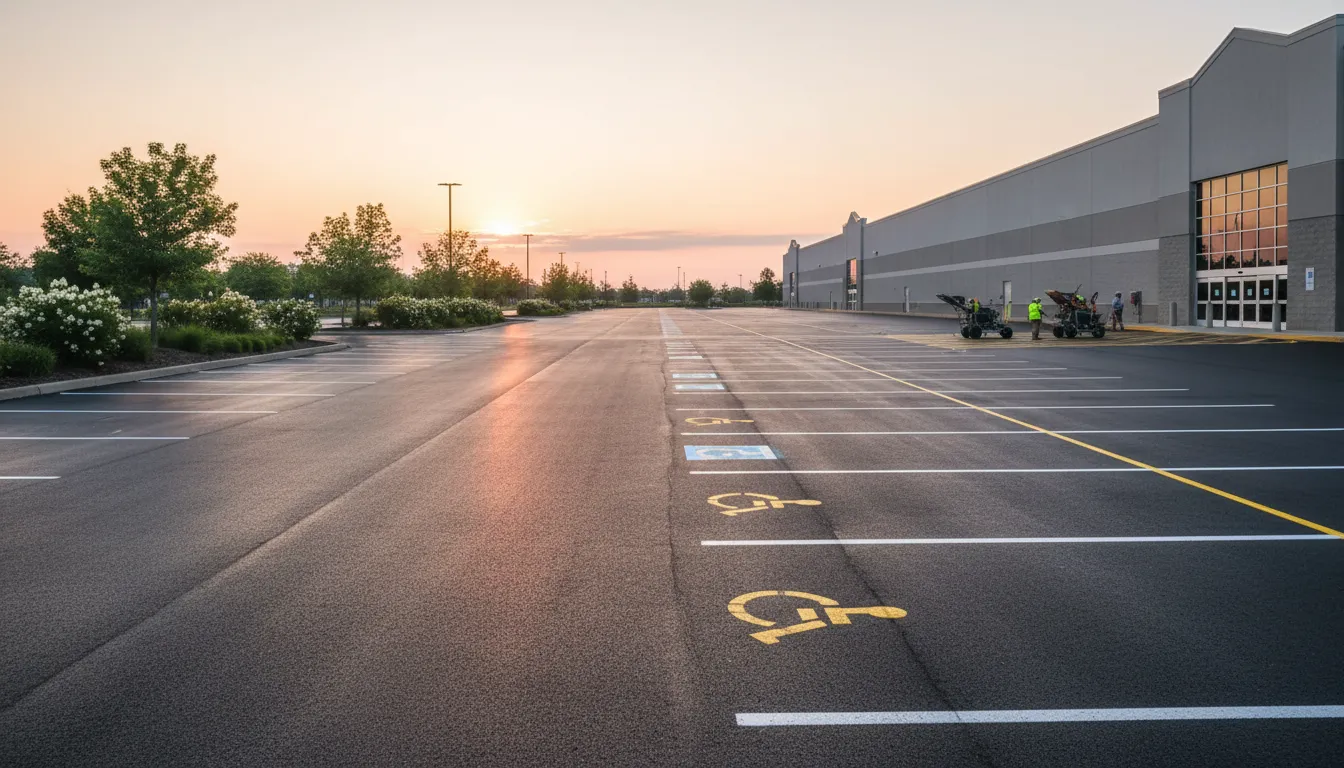
Find the Best Parking Lot Striping Companies for Your Business
No obligation • Fast responses • Nationwide coverage
Why you can trust Tidy Parking
Tidy Parking is a leading U.S. source for parking lot maintenance services, including striping, sealcoating, sweeping, paving, resurfacing, and repairs. Our content is created independently, and providers cannot pay to influence ratings or recommendations.
Search providers near you
Top Parking Lot Striping Companies in Newport Beach, California Ranked
Clear, compliant parking lot striping is a critical investment for any Newport Beach property. It's more than just paint on pavement; it's a system of visual communication that organizes traffic, maximizes space, and ensures safety for all users. Most importantly, proper line striping is a legal requirement, with strict regulations from the state of California and the City of Newport Beach governing everything from accessible parking to fire lane markings. Non-compliance can result in significant fines, starting at $4,000 per violation. This guide will help you understand the specific requirements for parking lot marking in Newport Beach, so you can ensure your property is safe, functional, and legally sound.
Alliance Paving Inc.
2201 E Winston Rd E, Anaheim, CA 92806
Alliance Paving Inc. is a paving and maintenance company based in Los Angeles, CA, serving Orange, Los Angeles, Riverside, San Bernardino, and San Diego counties. They specialize in commercial parking lot services including asphalt repair, sealcoating, striping, and complete pavement replacements. With over 20 years of experience, Alliance Paving focuses on extending pavement life through regular maintenance and offers coordinated project management to minimize business interruptions.
City Service Asphalt
769 Beverly Rd, Corona, CA 92879
City Service Asphalt is a family-owned paving company serving Los Angeles, CA, and Southern California with over 25 years of experience. They provide commercial and residential asphalt and concrete paving services, including parking lot striping, sealcoating, resurfacing, crack sealing, and ADA-compliant access improvements. The company handles projects of all sizes, from small repairs to large-scale commercial parking lots, using commercial-grade materials and in-house crews to ensure quality and durability. City Service Asphalt also offers asphalt overlay and removal services to restore and maintain pavement surfaces effectively. Their operations cover a broad range of clients, including retail centers, multifamily units, schools, and public works.
G-FORCE Parking Lot Striping of SoCal
Los Angeles, CA
G-FORCE Parking Lot Striping of SoCal is a veteran-owned company based in Los Angeles, CA, specializing in parking lot striping and pavement marking services. They serve Southern California with a range of services including parking lot line painting, warehouse floor markings, parking lot sign installation, athletic field markings, and ADA parking compliance. Using Sherwin-Williams premium traffic paints and advanced striping equipment, they aim to deliver durable and precise markings. The owner, Mary Morrison, brings a military background and over 20 years of experience to the business, which emphasizes quality, safety, and customer satisfaction.
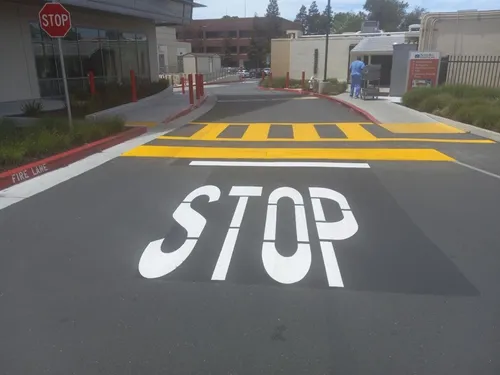
Alpha Asphalt
Stockton, CA
Alpha Asphalt is a full-service asphalt contractor based in Stockton, CA, specializing in parking lot paving, striping, sealcoating, and repair for both commercial and residential clients. They provide durable asphalt surfaces, precise striping, and protective sealcoating to enhance and maintain pavement quality. The company is known for using industry-grade materials and advanced equipment to deliver long-lasting results. Alpha Asphalt is a family-run business with a focus on clear communication and dependable scheduling.
Bay Cities Paving Inc
931 Mahar Avenue, 1314 North Avalon Boulevard Ste A, Wilmington, CA 90744
Bay Cities Paving Inc is a family-owned asphalt and concrete contractor serving Los Angeles, CA, with over 40 years of experience. They provide a range of services including parking lot paving, resurfacing, sealcoating, striping, and repair for commercial, industrial, and residential properties. The company handles projects from shopping malls and restaurants to single-family driveways, applying expert techniques and quality materials to ensure durable results. Established in 1984, Bay Cities Paving also offers sign installation services and educational seminars for property managers to address safety concerns.
Understanding Newport Beach and California Striping Regulations
Parking lot line painting in California is governed by a layered set of codes. At the state level, the California Building Code (CBC) Title 24, Part 2, and the federal Americans with Disabilities Act (ADA) Standards set the baseline for accessibility and safety1. Locally, the Newport Beach Municipal Code (NBMC) adds specific rules for elements like loading zones and fire lane enforcement1. A professional pavement marking contractor familiar with these overlapping jurisdictions is essential, as failing to adhere to any of them can lead to costly penalties and liability issues.
Accessible Parking Space Requirements (ADA Compliance)
ADA-compliant stall marking is non-negotiable. The dimensions and markings for accessible spaces are precise and designed for universal access.
- Stall Dimensions: A standard accessible parking space must be at least 9 feet (108 inches) wide. A van-accessible space must be at least 8 feet (96 inches) wide.
- Access Aisles: Each accessible space must have an adjacent access aisle. For standard spaces, this aisle must be at least 5 feet (60 inches) wide. For van-accessible spaces, the aisle must be a minimum of 8 feet (96 inches) wide2. This aisle must be marked with diagonal hatch lines, typically in blue or yellow, to indicate it is a no-parking zone for vehicles.
- Pavement Symbol: The International Symbol of Accessibility (ISA), measuring at least 36 inches by 36 inches, must be painted on the ground within each accessible stall3.
- Signage: Each accessible space must be identified by a vertical sign featuring the ISA. This sign must be mounted at least 60 inches above the ground to the bottom of the sign4. Van-accessible spaces require an additional "Van Accessible" plaque on the sign.
- Quantity and Ratio: The required number of accessible spaces depends on your lot's total capacity. A key rule is that one out of every six accessible spaces must be van-accessible5.
Fire Lane Marking Specifications
Fire lane striping is crucial for emergency access. Newport Beach regulations are strict to ensure fire apparatus can reach any part of a building unimpeded.
- Curb Painting: All curbs within a designated fire lane must be painted red.
- Stenciling: The words "FIRE LANE - NO PARKING" must be stenciled in white letters (with a minimum 3-inch height) on the top or face of the red curb. This stenciling must be repeated at intervals not exceeding 30 feet6.
- Signage: Posted "NO STOPPING - FIRE LANE 22500.1 CVC" signs are required in addition to the curb markings7.
- Width: The fire lane or fire access road itself must maintain an unobstructed width of at least 20 to 26 feet8.
Loading Zone and Crosswalk Markings
Proper traffic paint for commercial and passenger zones keeps logistics flowing and pedestrians safe.
- Commercial Loading Zones: These are indicated by a yellow paint line on the curb with black-stenciled letters reading "LOADING ONLY". The NBMC generally limits stopping for loading/unloading materials to 20 minutes.
- Passenger Loading Zones: Designated by a white paint line on the curb with black-stenciled letters for "PASSENGER LOADING ONLY"9. Stopping is typically limited to 3 minutes for passenger pick-up/drop-off9.
- Crosswalks: For pedestrian safety, crosswalk stripes should be 12 to 24 inches wide. The overall crosswalk width typically ranges from 8 to 20 feet, depending on anticipated foot traffic volume10. High-visibility thermoplastic is often recommended for these critical safety markings.
Find the perfect parking lot striping companies for your needs
Get personalized recommendations and expert advice
Practical Application: From Layout to Longevity
Knowing the rules is one thing; applying them correctly to your pavement is another. A well-executed parking lot layout and striping project involves careful planning, material selection, and maintenance.
Designing an Efficient and Compliant Layout
Before any paint is applied, a proper layout is drafted. This plan accounts for the total number of standard and compact car stalls, the correct number and placement of ADA stalls (including the van-accessible ratio), the flow of traffic with clearly marked directional arrows, and the location of fire lanes, loading zones, and crosswalks. The goal is to maximize parking capacity while ensuring all code-mandated clearances and dimensions are met. For example, a properly configured van-accessible space will encompass a 9-foot wide stall plus an 8-foot wide diagonally striped blue aisle, totaling 17 feet of dedicated width11.
Material Choices: Paint vs. Thermoplastic
The longevity and visibility of your lot markings depend heavily on the material used.
- Water-Based Traffic Paint: This is the most common and cost-effective material for general stall and line striping. A basic restriping job for standard car stalls typically costs between $20 and $40 per stall, or $2 to $5 per linear foot. However, paint wears relatively quickly, especially in high-traffic areas, and may need reapplication every 1-2 years.
- Thermoplastic: This is a premium material where plastic granules are heated and applied to the pavement. It is much more durable than paint, lasting 5 to 7 years or more, and offers superior reflectivity at night12. While the upfront cost is higher, it is highly recommended for high-wear areas like stop bars, crosswalks, fire lane lettering, and directional arrows where longevity and maximum visibility are critical.
Cost Considerations for Specific Services
Understanding potential costs helps in budgeting for your pavement marking project.
- General Restriping (Paint): As noted, costs are often estimated per linear foot ($2-$5) or per standard stall ($20-$40)13.
- ADA Stall Package: Restriping a single ADA-compliant stall and its adjacent access aisle, including the ISA pavement symbol, is a more detailed task. This can cost between $100 and $300 per stall, depending on the condition of the existing pavement and the complexity of the symbol painting14.
- Fire Lane Marking: Painting and stenciling a fire lane on a curb typically ranges from $3 to $6 per linear foot15.
- Thermoplastic Application: Given its durability, thermoplastic has a higher initial cost but a lower long-term cost-per-year. It is an ideal investment for critical safety markings.
Maintaining Compliance and Safety
Parking lot maintenance doesn't end after the striping dries. Faded markings are a liability-they confuse drivers, create safety hazards, and can lead to non-compliance citations.
The Importance of Regular Re-striping
Over time, sun exposure, weather, and tire friction will cause even the most durable markings to fade. Regularly scheduled re-striping is not just about aesthetics; it's a core part of property risk management. Faded crosswalks or stop lines can contribute to accidents, while faded ADA symbols or aisle markings can result in an ADA lawsuit. A proactive maintenance schedule, often involving touch-ups or full re-striping every 1-3 years for paint, protects your investment and keeps your lot safe and lawful16.
Partnering with a Knowledgeable Local Contractor
The complexities of CBC, ADA, and NBMC regulations make it imperative to work with a professional parking lot striping service that has proven experience in Newport Beach. A qualified contractor will:
- Conduct a site assessment to identify all compliance needs.
- Provide a layout that meets all dimensional and quantity requirements.
- Use the correct materials (paint colors, thermoplastic) as specified by code.
- Ensure all markings-from diagonal hatch lines in access aisles to "FIRE LANE" stencils-are applied to the exact letter of the law17.
Disclaimer: Regulations are subject to change. The information provided here is a guide. Always verify current requirements with the City of Newport Beach Building Division or a licensed California striping contractor before beginning any parking lot marking project18.
Frequently asked questions
Sources
Footnotes
-
Chapter 12.48 LOADING AND UNLOADING - General Code - https://www.codepublishing.com/CA/NewportBeach/html/NewportBeach12/NewportBeach1248.html ↩ ↩2
-
Parking Code Regulations California Building Code (CBC) Title 24 Part 2 - https://www.dgs.ca.gov/-/media/Divisions/CCDA/Tabs/Meetings/Meetings-Before-2023/Checklist-Committee-Meetings/Checklist-Committee-Meetings-2020/Item-7A---Parking-Code-Regulations-Accessible.pdf ↩
-
ADA Compliance Brief: Restriping Parking Spaces - https://www.ada.gov/resources/restriping-parking-spaces/ ↩
-
Accessible Parking Spaces | ADA.gov - https://www.ada.gov/topics/parking/ ↩
-
California ADA Parking Requirements 2025 Guide - ADA Striping - https://ada-striping.com/ada-parking-requirements/ ↩
-
Fire Lane Marking - https://www.sccfd.org/wp-content/uploads/2024/08/A-6-Fire-Lane-Marketing-07.01.2020.pdf ↩
-
965 - Parking Regulations - City of Newport Beach - https://ecms.newportbeachca.gov/WEB/DocView.aspx?id=34635&dbid=0&repo=CNB ↩
-
Fire Lane Requirements - https://northcountyfire.gov/wp-content/uploads/2021/10/FIRE-LANE-INFORMATION-SHEET-Revised-5-3-18.pdf ↩
-
Chapter 12.48 LOADING AND UNLOADING - General Code - https://www.codepublishing.com/CA/NewportBeach/html/NewportBeach12/NewportBeach1248.html ↩ ↩2
-
Parking Lot Striping Standards: Best Practices for Busy Lots - https://www.themonrazcompany.com/parking-lot-striping-standards ↩
-
Complete Parking Lot Striping Guide 2025 - ADA Striping - https://ada-striping.com/complete-parking-lot-striping-guide/ ↩
-
How to Keep Your Parking Lot ADA Compliant by Fire Lane Striping - https://asphaltcareservices.com/parking-lot-ada-compliant-with-fire-lane/ ↩
-
Parking Lot Striping Best Practices: Tips For Optimal Visibility And ... - https://wedolines.com/parking-lot-striping-best-practices-tips-for-optimal-visibility-and-safety/ ↩
-
Complete Guide to Parking Lot Striping in California - https://bowmanparkinglotstriping.com/complete-guide-to-parking-lot-striping-in-california/ ↩
-
Parking Lot Striping & ADA Compliance: What to Know - https://brixco.co/parking-lot-striping-ada-compliance/ ↩
-
Manage Parking Lot Traffic Paint, Signage, and Compliance - https://www.enrightasphalt.com/manage-parking-lot-traffic-paint-signage-compliance/ ↩
-
Parking Lot Striping Standards: Dimensions, Colors, and ADA Rules - https://www.getonecrew.com/post/parking-lot-striping-standards ↩
-
ADA Parking And Parking Lots Attorneys - https://www.karlinlaw.com/ada-accessibility-law/ada-parking-and-parking-lots/ ↩