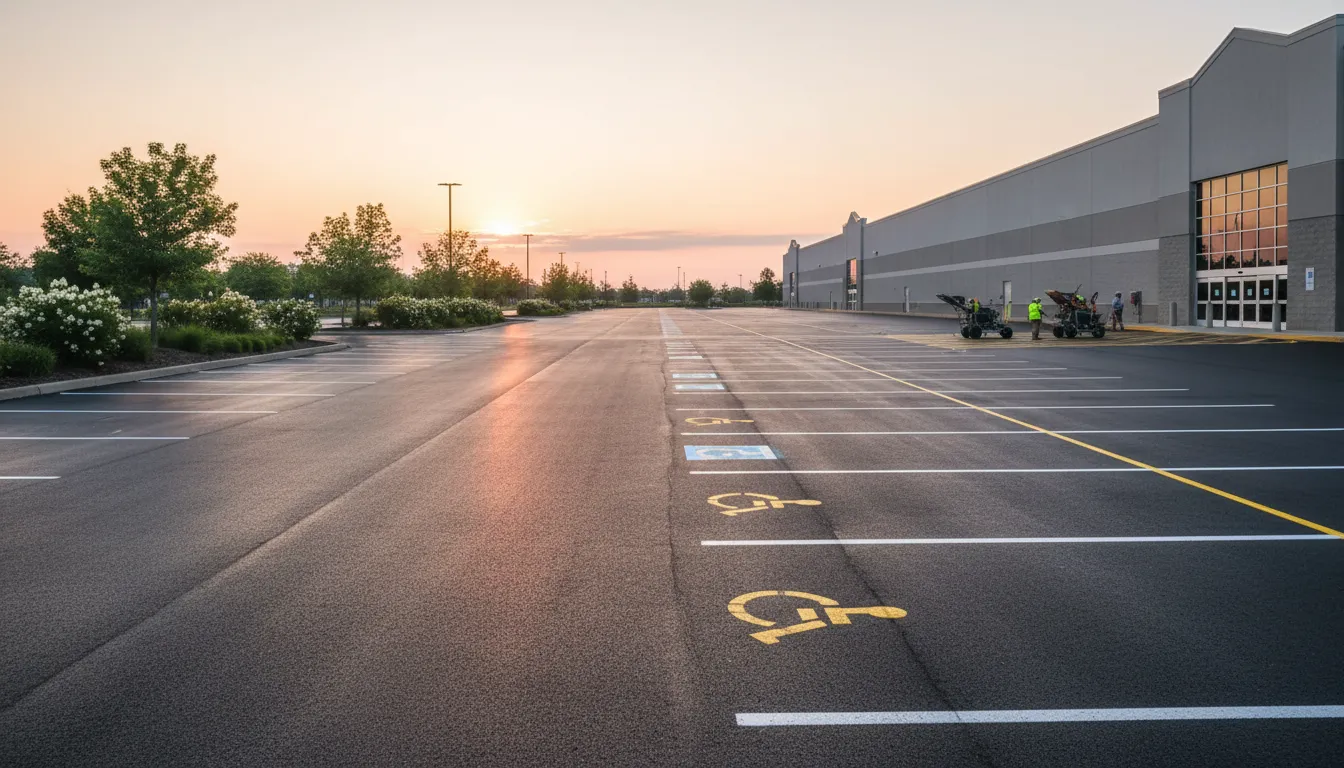
Find the Best Parking Lot Striping Companies for Your Business
No obligation • Fast responses • Nationwide coverage
Why you can trust Tidy Parking
Tidy Parking is a leading U.S. source for parking lot maintenance services, including striping, sealcoating, sweeping, paving, resurfacing, and repairs. Our content is created independently, and providers cannot pay to influence ratings or recommendations.
Search providers near you
Top Parking Lot Striping Companies in Highland, California Ranked
Proper parking lot striping is far more than just painting lines on asphalt. In Highland, California, it is a critical safety and legal requirement that organizes traffic flow, maximizes space, and ensures accessibility for all. This pavement marking work must comply with a complex web of state and local regulations, including the California Building Code (CBC), the California Vehicle Code (CVC), and specific City of Highland standards. For business and property owners, understanding these requirements is essential to avoid significant fines, which can start at $4,000 per violation in California. This guide explains the key regulations, dimensions, and practical steps for maintaining compliant line striping and pavement markings on your Highland property.
HKY Asphalt Paving of San Bernardino
Riverside, CA
HKY Asphalt Paving of San Bernardino is a paving contractor based in Riverside, CA, offering services including parking lot striping, sealcoating, paving, resurfacing, and repair. They serve residential and commercial clients across San Bernardino, handling everything from small driveways to large parking lots and road construction projects. The company emphasizes proper base preparation and uses commercial-grade materials to ensure durability in local soil and weather conditions. With over 30 years of experience, they also provide demolition and speed bump installation services, managing permits and debris removal as part of their comprehensive approach.
HKY Asphalt Paving
Anaheim, CA
HKY Asphalt Paving is a paving contractor based in Anaheim, CA, serving Riverside and nearby communities. They provide a range of services including asphalt paving, sealcoating, parking lot striping, resurfacing, and repair for residential and commercial properties. The company emphasizes thorough base preparation and proper grading to ensure durable surfaces that withstand local weather conditions. They also offer milling to remove damaged pavement, installation of speed bumps, and full demolition services for site preparation. With over 30 years of experience in the Riverside area, HKY Asphalt Paving has developed local knowledge to address soil and drainage challenges effectively.
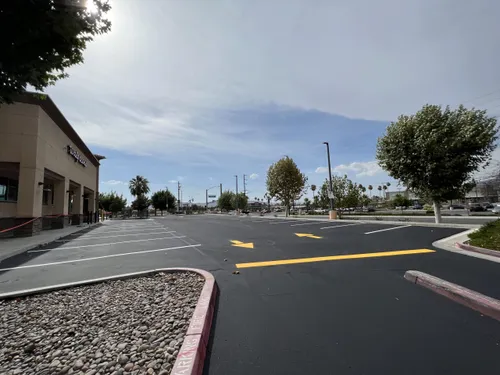
City Service Asphalt
769 Beverly Rd, Corona, CA 92879
City Service Asphalt is a family-owned paving company serving Los Angeles, CA, and Southern California with over 25 years of experience. They provide commercial and residential asphalt and concrete paving services, including parking lot striping, sealcoating, resurfacing, crack sealing, and ADA-compliant access improvements. The company handles projects of all sizes, from small repairs to large-scale commercial parking lots, using commercial-grade materials and in-house crews to ensure quality and durability. City Service Asphalt also offers asphalt overlay and removal services to restore and maintain pavement surfaces effectively. Their operations cover a broad range of clients, including retail centers, multifamily units, schools, and public works.
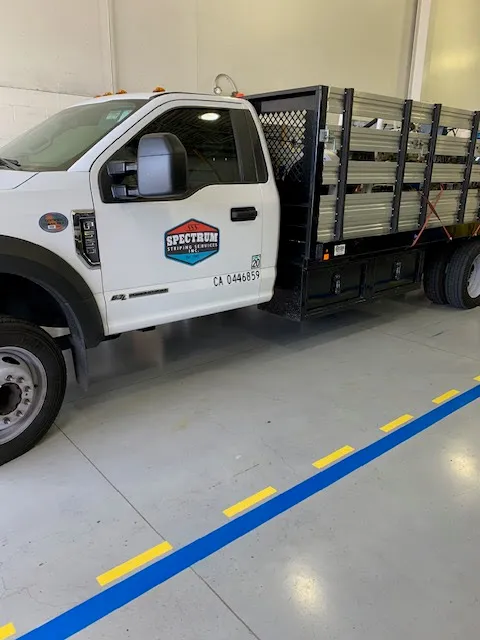
Spectrum Striping
1328 N Benson Ave, Upland, CA 91786
Spectrum Striping is a parking lot striping company based in Los Angeles, CA, serving Los Angeles and surrounding counties including San Bernardino, Riverside, and Orange. They provide a variety of pavement marking services such as parking lot striping, playground striping, warehouse floor striping, and curb striping. Established in 1992, Spectrum Striping has over 30 years of experience in the pavement marking industry. Their work includes clear, precise line striping to improve safety and organization in parking lots and other facilities.
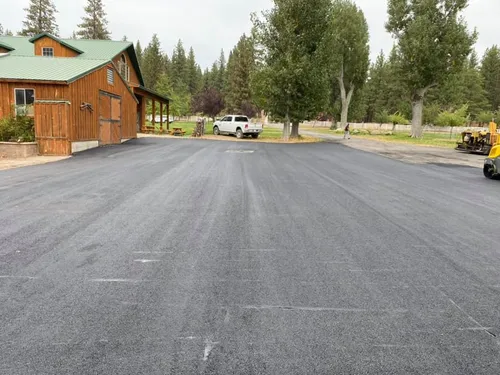
Majestic Asphalt
340 Village Rd, Menifee, CA 92584
Majestic Asphalt is a licensed and insured asphalt contractor based in Los Angeles, CA. They offer a range of services including asphalt paving, patching, sealcoating, striping, and driveway installation for residential and commercial clients. Known for using high-grade materials and proven methods, Majestic Asphalt focuses on durable results and quality craftsmanship. The company serves the Los Angeles area and is recognized for its reliable asphalt repair and maintenance work. With years of experience, they provide expert asphalt solutions designed to enhance curb appeal and extend pavement life.
Understanding the Regulatory Landscape in Highland
Parking lot marking in Highland is governed by overlapping authorities. The California Building Code (Title 24) sets the foundational standards for accessible design, including requirements for handicapped parking spaces. The California Vehicle Code dictates rules for fire lanes and traffic control. Finally, local standards from the City of Highland and the San Bernardino County Fire Protection District provide specific instructions for curb colors, lettering, and sign placement. Non-compliance isn't just a code violation; it exposes property owners to lawsuits under the Americans with Disabilities Act (ADA) and can create serious safety hazards by blocking emergency access or confusing drivers.
ADA-Compliant Accessible Parking: A Detailed Breakdown
Creating accessible parking spaces is one of the most regulated aspects of lot striping. The requirements are precise and non-negotiable.
Space Dimensions and Layout:
- Standard Accessible Spaces: Must be at least 9 feet (108 inches) wide 1.
- Van-Accessible Spaces: Must be at least 12 feet (144 inches) wide. For every six accessible spaces (or fraction thereof), at least one must be van-accessible.
- Access Aisles: Each space requires an adjacent access aisle for wheelchair deployment. Standard spaces need a 5-foot (60-inch) aisle, while van spaces require an 8-foot (96-inch) aisle. This aisle must be marked with diagonal blue or white stripes and should feature a blue border 2.
- "No Parking" Markings: The words "NO PARKING" must be painted in white letters at least 12 inches high within the access aisle, typically toward the rear 3.
- Surface Symbol: The International Symbol of Accessibility (a white wheelchair symbol on a blue background) must be painted on the pavement within each space.
Signage and Location Requirements:
- Vertical Signage: Each accessible space must have a posted sign mounted at least 60 inches (5 feet) above the ground. The sign must display the ISA symbol and the text "Minimum Fine $250" 4 5.
- Path of Travel: Accessible spaces must be located on the shortest accessible route to an accessible building entrance, with a maximum slope of 2% in all directions 6 7.
For a typical 100-space retail lot in Highland, this means providing a minimum of 4 accessible spaces, with at least 1 being van-accessible. The compliance action involves repainting to the correct widths, adding the striped access aisles with "No Parking" stencils, installing the proper fine signage, and ensuring the route to the entrance is unobstructed 8 9.
Fire Lane Marking and Striping Regulations
Clearly marked fire lanes are crucial for emergency responder access. The San Bernardino County Fire Protection District provides explicit standards for their designation and marking.
Curb and Roadway Markings:
- Color: Fire lane curbs must be painted solid red 10.
- Lettering: White lettering, at least 6 inches high, must be stenciled on the curb reading "NO PARKING - FIRE LANE - CVC 22500.1." This text must be repeated at intervals not exceeding 30 feet 11.
- Where No Curb Exists: If there is no curb, the lane must be outlined with 8-inch wide red stripes on the pavement. The words "FIRE LANE" must be stenciled in white on the pavement in letters at least 24 inches high 12.
Required Signage: Metal signs (typically 12x18 inches) with red letters on a white background must be posted. They must state "NO PARKING - FIRE LANE - CVC 22500.1" and be spaced no more than 50 feet apart 13. For a commercial property's frontage, this means painting all relevant curbs red and installing the required signs and stenciling.
Loading Zone and Crosswalk Markings
Properly designated zones for loading and passenger drop-off improve traffic flow and safety.
- Commercial Loading Zones: Are designated by painting the entire curb face yellow. The words "Loading Only" should be stenciled in black on the curb.
- Passenger Loading Zones: Are marked by painting the entire curb face white. The words "Passenger Loading Only" should be stenciled in black on the curb 14.
- Lettering Standards: All lettering on curbs for these zones must be at least 4 inches in height 15.
For crosswalks and other traffic control pavement markings, contractors must follow the California Manual on Uniform Traffic Control Devices (CA MUTCD) and City of Highland standards. To ensure durability and visibility, especially in high-traffic areas, two coats of quality traffic paint or more durable thermoplastic are often required.
Find the perfect parking lot striping companies for your needs
Get personalized recommendations and expert advice
Material and Application Best Practices
Choosing the right materials and application methods ensures your pavement markings last and remain compliant.
- Paint vs. Thermoplastic: Standard traffic paint is cost-effective for most lots but requires more frequent re-striping. Thermoplastic is a melted plastic material that is far more durable and reflective, making it ideal for high-traffic areas, crosswalks, and symbols that see a lot of wear 16.
- Visibility and Reflectivity: Especially for safety-critical markings like stop bars, crosswalks, and arrows, using reflective glass beads mixed into the paint or applied on top is essential for nighttime and bad-weather visibility.
- Proper Surface Preparation: The asphalt or concrete surface must be clean, dry, and free of oil, dirt, and loose debris for paint to properly adhere. For older lots, crack sealing and sealcoating may need to be done before re-striping to ensure a smooth, long-lasting result.
- Stenciling Precision: For ADA symbols, fire lane lettering, and handicap aisle markings, using metal or plastic stencils is necessary to achieve the crisp, regulation-sized letters and symbols required by code.
Cost Considerations for Striping Projects in Highland
The cost for parking lot line striping and marking varies based on the scope, materials, and level of compliance work needed. Here are some general estimates based on industry data:
- ADA Stall (Full Compliance): $300 - $600 per space. This comprehensive cost typically includes painting the stall and blue access aisle, stenciling the ISA symbol and "No Parking" text, and installing the required vertical signage.
- Standard Stall Line (Per Foot): $5 - $10 for repainting standard parking space lines.
- Red Curb Painting (Per Foot): $3 - $7.
- Fire Lane Stenciling: $50 - $100 per 30-foot section.
- Small Lot Restriping (20-30 spaces): $1,500 - $3,500 for a basic refresh of standard lines.
- Full Compliance Retrofit (Large Lot): Costs can easily exceed $10,000, particularly if the project requires significant asphalt repair, reconfiguration of spaces, or the installation of numerous new signs and accessible route upgrades 17 18.
The most significant financial risk, however, is not the cost of compliance but the cost of non-compliance. As noted, California fines for ADA violations can be steep, and a single lawsuit can far outweigh the investment in proper, professional striping 19.
Maintaining Your Parking Lot Markings
Regular maintenance is key to ongoing compliance and safety.
- Annual Inspection: At least once a year, walk your property and assess the condition of all markings. Look for fading, chipping, or wear, especially in high-traffic areas.
- Prompt Repainting: Don't wait for markings to become illegible. Schedule touch-ups or re-striping when visibility begins to diminish. A good rule of thumb is to restripe every 1-2 years, depending on traffic volume and sun exposure.
- Post-Sealcoating: If you sealcoat your asphalt, you must restripe the entire lot immediately afterward, as the sealcoat will cover all existing markings.
- Documentation: Keep records of all striping work, including dates, contractor information, and notes on compliance features. This can be valuable if ever questioned about your property's adherence to codes.
Frequently asked questions
Sources
Footnotes
-
ADA Compliance Brief: Restriping Parking Spaces - https://www.ada.gov/resources/restriping-parking-spaces/ ↩
-
ADA Parking And Parking Lots Attorneys - Karlin Law Firm LLP - https://www.karlinlaw.com/ada-accessibility-law/ada-parking-and-parking-lots/ ↩
-
2025 Los Angeles ADA Parking Guide for Business Owners - https://ada-striping.com/los-angeles-business-owners-guide-for-handicapped-parking-regulations/ ↩
-
ADA Compliance Guide for Parking Lot Line Striping - https://www.pavementsolutions.org/ada-compliance-guide-for-parking-lot-line-striping/ ↩
-
11.0 SIGNAGE - Highland, CA - https://www.highlandca.gov/DocumentCenter/View/241/110---Signage-PDF ↩
-
The Best Guide to ADA Handicap Parking Requirements for ... - https://coastalpipelineinc.com/the-best-guide-to-ada-handicap-parking-requirements-for-california-properties/ ↩
-
Untitled - https://www.washco-md.net/wp-content/uploads/ReviewofSPComplianceCriteriaforADAAccessability.pdf ↩
-
Parking Lot Striping & ADA Compliance: What to Know - https://brixco.co/parking-lot-striping-ada-compliance/ ↩
-
Texas Law About Parking Lot Striping - https://underwaycs.com/parking-lots/texas-law-about-parking-lot-striping/ ↩
-
Fire Lane Striping: Guide to Safety, Compliance & Regulations - https://everlinecoatings.com/us/fire-lane-striping-guide-to-safety-compliance-regulations/ ↩
-
CDA C454-20140826112552 - https://www.morganhill.ca.gov/DocumentCenter/View/13845 ↩
-
Fire Lane Marking - https://www.sccfd.org/wp-content/uploads/2024/08/A-6-Fire-Lane-Marketing-07.01.2020.pdf ↩
-
California ADA Parking Requirements 2025 Guide - ADA Striping - https://ada-striping.com/ada-parking-requirements/ ↩
-
Establishment of Loading, Parking, and Standing Zones: Curb ... - https://ecode360.com/35893512 ↩
-
A - 2 - San Bernardino County Fire Protection District - https://sbcfire.org/wp-content/uploads/sites/46/2023/08/SBCOFPD-STANDARD-A-2-FIRE-APPARATUS-ACCESS-ROAD-DESIGNATION-AND-MARKING-7.1.23.pdf ↩
-
12.0 PAVEMENT MARKINGS - Highland, CA - https://www.highlandca.gov/DocumentCenter/View/242/120---Pavement-Marking-PDF ↩
-
Line Striping & Pavement Markings | ADA-Compliant Parking Lot Striping - https://parkingareamaintenance.com/line-striping/ ↩
-
ADA Compliant Striping - Straight Shot Paving - https://www.straightshotpaving.com/blog/ada-striping-requirements-tn ↩
-
Complete Parking Lot Striping Guide 2025 - https://ada-striping.com/complete-parking-lot-striping-guide/ ↩