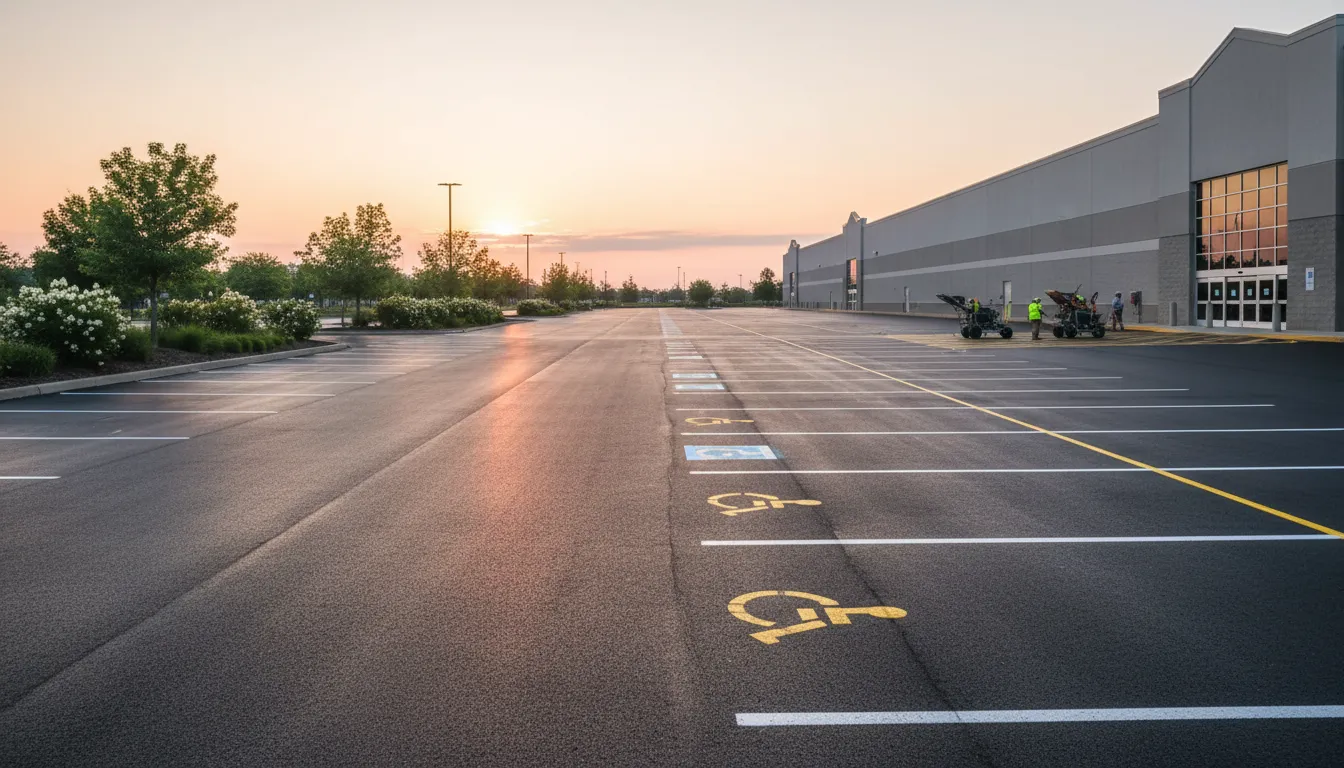
Find the Best Parking Lot Striping Companies for Your Business
No obligation • Fast responses • Nationwide coverage

Why you can trust Tidy Parking
Tidy Parking is a leading U.S. source for parking lot maintenance services, including striping, sealcoating, sweeping, paving, resurfacing, and repairs. Our content is created independently, and providers cannot pay to influence ratings or recommendations.
Search providers near you
Top Parking Lot Striping Companies in Kenosha, Wisconsin Ranked
Clear, compliant pavement markings are a critical component of any commercial property in Kenosha. Proper parking lot striping and pavement marking ensure safety, maximize space, and fulfill legal obligations under federal, state, and local laws. For business owners and property managers, navigating the specific requirements for accessible spaces, fire lanes, and traffic flow can be complex. This guide explains the key regulations and best practices for line striping in Kenosha, helping you understand what's needed to maintain a safe, functional, and legally sound parking area.
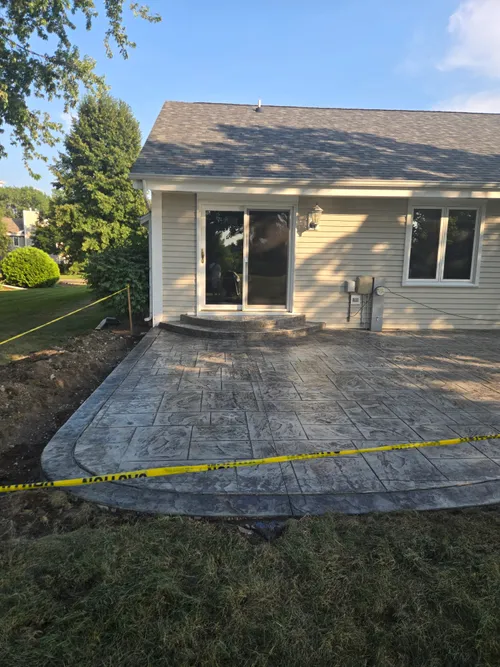
Anguiano's Sealcoating & Striping LLC + Concrete Division
2248 S 18th St, Milwaukee, WI 53215
Anguiano's Sealcoating & Striping LLC + Concrete Division is a family- and woman-owned business serving Milwaukee, WI, and surrounding counties. They specialize in parking lot striping, sealcoating, asphalt removal and replacement, asphalt patching, asphalt resurfacing, concrete work, culvert replacement, and snow removal. The company offers a 1-year paving warranty and warranties for sealcoating and concrete services. With over 22 years of experience and being owner-operated since 2012, they provide services with a personal touch and have a team fluent in Spanish to serve a diverse customer base.
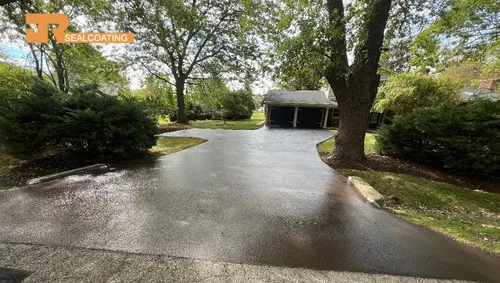
JR Sealcoating & Striping
108 N Shaddle Ave, Mundelein, IL 60060
JR Sealcoating & Striping is a parking lot striping, sealcoating, and repair company based in Chicago, IL. They provide services for both residential and commercial properties, including sealcoating, crack filling, asphalt repair, and parking lot striping. Their work involves surface preparation, protective coating, edging trimming, and debris blowing to maintain and enhance driveways and parking areas.

Premier Paving Of Northern Illinois
70 US-45 STE 200, Grayslake, IL 60030
Premier Paving Of Northern Illinois is a veteran-owned asphalt paving company serving Chicago, IL, and surrounding communities. With over 20 years of experience, they offer a full range of residential and commercial services including driveway paving, parking lot paving, striping, and asphalt maintenance. Their team handles all project phases from preparation to final paving, ensuring proper grading and compaction. Premier Paving is known for its commitment to craftsmanship and client communication, working with homeowners, HOAs, golf courses, and property managers. The company also manages permitting and inspections required for paving projects.
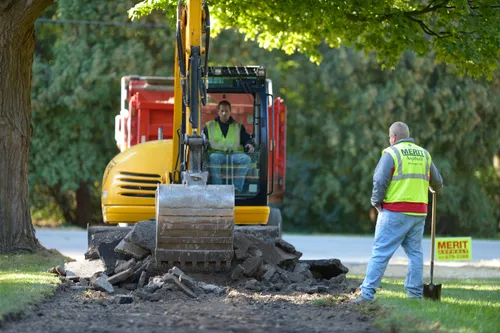
Merit Asphalt
S84W18645 Enterprise Dr, Muskego, WI 53150
Merit Asphalt is a parking lot paving and maintenance company based in Milwaukee, WI, serving Southeastern Wisconsin since 1983. They provide a range of asphalt services including parking lot striping, sealcoating, resurfacing, repairs, and paving for both commercial and residential clients. Their team uses advanced techniques and quality materials to handle projects from private driveways to large commercial parking lots. With decades of experience, Merit Asphalt manages everything from project planning to asphalt installation and maintenance.
American Asphalt Maintenance Inc
2409 Hilgers Ct, Mundelein, IL 60060
American Asphalt Maintenance Inc is a parking lot and residential driveway paving contractor based near Chicago, IL. They specialize in asphalt driveway removal and replacement, sealcoating, striping, and paving services primarily for residential customers in the North Shore suburbs of Chicago. With over 40 years of experience, the company focuses on durable asphalt maintenance and repair, using licensed and insured crews equipped with professional tools. They offer live phone support five days a week to assist customers.
Understanding Kenosha's Regulatory Landscape
Parking lot striping in Kenosha is governed by a three-tiered system of regulations. At the federal level, the Americans with Disabilities Act (ADA) sets the baseline for accessible parking 1. Wisconsin State Statutes, particularly Wis. Stat. §346.503, incorporate and sometimes expand upon these federal rules. Finally, the City of Kenosha enforces its own ordinances concerning fire lanes, crosswalks, and general traffic safety. Non-compliance can result in fines, liability issues, and can create unsafe conditions for visitors and employees.
A common misconception is that once a lot is striped, it's compliant forever. Wisconsin's harsh winters, with repeated freeze-thaw cycles, road salt, and snow plowing, degrade pavement markings quickly. Industry professionals recommend restriping every 1 to 2 years to maintain visibility and compliance. Regular maintenance of your lot's line striping is not just cosmetic; it's a core part of property upkeep and risk management.
ADA Accessible Parking: A Detailed Checklist for Wisconsin
Creating accessible parking spaces is a legal requirement, not an optional upgrade. The rules are precise, and getting them wrong can exclude individuals and open a property to complaints or lawsuits.
Space Ratios and Dimensions: The number of required accessible spaces depends on your lot's total capacity 2. For lots with 1 to 25 total spaces, one accessible space is required. For 26 to 50 spaces, two are required. For lots with 51 to 1,000 spaces, 2% of the total spaces must be accessible. One in every six accessible spaces must be designated as "van accessible" 3.
In Wisconsin, each standard accessible parking stall must be at least 12 feet wide. An alternative configuration allows for an 8-foot wide stall paired with an 8-foot wide access aisle 4. The access aisle is crucial-it's the zone where ramps and lifts deploy. For van-accessible spaces, this aisle must be a full 8 feet wide and should be marked with blue hatch marks or diagonal lines for clear identification 4.
Signage and Slope Requirements: Each accessible space must be identified with a proper sign. Wisconsin typically requires a 12-inch by 18-inch sign with green lettering on a white background that reads "Reserved Parking" and displays the International Symbol of Access. The sign must be mounted so the bottom is at least 60 inches above the pavement. Van-accessible spaces must have additional text on the sign stating "Van Accessible".
Perhaps the most overlooked requirement is the surface slope. The pavement in the accessible space and its access aisle must have a slope no greater than 1:48 (2.08%) in any direction 5 6. This is often where older lots fail compliance, as asphalt settles over time. Correcting slope issues may require milling, patching, or full repaving before new striping can be applied, which can significantly impact project costs 7 6.
Fire Lane and Safety Marking Regulations
Fire lane striping is a matter of public safety and is strictly enforced by local fire departments and the Kenosha Police. These zones must be immediately identifiable to prevent blocked access for emergency vehicles.
Marking Specifications: In Kenosha, fire lanes must be designated by either red-painted curbs or 6-inch wide red lines painted on the pavement itself 8. Simply outlining the area in red is not enough. The words "NO PARKING - FIRE LANE" must be stenciled in white lettering onto the red surface at intervals of every 25 to 50 feet 9. This repeated messaging is key for enforcement and driver awareness.
Associated Parking Prohibitions: Local enforcement extends beyond the painted fire lane. Parking is prohibited within 10 feet of a fire hydrant in Kenosha. Furthermore, city ordinance prohibits parking within 15 feet of a crosswalk10 11. This 15-foot zone is a critical safety buffer for pedestrian visibility and must be kept clear. These areas are often marked with yellow curb paint or "No Parking" signs, but the striping for the crosswalk itself-using white lines 2 to 6 inches wide-must also be maintained for clarity.
Find the perfect parking lot striping companies for your needs
Get personalized recommendations and expert advice
Traffic Flow and Standard Pavement Markings
Beyond ADA and fire safety, effective pavement markings organize traffic and prevent accidents. A well-designed lot includes clear directional arrows, stop bars at intersections, pedestrian crosswalks, and loading zones.
Loading Zones and Directional Arrows: Loading zones should be clearly marked and accompanied by signs that read "Loading Zone, No Parking" or "No Parking Between Signs" to be legally enforceable 12. Directional arrows for one-way aisles must be large enough to be seen from a distance and should be repainted frequently as they experience high tire wear.
Crosswalks and Stop Lines: All crosswalk lines, stop lines (also known as stop bars), and pedestrian symbols must be white in color 13 14. Faded crosswalks are a major liability. The standard transverse line crosswalk, with lines marking the boundaries of the walkway, is common and should be repainted annually in high-traffic areas.
The Cost Factors for Parking Lot Striping in Kenosha
The cost for parking lot striping and pavement marking is highly variable. While painting a single stall line is inexpensive, a full lot project involves many factors. The primary cost drivers are the total square footage of lines to be painted, the number of complex symbols (like handicap logos or directional arrows), and the condition of the existing pavement.
If the underlying asphalt is cracked, potholed, or has non-compliant slopes, repair work must be completed before striping can begin. The requirement for new, compliant signage at every accessible space also adds a material cost to ADA upgrades 15. The most cost-effective strategy is to incorporate line striping into a regular maintenance schedule, preventing the need for more expensive asphalt repairs down the line and ensuring continuous compliance with Kenosha's regulations 16.
A Final Note on Compliance: This guide outlines general requirements, but local interpretations can vary. It is always recommended to verify specific plans with the Kenosha Fire Department and the city's Zoning Department before beginning a major striping project, as they have the final authority on local code enforcement.
Frequently asked questions
Sources
Footnotes
-
Accessible Parking Spaces | ADA.gov - https://www.ada.gov/topics/parking/ ↩
-
Is Your Parking Lot ADA Compliant? A 2026 Striping Checklist ... - https://asphaltinc.com/parking-lot-striping-wisconsin-ada-2026/ ↩
-
Commercial Parking Lot Striping: Costs, Standards + Pro Tips - https://www.getonecrew.com/post/commercial-parking-lot-striping ↩
-
ADA Compliance Guide for Parking Lot Line Striping - https://www.pavementsolutions.org/ada-compliance-guide-for-parking-lot-line-striping/ ↩ ↩2
-
ADA Compliance Checkup for Wisconsin Parking Lots - Poblocki - https://poblockipaving.com/ada-compliance-checkup-for-wisconsin-parking-lots/ ↩
-
ADA Compliance Brief: Restriping Parking Spaces - https://www.ada.gov/resources/restriping-parking-spaces/ ↩ ↩2
-
Is Your Parking Lot ADA Compliant? A 2026 Striping Checklist ... - https://asphaltinc.com/parking-lot-striping-wisconsin-ada-2026/ ↩
-
Fire Lane Requirements in the US as of 2025 - https://asphaltsealcoatingsupply.com/blogs/news/fire-lane-requirements-in-the-us-as-of-2025 ↩
-
(A). PAINTING EACH FIRE LANE SHALL BE ... - Webster - https://www.webstertx.gov/DocumentCenter/View/8357 ↩
-
A few reminders for parking rules in the City of Kenosha. No ... - https://www.facebook.com/Kenoshapolice/posts/a-few-reminders-for-parking-rules-in-the-city-of-kenosha-no-parking-within%EF%B8%8F-15-o/636110928617673/ ↩
-
SCHOOL ZONE SAFETY Kenosha Police Department - https://www.kenosha.org/Document%20Center/Departments/Police/Public%20Information/School%20Zone%20Safety%202024.pdf ↩
-
DHS 60.01(7)(a)1.a. - Wisconsin Legislative Documents - https://docs.legis.wisconsin.gov/document/administrativecode/DHS%2060.01%287%29%28a%291.a. ↩
-
TEOPS Chapter 3 - Wisconsin Department of Transportation - https://wisconsindot.gov/dtsdManuals/traffic-ops/manuals-and-standards/teops/03.pdf ↩
-
Pavement Markings - Wisconsin Towns Association - https://www.wisctowns.com/documents/bltn_009_pavement_markings.pdf ↩
-
Parking signs in Wisconsin | MyParkingSign.com Blog - https://www.myparkingsign.com/blog/parking-signs-in-wisconsin/ ↩
-
Fire Lane Regulations: Are Your Red Zones Faded Enough to ... - https://asphaltinc.com/pavement-marking-fire-lane-code-compliance/ ↩