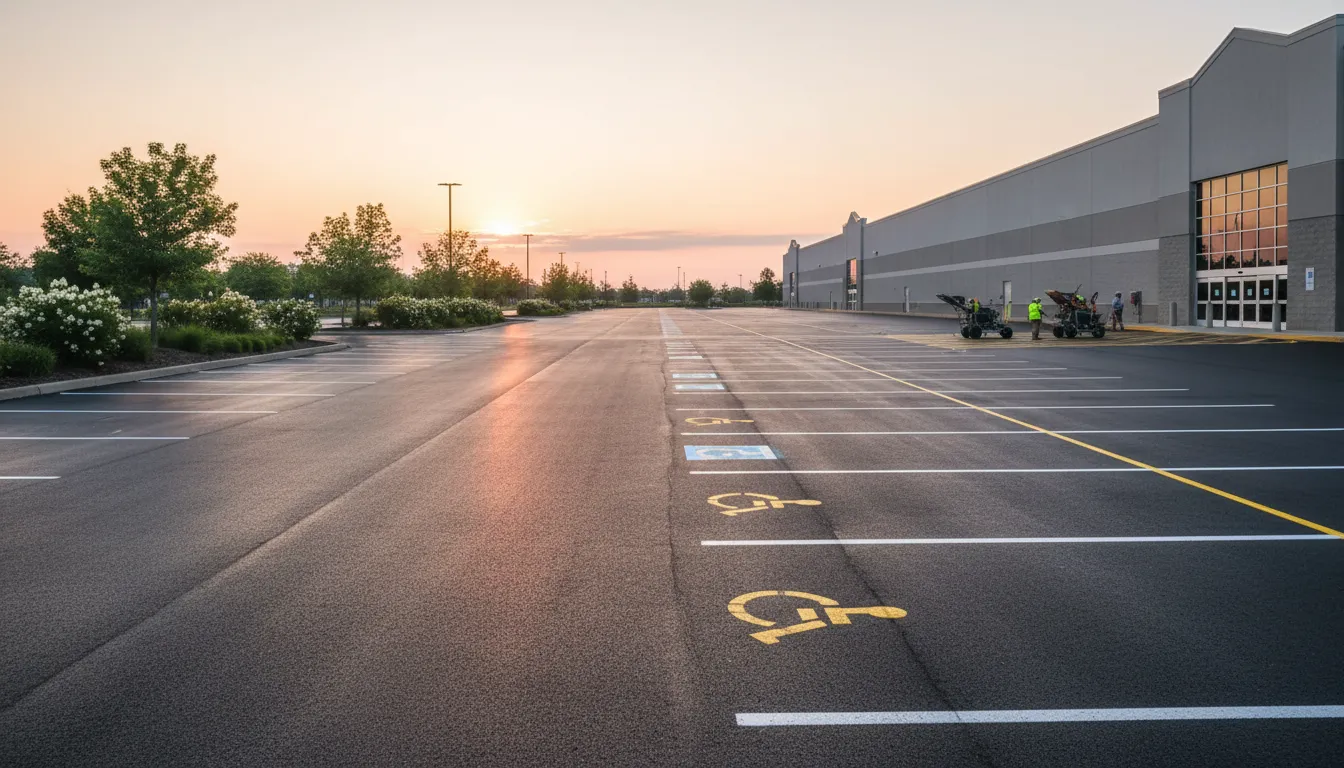
Find the Best Parking Lot Striping Companies for Your Business
No obligation • Fast responses • Nationwide coverage

Why you can trust Tidy Parking
Tidy Parking is a leading U.S. source for parking lot maintenance services, including striping, sealcoating, sweeping, paving, resurfacing, and repairs. Our content is created independently, and providers cannot pay to influence ratings or recommendations.
Search providers near you
Top Parking Lot Striping Companies in Waipahu, Hawaii Ranked
Parking lot striping is the essential process of applying clear, durable markings to define stalls, traffic flow, and safety zones in a paved area. In Waipahu, proper line striping is not just about organization; it's a critical legal requirement that ensures accessibility, fire safety, and efficient use of space for local businesses and properties. This guide explains the specific regulations, best practices, and considerations for parking lot marking in our community, helping you understand what's needed to maintain a compliant and safe property.

Understanding Waipahu's Striping Regulations
Parking lot marking in Waipahu is governed by a combination of federal, state, and local codes. Compliance is mandatory, and non-adherence can result in significant fines ranging from $250 to $500 per day. The primary standards include the 2010 ADA Standards for Accessible Design, Hawaii Administrative Rules (HAR) Title 11 Chapter 219, and Honolulu County fire codes. These rules dictate everything from line width and color to the placement of signs and the slope of the pavement.
A professional pavement marking contractor familiar with these overlapping requirements is invaluable. They ensure that your lot's layout, from standard stalls to accessible parking and fire lanes, meets all legal benchmarks, protecting you from liability and providing safe access for all visitors.
Key Requirements for Accessible Parking Spaces
Accessible parking, often referred to as handicap or reserved parking, has precise dimensional and marking specifications.
Stall and Aisle Dimensions:
- Standard Accessible Stall: Must be at least 8 feet wide.
- Access Aisle: A 5-foot wide access aisle must be adjacent to the stall. This aisle can be shared between two spaces.
- Van-Accessible Stall: One of every six accessible spaces must be van-accessible. These require either an 11-foot wide stall with a 5-foot aisle, or an 8-foot wide stall with an 8-foot aisle 1 2.
Marking Specifications:
- Lines: All outlines must be a minimum of 4 inches wide. The stall is typically outlined in blue and white.
- Access Aisle Marking: The crucial access aisle must be clearly outlined and marked with diagonal stripes (4 inches wide at a 45-degree angle). The Hawaii Department of Health specifically recommends against painting the entire stall solid blue, as this can create a slippery surface when wet.
- Signage: Each accessible space must have a posted sign. Hawaii law requires the sign to state: "Reserved Parking," "Maximum Fine $500," and "Placard or Special License Plate Required." The International Symbol of Accessibility must be displayed, and the bottom of the sign must be mounted at least 60 inches above the ground 3 4.
Pavement Slope: The surface of the accessible stall and access aisle must have a maximum slope of 1:48 (2.08%) in all directions to ensure stability for wheelchair users 5.
Fire Lane Marking and Stenciling
Clearly marked fire lanes are a non-negotiable safety requirement for many Waipahu properties, especially those with commercial or multi-unit buildings.
Designation and Color:
- Fire lanes must be designated with a continuous red painted curb or red striping on the pavement surface 6.
Stenciling Requirements:
- The words "FIRE LANE - NO PARKING" or "NO PARKING - FIRE LANE" must be stenciled on the pavement in white or yellow letters, typically 3 to 4 inches tall.
- This stenciling must be repeated at intervals not exceeding 50 feet along the entire length of the fire lane 7.
- Reflective "FIRE LANE - NO PARKING" signs must also be posted, often with a minimum 7-foot clearance above the ground.
Standards for General Traffic and Safety Markings
Beyond accessible and fire zones, general pavement markings organize traffic and enhance safety.
Line Width: All traffic lines, including lane dividers and stall lines, should be a minimum of 4 inches wide for adequate visibility 8.
Loading Zones: Passenger loading zones should be clearly marked and be at least 5 feet wide by 20 feet long. They are typically designated for short-term, 10-minute maximum parking.
Crosswalks and Daylighting: A critical Hawaii law that took effect in January 2026 requires "daylighting" at intersections. This means no parking is allowed within 20 feet of any crosswalk or intersection, whether marked or not, to improve visibility and safety for pedestrians and drivers 9. Crosswalks themselves should be marked with high-visibility, diagonal, or transverse white lines.
Find the perfect parking lot striping companies for your needs
Get personalized recommendations and expert advice
Material Choices for Pavement Markings
The longevity and visibility of your lot's markings depend heavily on the material used. Common options include:
- Water-Based Acrylic Paint: The most common and cost-effective option for parking lot line painting. It's quick-drying and suitable for most climates, though it requires more frequent re-striping (typically every 1-2 years).
- Thermoplastic: A melted plastic material applied hot to the pavement. It is extremely durable, highly reflective (especially with glass beads mixed in), and can last 3-5 years or longer. It is often used for high-traffic areas and symbols like handicap logos.
- Preformed Thermoplastic Tape: A less common but effective option involving pre-cut shapes and lines with adhesive backing, useful for precise symbols and shorter line segments.
Choosing the right material involves balancing initial cost, expected traffic, and long-term maintenance budgets. A local contractor can advise on the best choice for Waipahu's specific climate and your property's needs.
Planning Your Striping Project: Scenarios
Understanding how these rules come together is key. Here are two common scenarios for Waipahu properties:
Scenario 1: A Small 50-Space Lot A local Waipahu business with a 50-space lot is required to have a minimum of two accessible parking spaces. One of these must be van-accessible. The business opts for two 8-foot wide stalls sharing a single 5-foot wide access aisle. The stalls and aisle are outlined with 4-inch blue and white lines, and the aisle is diagonally striped. A compliant sign stating "Reserved Parking," with the required verbiage and symbol, is mounted on a 7-foot pole in front of each space 10 11.
Scenario 2: Designating a Fire Lane A warehouse in Waipahu needs a fire lane along its main entrance, a 100-foot stretch. The contractor paints a continuous red stripe along the curb and pavement edge. They then use a stencil to apply "FIRE LANE - NO PARKING" in white letters at the start (0 ft), middle (50 ft), and end (100 ft) of the lane. Reflective metal signs with the same message are installed on posts at each end of the lane 12.
Maintenance and Re-Striping Schedule
Parking lot markings fade due to sun exposure, weather, and tire abrasion. Regular maintenance is crucial for ongoing compliance and safety.
- Inspection: Visually inspect your markings every 6 months for fading, cracking, or peeling.
- Re-striping Frequency: Most lots with acrylic paint require re-striping every 12 to 24 months. Thermoplastic can last several years longer.
- Prompt Repairs: Damaged or significantly faded markings, especially for accessible stalls and fire lanes, should be repaired immediately to avoid non-compliance and safety hazards.
Frequently asked questions
Sources
Footnotes
-
How to Design an Accessible Parking Space (Federal and State of ... - https://health.hawaii.gov/dcab/files/2017/06/Fact-Sheet-DCAB-Parking-Brochure-June-2017.pdf ↩
-
Accessible Parking Spaces - ADA.gov - https://www.ada.gov/topics/parking/ ↩
-
reserved parking - Hawaii Department of Health - https://health.hawaii.gov/dcab/files/2013/05/DCAB-Parking-Brochure-11-29-12A.pdf ↩
-
Parking signs in Hawaii | MyParkingSign.com Blog - https://www.myparkingsign.com/blog/parking-signs-in-hawaii/ ↩
-
Wisconsin Parking Lot Accessibility: Slope, Signage & Striping Standards - https://potrykusconstruction.com/wisconsin-parking-lot-accessibility-slope-signage-striping-standards/ ↩
-
§ 150.191 FIRE LANE REQUIREMENTS. - https://codelibrary.amlegal.com/codes/anthonynm/latest/anthony_nm/0-0-0-3281 ↩
-
FIRE LANE REQUIREMENTS | epcesd1 - https://www.epcesd1.com/wp-content/uploads/2022/03/Fire-Lane-Requirements.pdf ↩
-
Basic Guide to Parking Lot Striping - Traffic Safety Store - https://www.trafficsafetystore.com/blog/guide-to-parking-lot-striping/ ↩
-
New year, new parking law | News | kitv.com - https://www.kitv.com/news/new-year-new-parking-law/article_7ad6c37e-7c86-444c-9cd9-df5ae2b3b5f8.html ↩
-
ADA Compliance Guide for Parking Lot Line Striping - https://www.pavementsolutions.org/ada-compliance-guide-for-parking-lot-line-striping/ ↩
-
ADA Compliance Guide for Parking Lot Line Striping - https://www.pavementsolutions.org/ada-compliance-guide-for-parking-lot-line-striping/ ↩
-
5A-11-2-3: ACCESSIBLE PARKING REQUIREMENTS: - https://codelibrary.amlegal.com/codes/darienil/latest/darien_il/0-0-0-4622 ↩