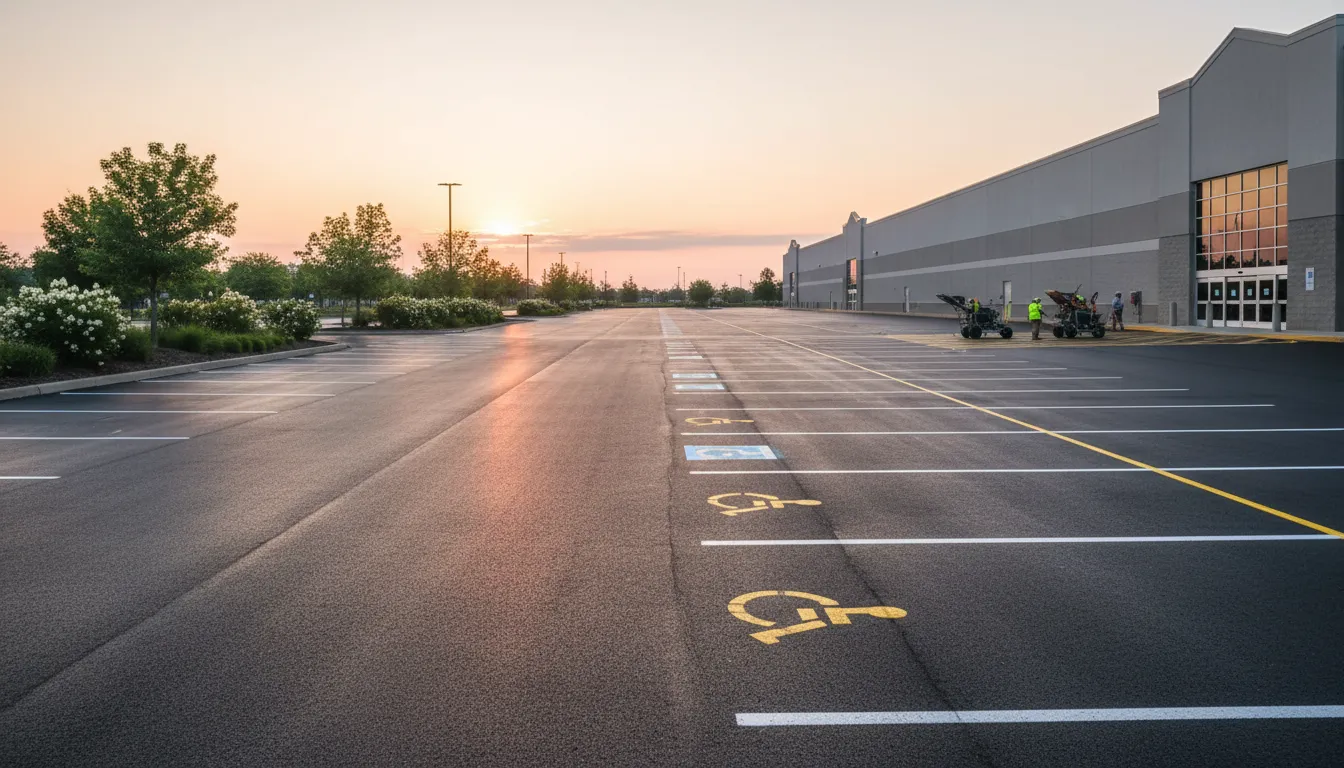
Find the Best Parking Lot Striping Companies for Your Business
No obligation • Fast responses • Nationwide coverage
Why you can trust Tidy Parking
Tidy Parking is a leading U.S. source for parking lot maintenance services, including striping, sealcoating, sweeping, paving, resurfacing, and repairs. Our content is created independently, and providers cannot pay to influence ratings or recommendations.
Search providers near you
Top Parking Lot Striping Companies in Wilmington, Delaware Ranked
Maintaining clear, compliant pavement markings is a critical part of property management in Delaware. Proper parking lot striping ensures safety, maximizes space efficiency, and is a legal requirement under both federal and state regulations. This guide explains the key standards for line painting in Delaware, from ADA-accessible spaces to fire lane markings, and provides practical information to help you plan your next striping or restriping project with a qualified local professional.
Premier Sealcoating Line Striping & Asphalt Maintenance LLC
Allentown, PA
Premier Sealcoating Line Striping & Asphalt Maintenance LLC provides comprehensive asphalt maintenance services in Allentown, PA. Their offerings include crack sealing, sealcoating, line striping, pothole patching, resurfacing sports courts, and traffic sign installation. The company uses high-quality materials such as Sherwin-Williams traffic marking paints and premium sealers fortified with silica sand to enhance durability and appearance. They serve a wide area across Pennsylvania and New Jersey, including cities like Bethlehem, Harrisburg, and Philadelphia. Premier Sealcoating is fully licensed and insured, with certifications including COSTARS, PennDOT DBE, Pennsylvania SDB, and WBENC, emphasizing their commitment to quality and compliance.
Abc sealcoating llc
30 Acres Dr, Ridley Park, PA 19078
Abc Sealcoating LLC is a paving contractor based near Philadelphia, PA, offering a range of services including parking lot striping, sealcoating, paving, and repair. With over 20 years of experience, the company handles projects from large commercial parking lots to residential driveway repairs. Their capabilities include asphalt maintenance such as fixing potholes and unstable walkways, as well as professional sealcoating to protect and restore pavement surfaces. Abc Sealcoating LLC serves the Ridley Park area and is equipped to manage both small and large paving jobs.
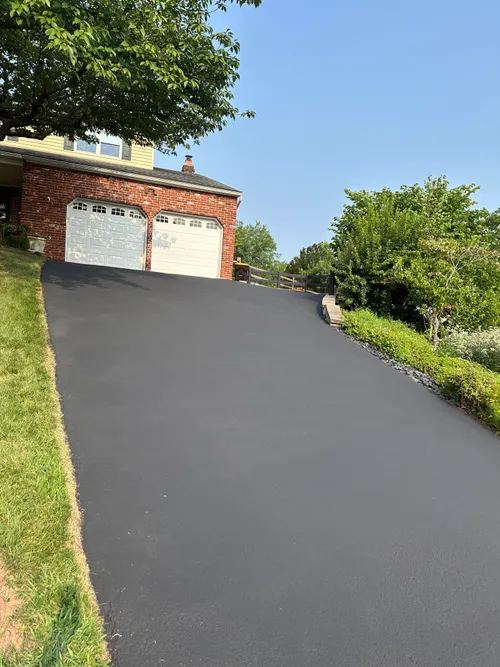
Beyond Sealcoating, LLC
2011 W Main St Rear Garage, Norristown, PA 19403
Beyond Sealcoating, LLC is a family-owned and fully insured company based near Philadelphia, PA, specializing in sealcoating, crack sealing, and parking lot striping. They serve Montgomery County and surrounding areas, focusing on protecting and extending the life of asphalt surfaces for both residential and commercial clients. Their services include hand-brushed residential sealcoating, hot rubberized tar crack sealing, and professional line striping to maintain ADA standards. Beyond Sealcoating uses high-quality sealers and crack fillers, such as Neyra Jennite AE with Diamond Shield additives and Sealmaster hot tar products, to enhance durability and appearance.
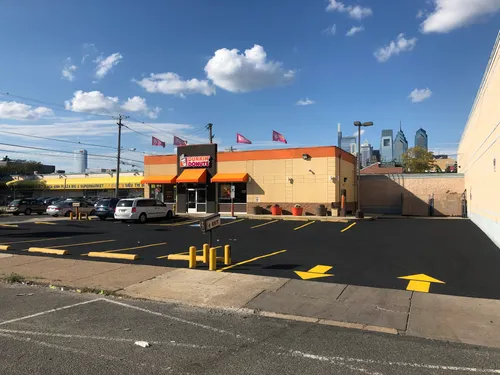
All Out Parking Lots
501 Abbott Dr, Broomall, PA 19008
All Out Parking Lots is a full-service parking lot contractor based in Philadelphia, PA, offering a comprehensive range of asphalt and concrete services. Their expertise includes asphalt repair, sealcoating, pavement marking, paving, and concrete replacement, serving commercial clients with flexible solutions for parking lot projects. They have worked on multiple high-profile sites in the Greater Philadelphia region, providing services such as overlays, pothole remediation, and ADA-compliant pavement marking. The company emphasizes safety and quality in all projects and has experience managing large-scale multi-site facility partnerships.
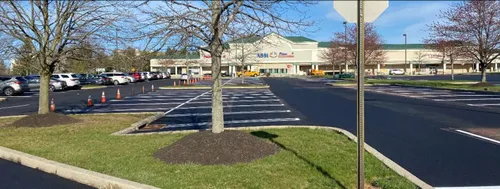
A One Asphalt Paving LLC
Philadelphia, PA
A One Asphalt Paving LLC is a family-owned and woman-led asphalt paving company serving Philadelphia, PA, and surrounding areas. With over 37 years of experience since 1988, they provide a wide range of services including driveway paving, parking lot paving, resurfacing, sealcoating, line striping, and maintenance for both residential and commercial properties. Their team uses high-quality materials and advanced techniques to deliver durable, long-lasting asphalt surfaces that meet local regulations and enhance property safety and appearance. The company offers a one-year material warranty and same-day appointments, reflecting their commitment to efficient project completion and customer convenience.
Understanding Delaware's Striping Regulations
Parking lot markings in Delaware are governed by a combination of federal, state, and often local municipal codes. The primary goal of these regulations is to ensure safety, accessibility, and orderly traffic flow. Non-compliance can result in fines, liability issues, and reduced usability of your property.
At the federal level, the Americans with Disabilities Act (ADA) sets the baseline for accessible parking space design and marking. Delaware state law incorporates these standards and adds specific requirements, particularly concerning fire lanes and general parking lot dimensions. Furthermore, counties like Sussex and cities like Fenwick Island may have additional ordinances that dictate space sizes and layout specifics. It's essential to verify requirements with your local building or fire marshal's office before beginning a project.
ADA Accessible Parking Space Requirements
ADA-compliant spaces are not optional; they are a civil right and a legal mandate. The rules are precise and must be followed exactly.
- Space Dimensions: A standard car-accessible space must be at least 96 inches (8 feet) wide. The adjacent access aisle must be at least 60 inches (5 feet) wide, creating a combined clear area for deploying mobility equipment 1 2.
- Van-Accessible Spaces: Van-accessible spaces have stricter requirements. They must be at least 132 inches (11 feet) wide, or they can be 96 inches wide if they are paired with a 96-inch (8-foot) wide access aisle. They also require a minimum of 98 inches of vertical clearance along the access aisle and the parking space 3 4. In Delaware, at least one out of every three accessible spaces (or fraction thereof) must be van accessible 3.
- Markings: Accessible spaces must be marked with the International Symbol of Accessibility painted on the pavement surface. The access aisle must be clearly marked, typically with diagonal hatched lines, and should be painted a contrasting color like blue 5. Each space must also be accompanied by a proper sign (minimum 12" x 18") featuring the ISA, mounted at least 60 inches above the ground 5.
- Location: Accessible spaces must be located on the shortest accessible route to the building entrance, and they cannot be placed where individuals would have to cross a lane of vehicular traffic to reach the entrance.
Fire Lane Marking Standards
The Delaware State Fire Prevention Commission has clear regulations for designating and marking fire lanes to ensure unobstructed access for emergency vehicles 6 7.
- Curbs: Any curb within a designated fire lane must be painted yellow on both the top and the vertical face 8.
- Pavement Markings: Where no curb exists, the boundary of the fire lane must be defined by a solid 4-inch wide yellow line. The words "NO PARKING" must be painted on the pavement in yellow letters at least 6 feet high and 12 feet long.
- Signage: Fire lane signs must be posted at each end of the lane and at intervals not exceeding 150 feet. Signs should be mounted 6 to 8 feet above the ground 9.
- Clearance: Parking is prohibited for 15 feet in any direction from an intersection at the corner of a building. No parking is allowed between a primary fire lane and the building it serves 10.
General Parking Space and Layout Specifications
Beyond accessible spaces, Delaware has standards for all parking stalls and traffic aisles to ensure functionality and safety.
- Standard Space Size: Off-street parking spaces in Delaware generally must provide an area of not less than 162 square feet. A common configuration is 9 feet wide by 18 feet deep.
- Compact Car Spaces: Municipalities may allow a percentage of spaces (often up to 20%) to be designated for compact cars. These are typically smaller, such as 8 feet wide by 17 feet deep, and must be clearly marked as "COMPACT" 11.
- Traffic Aisles: The width of the driving aisle depends on the parking angle. For parking at 75 degrees or greater, a minimum aisle width of 24 feet is required. For angles less than 75 degrees, a 20-foot minimum is standard 12. This ensures vehicles can maneuver safely.
- Line Specifications: Parking space lines and lane markings are typically 4 inches wide. They must be maintained in a vivid and durable condition to remain compliant and effective 13.
Find the perfect parking lot striping companies for your needs
Get personalized recommendations and expert advice
The Importance of Regular Restriping
Pavement markings fade due to sunlight, weather, snow plowing, and tire friction. Regular restriping is not just about aesthetics; it's a maintenance necessity for safety and compliance.
- Safety: Faded lines contribute to driver confusion, haphazard parking, and increased risk of accidents or pedestrian incidents.
- Compliance: Regulations require markings to be "clearly visible." If your accessible spaces or fire lanes are not distinctly marked, you are out of compliance regardless of when they were originally painted 14 15.
- Frequency: The recommended restriping cycle is every 12 to 24 months, depending on the volume of traffic and weather exposure your lot receives 16. A professional assessment can determine the optimal schedule for your property.
Cost Factors for Parking Lot Striping in Delaware
The cost to stripe or restripe a parking lot in Delaware varies based on the scope of work, materials used, and site conditions. Understanding these factors can help you budget effectively.
- Project Scope: A primary cost driver is the total linear footage of paint required. A standard medium-sized lot with 30-50 spaces may range from $500 to $1,200 for basic line repainting.
- Per-Stall Cost: A useful metric is the cost per standard 18-foot white line, which typically falls between $4 and $5 17.
- Specialty Markings: Accessible stalls cost more due to the additional blue paint and stencil work, generally ranging from $25 to $50 each. Fire lane markings (curb painting and "NO PARKING" text) can cost $25 to $75 per location 18. Curb painting is often priced per linear foot, from $1 to $4.
- Material Choice: Water-based traffic paint is common and cost-effective. Thermoplastic or epoxy markings are more durable and longer-lasting but come at a higher initial cost 19.
- Additional Fees: Contractors often charge a mobilization fee (typically $150 to $350) to cover equipment transport and setup, especially for smaller projects 20 21.
- Site Preparation: If old markings need to be removed (e.g., by grinding or water blasting) or if significant crack filling is needed before painting, this will add to the total project cost.
Choosing a Professional Striping Contractor
Given the regulatory complexity and the need for precision, hiring an experienced professional is crucial.
- Verify Licensing and Insurance: Ensure the contractor is properly licensed to work in Delaware and carries both liability and workers' compensation insurance.
- Check References and Portfolios: Ask for examples of recent work, particularly projects of a similar scale. References can speak to the contractor's reliability, quality, and adherence to codes.
- Get Detailed, Written Estimates: A professional estimate should break down costs for labor, materials (specifying paint type), mobilization, and any prep work. It should also outline the project timeline.
- Ask About Compliance: A knowledgeable contractor will be familiar with ADA and Delaware fire lane requirements. They should be able to discuss how they will ensure your lot meets all standards.
- Review the Contract: Before work begins, ensure you have a signed contract that includes the estimate details, project scope, payment schedule, and warranty information for the materials and workmanship.
Frequently asked questions
Sources
Footnotes
-
Accessible Parking Spaces | ADA.gov - https://www.ada.gov/topics/parking/ ↩
-
Legislation Document - Delaware General Assembly - https://legis.delaware.gov/json/BillDetail/GenerateHtmlDocument?legislationId=109595&legislationTypeId=1&docTypeId=2&legislationName=HB448 ↩
-
Legislation Document - Delaware General Assembly - https://legis.delaware.gov/json/BillDetail/GenerateHtmlDocument?legislationId=142149&legislationTypeId=6&docTypeId=2&legislationName=HS1forHB48 ↩ ↩2
-
Chapter 5: Parking Spaces - Access-Board.gov - https://www.access-board.gov/ada/guides/chapter-5-parking/ ↩
-
Parking signs in Delaware | MyParkingSign.com Blog - https://www.myparkingsign.com/blog/parking-signs-delaware/ ↩ ↩2
-
ADA Requirements for Parking: Compliance and Penalties - https://www.accessibilitychecker.org/blog/ada-requirements-for-parking-standards-compliance-and-penalties/ ↩
-
DELAWARE State Fire Prevention Commission - https://regulations.delaware.gov/register/july2012/proposed/16%20DE%20Reg%2016d%2007-01-12.htm ↩
-
State Fire Marshall's Office - Delaware Regulations - Regulation - https://regulations.delaware.gov/register/november1998/proposed/2%20DE%20Reg%20765%2011-01-98.htm ↩
-
1 Del. Admin. Code § 705-5-7.0 - Marking and Identification of ... - https://www.law.cornell.edu/regulations/delaware/1-Del-Admin-Code-SS-705-5-7.0 ↩
-
1 Del. Admin. Code § 705-5-6.0 - Design of Fire Lanes - https://www.law.cornell.edu/regulations/delaware/1-Del-Admin-Code-SS-705-5-6.0 ↩
-
Ordinance No. 1831: Space size, standard and compact - https://sussexcountyde.gov/sites/default/files/ordinances/o1831.pdf ↩
-
Parking Lot Dimensional Requirements 081319 - Fenwick Island - https://fenwickisland.delaware.gov/files/2019/08/FIPS-Parking-Lot-Summary-081319.pdf ↩
-
State Fire Marshall's Office - Delaware Regulations - https://regulations.delaware.gov/register/november1998/proposed/2%20DE%20Reg%20765%2011-01-98.htm ↩
-
ADA Compliance Brief: Restriping Parking Spaces - https://www.ada.gov/resources/restriping-parking-spaces/ ↩
-
ADA Compliance Brief: Restriping Parking Spaces - https://www.ada.gov/resources/restriping-parking-spaces/ ↩
-
When to Consider Commercial Parking Lot Striping - Alpha Paving - https://alphapavingtexas.com/time-to-consider-parking-lot-striping/ ↩
-
Cost to Restripe a Parking Lot - Truline Striping Company - https://trulinestripingco.com/blog/cost-to-restripe-a-parking-lot/ ↩
-
Parking Lots Costs & Prices - ProMatcher Cost Report - https://parking-lots.promatcher.com/cost/ ↩
-
How Much Does It Cost to Stripe a Parking Lot? [2025 Data] - https://www.homeadvisor.com/cost/outdoor-living/parking-lot-striping/ ↩
-
How Much Does Parking Lot Striping Cost? (2026) - HomeGuide - https://homeguide.com/costs/parking-lot-striping-cost ↩
-
How Much Does Striping a Parking Lot Cost? [2026 Data] | Angi - https://www.angi.com/articles/stripe-parking-lot-cost.htm ↩