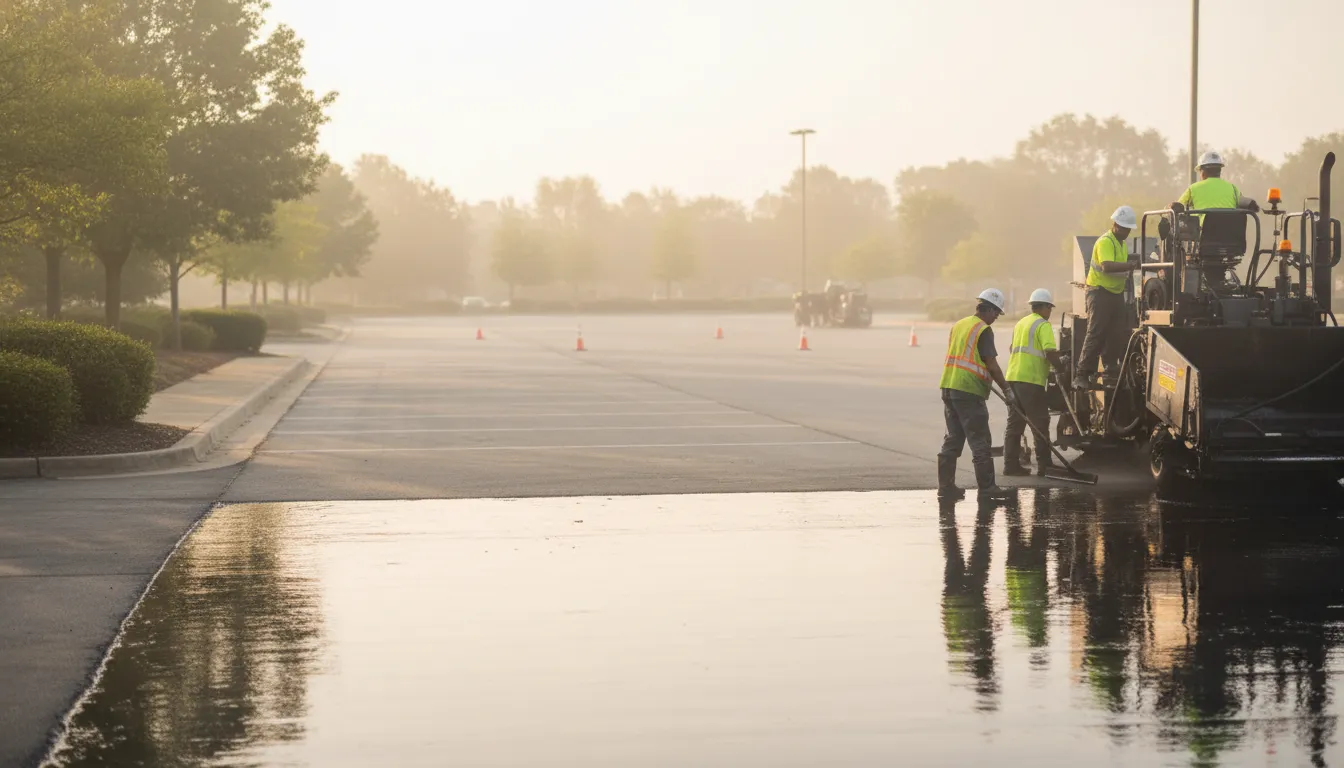
Find the Best Parking Lot Sealcoating Companies for Your Business
No obligation • Fast responses • Nationwide coverage
Why you can trust Tidy Parking
Tidy Parking is a leading U.S. source for parking lot maintenance services, including striping, sealcoating, sweeping, paving, resurfacing, and repairs. Our content is created independently, and providers cannot pay to influence ratings or recommendations.
Search providers near you
Best Parking Lot Sealcoating Companies in New York Ranked
Parking lot sealcoating is a critical maintenance service that applies a protective layer to asphalt surfaces, shielding them from New York's punishing weather, chemical spills, and daily wear. This process is essential for extending pavement life, maintaining a professional appearance, and preventing costly repairs. For property managers and business owners across the state, understanding the specific timing, preparation, and costs involved is key to a successful project. This guide provides the local insights needed to plan effectively and connect with qualified professionals for your property.
Mid-State Sealcoating
Syracuse, NY
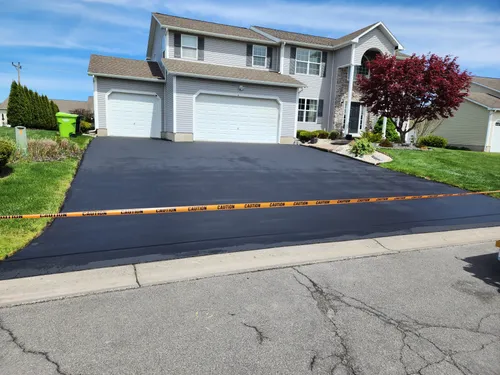
Mid-State Sealcoating is a parking lot and driveway maintenance company based in Syracuse, NY. They offer services including paving, asphalt crack filling and repair, sealcoating, and parking lot striping for commercial properties. Their paving process involves excavation, crusher run and binder application, followed by a top coat of asphalt, with milling services available as needed. They use high-quality commercial grade asphalt materials and apply sealcoating with a specific brush technique to enhance adhesion. The owner personally inspects each job to ensure quality.
United Blacktop
New York, NY
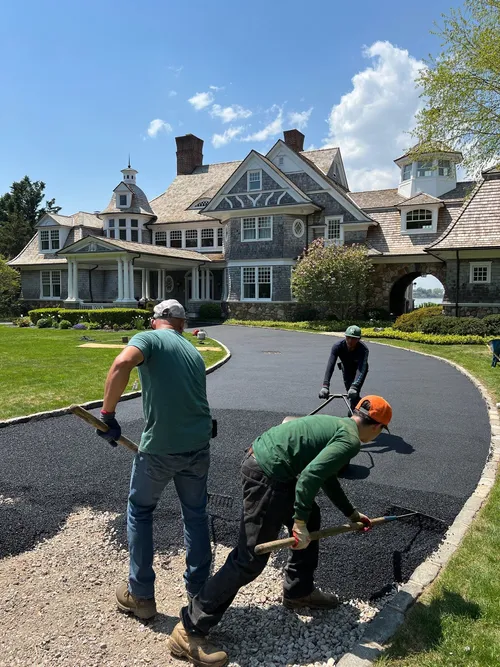
United Blacktop is a family-owned asphalt and paving company serving New York, NY, with over 20 years of industry experience. They provide a range of services including driveway sealcoating, crack filling and repair, sports court resurfacing, asphalt paving, concrete and brick pavers, as well as commercial parking lot maintenance. Their team is known for using premium materials and offering warranties on all workmanship and materials.
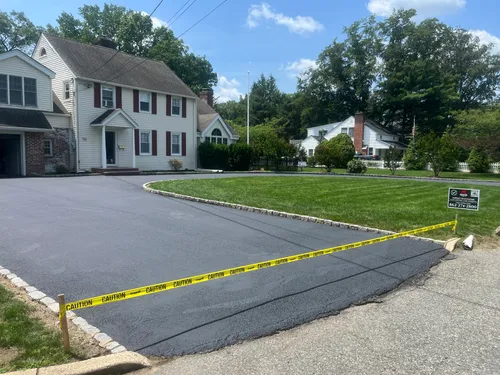
Kingdom Contracting & Sealcoating LLC
678 Newark Pompton Turnpike NJ 07444, Pompton Plains, NJ 07444
Kingdom Contracting & Sealcoating LLC is a family-owned asphalt maintenance company based near Pompton Plains, NJ, serving communities in North Jersey including Morris, Passaic, Bergen, Essex, and Union counties. They specialize in driveway and parking lot sealcoating, asphalt repair, crack filling, and commercial parking lot maintenance for homeowners, businesses, and HOAs. Founded in 2017, the company focuses on proper surface preparation and quality materials to ensure durable results.
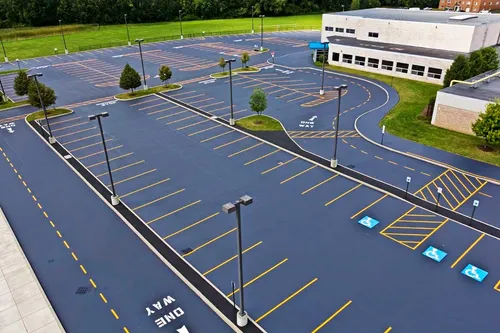
Manel Sealers Inc
65 Weicher St, Rochester, NY 14606
Manel Sealers Inc is a parking lot striping, sealcoating, sweeping, paving, and repair company based in Rochester, NY. Serving Rochester and Monroe County, they offer a range of asphalt services including parking lot sealcoating, crack repair, striping, cleaning, and asphalt milling and patching. Established in 1952, the company has three generations of experience and uses state-of-the-art equipment and materials to deliver their services. Manel Sealers Inc is known for its comprehensive asphalt maintenance and repair capabilities.
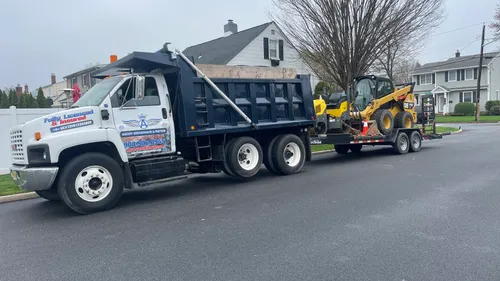
Ascot Driveways and Patios
55 Madison Ave suite 400 #4342, Morristown, NJ 07960
Ascot Driveways and Patios is a paving and masonry contractor serving New York, NY, and the surrounding Morris County area. They specialize in asphalt and concrete driveway installation, sealcoating, repairs, masonry wall building, patio construction, and landscaping hardscaping services. The company is experienced in restoring asphalt driveways with high-strength seal coating and offers a wide range of driveway and patio solutions tailored to customer needs. Ascot Driveways and Patios is a family-operated business known for its skilled craftsmanship and attention to detail, with a history of satisfied clients and completed projects in the region.
Why Sealcoating is Essential for New York Pavement
New York's climate is notoriously harsh on asphalt. The annual cycle of freezing winters and hot summers, combined with road salt, UV radiation, and moisture, relentlessly attacks pavement surfaces. Sealcoating acts as a barrier against these elements1. It prevents water from seeping into cracks and expanding during freeze-thaw cycles-a primary cause of potholes and structural failure2. It also protects against oxidation from the sun, which makes asphalt brittle, and resists damage from gasoline, oil, and de-icing chemicals. For commercial properties, a well-maintained, freshly sealed lot projects professionalism, enhances safety by providing a clear, dark surface for striping, and is a cost-effective strategy to preserve a significant asset3 1.
The Optimal Sealcoating Season in New York
Timing is everything for a durable sealcoat application. The window for ideal conditions in New York is relatively narrow and strictly dictated by weather.
- Prime Season: The best period runs from late May through September. This timeframe offers the most consistent conditions for proper curing.
- Temperature Requirements: Both air and pavement surface temperatures must be at least 50°F (10°C) and rising for application. The ideal range is between 55°F and 90°F. Crucially, temperatures must remain above 50°F for a minimum of 24 to 48 hours after application to allow the sealant to cure fully. If it freezes within this period, the coating can peel or flake.
- Cut-off Date: As a rule of thumb, projects should be scheduled for completion before the cold settles in late October. Applying sealcoat after October 31st carries significant risk; if freezing temperatures occur within 30 days, the sealcoat is highly likely to fail by spring4.
- Other Weather Factors: Low humidity (below 60%) and direct sunlight aid the curing process, as sealants cure by releasing water5. Rain must not be forecast for at least 24 hours before or after application. Windy conditions (over 10 mph) should be avoided to prevent overspray onto vehicles, buildings, and landscaping6 7.
Recommended Sealcoating Frequency and Schedule
A proactive maintenance schedule prevents minor issues from becoming major reconstruction projects.
- Initial Sealcoat: New asphalt needs time to cure and release oils. The first sealcoat should be applied 6 to 12 months after installation.
- Routine Maintenance: For most commercial parking lots in New York, resealing every 2 to 3 years is standard practice to maintain optimal protection8 9.
- High-Traffic Areas: Lots for retail centers, warehouses, or multi-tenant buildings that experience constant vehicle flow may require more frequent applications, potentially every 1 to 2 years10.
- Integrated Maintenance: Sealcoating is most effective as part of a comprehensive plan. Crack sealing should be performed as soon as cracks appear, well before the sealcoating project, to prevent water intrusion11. Other repairs like patching should also be completed in advance.
Find the perfect parking lot sealcoating companies for your needs
Get personalized recommendations and expert advice
Critical Preparation Steps for Lasting Results
Proper surface preparation is non-negotiable and often constitutes a significant portion of the project's labor. Skipping steps leads to premature coating failure.
- Thorough Cleaning: The entire surface must be free of dirt, dust, leaves, loose stones, and debris. This is typically achieved with commercial power sweepers, air blowers, and brooms.
- Vegetation Control: All grass and weeds growing along pavement edges and cracks must be removed. This reveals the true edge of the asphalt for precise application and prevents vegetation from undermining the seal.
- Oil and Grease Removal: Petroleum stains must be meticulously cleaned with detergent and water, then treated with a specialized oil spot primer. Without this step, sealcoat will not adhere to the stained area. A simple "water test" can check cleanliness: if water beads up on the pavement, an oily film is present.
- Complete Repairs: All necessary asphalt repairs, patching, and crack filling must be completed and allowed to cure fully-often for 15 days or more-before sealcoat is applied12.
- Site Security: The work area must be properly barricaded and closed to all traffic for at least 24 to 36 hours during and after application to ensure an undisturbed cure13.
Materials and Application Best Practices
Choosing the right materials and methods impacts performance, safety, and longevity.
- Material Types: The two primary types are asphalt emulsion and coal tar emulsion. Asphalt emulsion is widely used and preferred for its environmental profile and effective performance. Coal tar is known for superior fuel and chemical resistance but has environmental and regulatory considerations. Latex additives are often recommended to improve flexibility, drying time, and durability of the sealant.
- Application Method: Professional contractors typically use specialized spray systems for large areas to ensure an even, consistent coat, followed by squeegees in tight spaces. DIY brush-on applications are not recommended for commercial properties due to the difficulty in achieving proper thickness and consistency.
- Specifications: Municipalities and state agencies, like the NYSDOT, have detailed technical specifications for sealcoating (e.g., Item 410.20400001), which professional contractors follow. These specs cover material standards, application rates, and weather limitations.
Understanding Costs for New York Projects
The cost of sealcoating a parking lot in New York is typically quoted per square foot and varies based on size, condition, and location.
- Standard Sealcoating: The average price range is $0.15 to $0.30 per square foot14 15. Larger lots generally have a lower cost per square foot due to economies of scale.
- Factors Influencing Cost:
- Lot Size & Complexity: Small lots or those with many obstructions (light poles, planters) cost more per square foot.
- Preparation Required: Extensive cleaning, numerous oil spots requiring priming, and vegetation removal add to labor costs.
- Additional Services: Crack sealing is a separate service, typically costing $1 to $2 per linear foot16. Oil spot priming can add $50 to $150 per application17. Fresh line striping is almost always done after sealcoating and is priced per linear foot.
- Contractor Tip: For projects completed in the late fall, especially in the NYC and Long Island areas, it can be prudent to retain a small percentage (e.g., 20%) of the contract payment until spring. This allows for an inspection after winter to ensure the sealcoat has not failed prematurely due to unfavorable curing conditions18.
Frequently asked questions
Sources
Footnotes
-
Sealcoating 101: Why Your Business Parking Lot Needs It - https://www.pateasphalt.com/post/sealcoating-101-why-your-business-parking-lot-needs-it ↩ ↩2
-
Parking Lot Paving vs. Resurfacing: What's Better for New York ... - https://mrblacktop.net/parking-lot-paving-vs-resurfacing-whats-better-for-new-york-weather ↩
-
Asphalt Sealcoating: A Wise Winter Preparation Strategy - https://paveconnect.com/blog/sealcoating-a-wise-winter-preparation-strategy/ ↩
-
Is It Too Cold to Sealcoat My Parking Lot? - PaveConnect - https://paveconnect.com/blog/is-it-too-cold-to-sealcoat-my-parking-lot/ ↩
-
Best Weather Conditions for Sealcoating - D.B.Krieg, Inc. - https://dbkrieginc.com/blog/best-temperature-weather-for-sealcoating/ ↩
-
item 410.20400001 - seal coating asphalt surfaces - https://www.dot.ny.gov/spec-repository-us/410.20400001.pdf ↩
-
PARKING LOT RESTORATION TECHNICAL SPECIFICATIONS - https://www.madisoncounty.ny.gov/DocumentCenter/View/20402 ↩
-
How Often Should a Parking Lot Be Sealcoated? 510-723-0280 - https://americanasphalt.com/how-often-should-a-parking-lot-be-sealcoated/ ↩
-
How Often Should You Seal Coat Asphalt? - Elcor Construction - https://elcorconstruction.com/how-often-should-you-seal-coat-asphalt/ ↩
-
Parking Lots - When To Schedule What? | PaveMaster - https://pavemaster.com/when-to-schedule-parking-lot-work/ ↩
-
When to Sealcoat Your Parking Lot - G-FORCE® - https://www.gogforce.com/news/sealcoating-your-parking-lot/ ↩
-
Is It Too Cold to Sealcoat My Parking Lot? - PaveConnect - https://paveconnect.com/blog/is-it-too-cold-to-sealcoat-my-parking-lot/ ↩
-
specifications for seal coating asphalt surfaces - Ontario County - https://www.ontariocountyny.gov/DocumentCenter/View/41870/Seal-Coating-Asphalt-Surfaces_RevSpecifications ↩
-
Sealcoating a Parking Lot: When, Why & How Much (2026 Guide) - https://strikeforcestriping.com/sealcoating-parking-lot-guide ↩
-
Sealcoating Cost Planning Guide for Commercial Parking Lots - Daniel B. Krieg - https://dbkrieginc.com/blog/sealcoating-cost-planning-guide-for-commercial-parking-lots/ ↩
-
Parking Lot Resurfacing: Complete Cost Guide & Process [2025] - C&C Super Seal - https://www.candcsuperseal.com/parking-lot-resurfacing-complete-cost-guide-process-2025/ ↩
-
How Much Does It Cost to Sealcoat a Parking Lot? - https://acplm.net/cost-to-sealcoat-a-parking-lot/ ↩
-
Is It Too Cold To Sealcoat My Parking Lot? - Fix Asphalt - https://www.fixasphalt.com/blog/is-it-too-cold-to-sealcoat-an-asphalt-parking-lot ↩