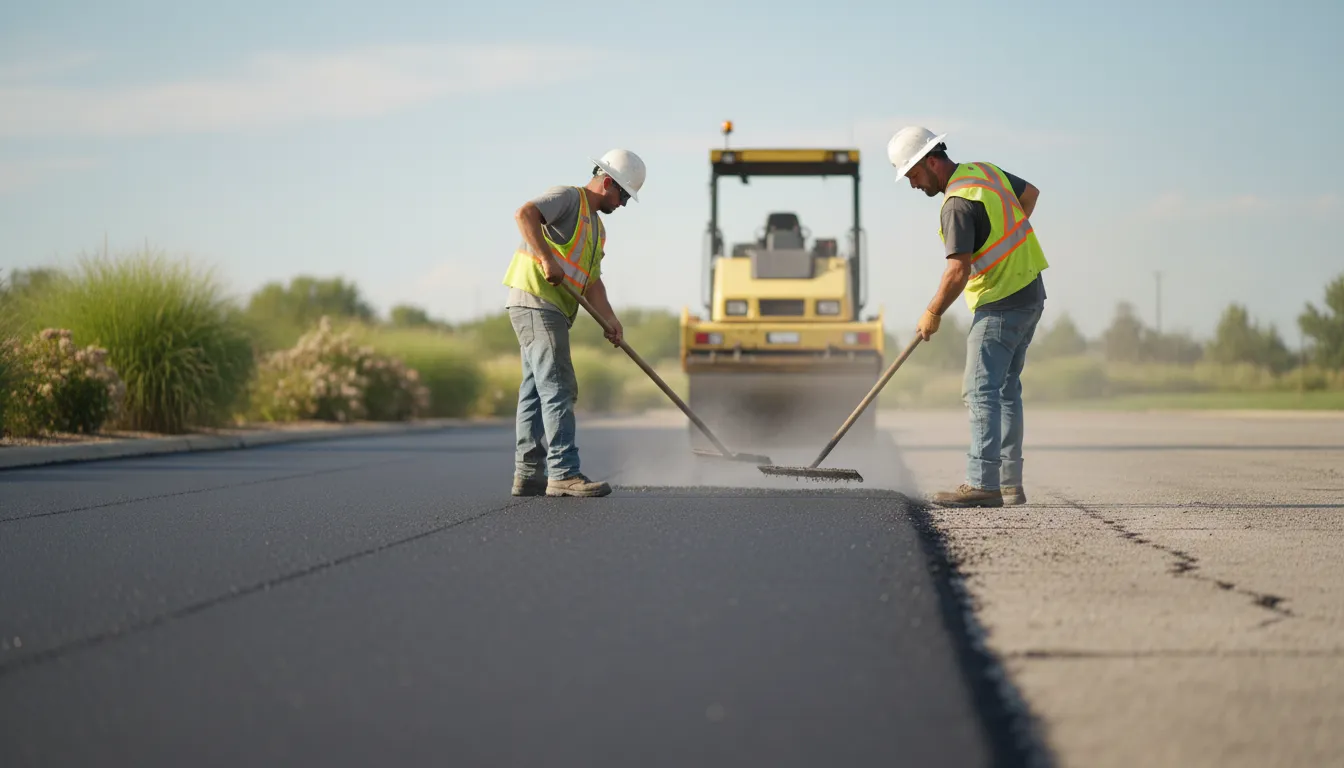
Find the Best Parking Lot Paving Contractors for Your Business
No obligation • Fast responses • Nationwide coverage
Why you can trust Tidy Parking
Tidy Parking is a leading U.S. source for parking lot maintenance services, including striping, sealcoating, sweeping, paving, resurfacing, and repairs. Our content is created independently, and providers cannot pay to influence ratings or recommendations.
Search providers near you
Top Parking Lot Paving Contractors in Jackson, Tennessee Ranked
A well-paved parking lot is a critical asset for any Tennessee business, providing safe, durable, and professional access for customers and employees. The process involves more than just laying asphalt; it requires careful planning to handle the state's unique climate and soil conditions. This guide explains the key considerations, materials, and costs for commercial asphalt paving in Tennessee, helping you understand what goes into a successful project and how to connect with qualified local paving professionals.

Tennessee's Environmental Challenges for Pavement
Tennessee's climate and geology present specific challenges that must be addressed in any parking lot construction to ensure long-term durability.
- High Rainfall & Drainage: With over 50 inches of annual rain across much of the state, effective water management is non-negotiable. A properly designed lot must shed water quickly to prevent seepage that weakens the base and subgrade. This requires a minimum 2% slope (about 1/4 inch per foot) and often includes additional stormwater management features 1.
- Freeze-Thaw Cycles: Winter temperatures fluctuate above and below freezing, causing water in the ground to repeatedly freeze and expand, then thaw. This "frost heave" can crack and buckle pavement that lacks a sufficiently thick, stable base layer.
- Clay Soils: Common in Tennessee, clay soils expand when wet and shrink when dry, creating an unstable foundation. Without proper preparation, this movement leads to premature cracking and settling in the asphalt above 2.
- Summer Heat: Prolonged periods with temperatures over 95°F can cause standard asphalt to soften and rut under heavy loads. The asphalt mix must be designed with heat stability in mind to resist deformation 3.
Optimal Pavement Design & Materials
To withstand these conditions, a parking lot in Tennessee should be built as a multi-layered system, with each layer serving a specific structural purpose.
1. The Subgrade and Base: The Foundation
The native soil (subgrade) must be properly graded and compacted to a high density (often 95% Proctor density) to provide a solid platform 4. On unstable clay soils, stabilization with lime or cement, or the use of geotextile fabrics, may be necessary. On top of this, a 6-8 inch layer of dense-graded aggregate (DGA) stone is standard 5. This base layer distributes loads, provides drainage, and resists frost heave. It must be meticulously compacted in layers (lifts).
2. The Asphalt Structure: Binder and Surface Courses
Asphalt is typically installed in two or more layers:
- Binder Course: This is the structural layer, using a hot mix asphalt (HMA) with larger aggregate for strength. It is placed directly on the prepared base.
- Surface Course: The final wearing layer uses a finer-graded HMA mix for a smooth, dense, and weather-resistant finish.
Critical to performance is the asphalt binder. In Tennessee, a Performance Grade (PG) 64-22 binder is common, suitable for average temperature ranges 6. For lots expecting heavy truck traffic or in areas with intense summer heat, a modified binder like PG 70-22 or PG 76-22 is recommended for enhanced resistance to rutting and thermal cracking 7.
3. Thickness Specifications
Total pavement thickness depends entirely on the expected traffic:
- Light Duty (Passenger Cars): Typically requires 2-3 inches of asphalt over 6 inches of compacted stone base 8.
- Heavy Duty (Delivery Trucks, Garbage Trucks, Frequent Traffic): Requires 4-6 inches of asphalt over 8 or more inches of compacted stone base 9. Never compromise on thickness for cost savings, as it is the primary factor in pavement lifespan.
Drainage: The Most Critical Element
Given Tennessee's rainfall, drainage design is arguably the most important aspect of parking lot paving. Poor drainage is the leading cause of pavement failure.
- Surface Slope: As mentioned, a minimum 2% slope is essential to direct water toward drains or perimeters 10.
- Subsurface Drainage: In areas with high water tables or poor percolation, French drains or underdrains may be installed beneath or beside the base layer to intercept and channel groundwater away, preventing it from saturating and softening the subgrade.
- Stormwater Compliance: Local and state regulations often mandate managing runoff. Solutions can include catch basins, trench drains, and retention ponds 11. In some municipalities, permeable pavement systems are an approved option to reduce runoff volume 12.
The Paving Process: Step-by-Step
A quality paving contractor will follow a meticulous process:
- Site Evaluation & Planning: Assessing soil, drainage, and usage needs to create a design and specification.
- Demolition & Removal: Clearing and hauling away old pavement if necessary.
- Grading & Excavation: Shaping the earth to the precise contours and slopes required for drainage.
- Subgrade Preparation: Compacting the native soil to the required density.
- Base Installation: Spreading and compacting the aggregate stone base in layers.
- Binder Course Installation: Applying a tack coat to the base, then laying and compacting the structural asphalt layer.
- Surface Course Installation: Applying a tack coat to the binder course, then laying and compacting the final smooth asphalt layer.
- Drainage & Curbing: Installing necessary drains, catch basins, and concrete curbs.
- Striping & Sealing: Once the asphalt has cured (typically 30-90 days), applying pavement markings and a protective sealcoat.
Find the perfect parking lot paving contractors for your needs
Get personalized recommendations and expert advice
Cost Factors for Parking Lot Paving in Tennessee
Costs are typically quoted per square foot and vary widely based on project specifics. Statewide, standard asphalt paving generally ranges from $3 to $6 per square foot.
- Project Size: Economies of scale apply. Small lots (under 10,000 sq. ft.) have a higher per-square-foot cost ($4.50 - $7.00) due to fixed mobilization fees. Large lots (over 10,000 sq. ft.) see lower per-square-foot costs ($2.50 - $4.50) 13 14.
- Site Conditions: Extensive grading, poor soil requiring stabilization, or the addition of complex drainage systems will increase costs.
- Pavement Thickness & Design: Heavy-duty designs with thicker asphalt and base layers cost more than light-duty specs.
- Material Alternatives:
- Gravel: A temporary, low-cost option at $1.25-$1.80/sq. ft., but requires frequent maintenance.
- Concrete: A durable alternative with a higher initial cost of $6-$10/sq. ft., and longer installation time 15.
Maintaining Your Tennessee Parking Lot Investment
Protecting your investment starts as soon as the asphalt cures. A high-quality sealcoat should be applied after the first 6-12 months and then reapplied every 2-3 years. This seals the surface from water, oil, and UV damage. Promptly repairing cracks and potholes prevents water infiltration that leads to base failure. Regular professional sweeping and cleaning also prolong the life of the pavement.
Choosing the right contractor is paramount. Look for a licensed, insured company with extensive experience in commercial paving and specific references for projects in Tennessee. They should understand local soil challenges, drainage regulations, and the proper material specifications for our climate.
Frequently asked questions
Sources
Footnotes
-
Drainage Solutions for Asphalt Surfaces - Nashville - R&R Paving - https://randrpavingnashville.com/blog/2025/05/08/drainage-solutions-for-asphalt-surfaces-preventing-water-damage-year-round/ ↩
-
Asphalt Driveway Cost 2026 | NJ Pricing Guide & Estimates - https://randysealcoatingandstriping.com/asphalt-paving-cost ↩
-
Asphalt Paving Price: Factors and Costs per Square Foot - https://renoquotes.com/en/blog/how-much-does-asphalt-paving-cost-per-square-foot ↩
-
Asphalt Paving and Construction - https://www.hawkinspaving.com/grading ↩
-
PAVEMENT DESIGN GUIDE | TN.gov - https://www.tn.gov/content/dam/tn/tdot/hq-materials-tests/pavement-design/TDOT%20Pavement%20Design%20Guide%202025.pdf ↩
-
ASPHALT PARKING LOT GUIDE - PAIKY - https://www.paiky.org/wp-content/uploads/2019/06/PAIKY-Parking_Lot_Guide.pdf ↩
-
Parking Lot Paving | Top Grade Paving - https://topgradepaving.com/parking-lot-paving/ ↩
-
Parking Lot Paving - https://www.nashpaving.com/services/parking-lot-paving/ ↩
-
Commercial and residential paving - Part 2 - https://www.asphaltmagazine.com/commercial-and-residential-paving-part-2/ ↩
-
Parking Lot Services - Hyder Paving Company - https://hyderpaving.com/services/parking-lot-services ↩
-
Cost to Pave a 2-Acre Parking Lot in Somerset County NJ - https://www.nvnpaving.com/cost-to-pave-2-acre-parking-lot-somerset-county-nj/ ↩
-
2.2.23 Permeable Pavement | Murfreesboro, TN - https://www.murfreesborotn.gov/DocumentCenter/View/28122/2223-Permeable-Pavement---2023-Rev ↩
-
Parking Lot Paving Budget Guide Johnson City - https://greenfieldpavement.com/how-to-plan-and-budget-for-parking-lot-paving-in-johnson-city/ ↩
-
How Much Does Asphalt Paving Cost in 2025 - https://www.pateasphalt.com/post/how-much-does-asphalt-paving-cost ↩
-
Asphalt vs. Concrete Parking Lots - https://www.blackdiamondpaving.com/asphalt-vs-concrete-parking-lots/ ↩