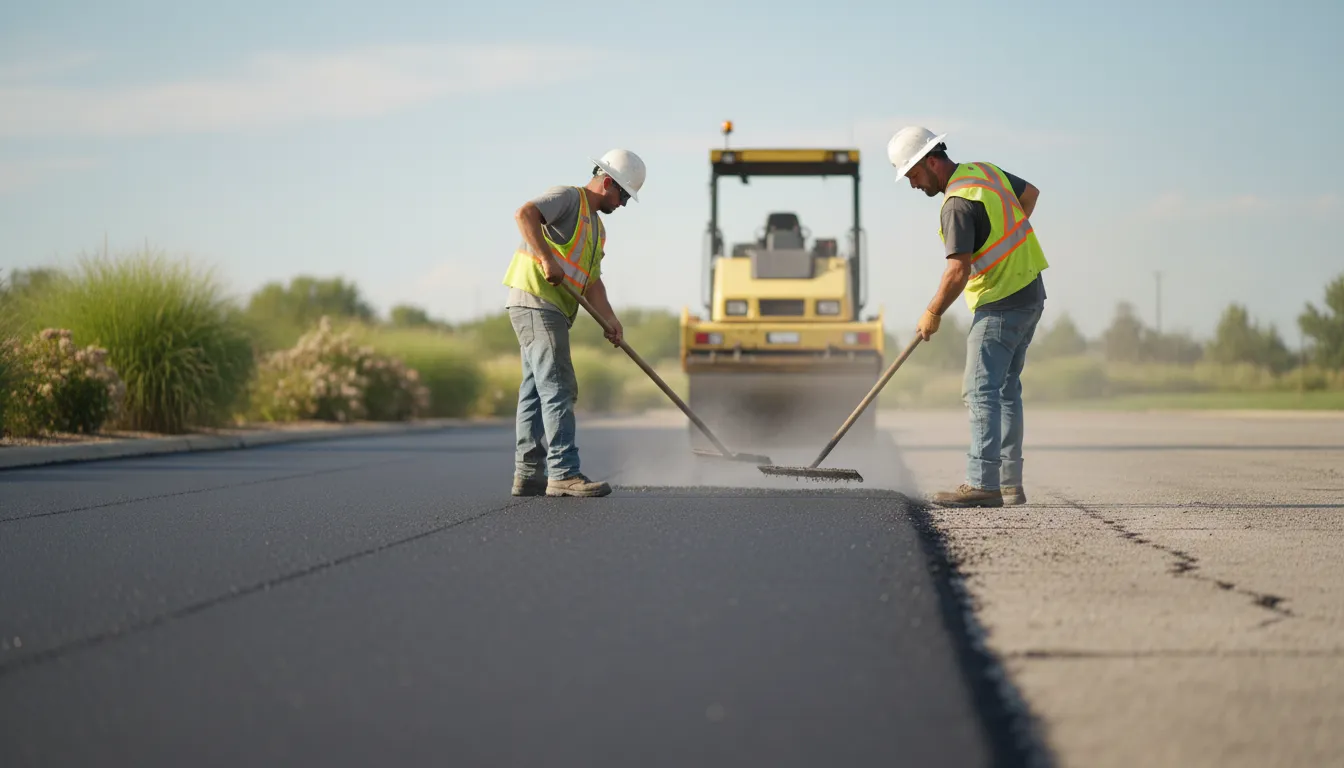
Find the Best Parking Lot Paving Contractors for Your Business
No obligation • Fast responses • Nationwide coverage

Why you can trust Tidy Parking
Tidy Parking is a leading U.S. source for parking lot maintenance services, including striping, sealcoating, sweeping, paving, resurfacing, and repairs. Our content is created independently, and providers cannot pay to influence ratings or recommendations.
Search providers near you
Top Parking Lot Paving Contractors in Springfield, Ohio Ranked
A well-paved parking lot is a critical asset for any Ohio business or property, providing a safe, durable, and professional first impression. In Ohio's demanding climate, successful paving requires adherence to specific engineering standards and material specifications to withstand freeze-thaw cycles and heavy use. This guide explains the key considerations, from state-recommended designs and materials to cost factors, helping you make informed decisions for your next paving project in Ohio.
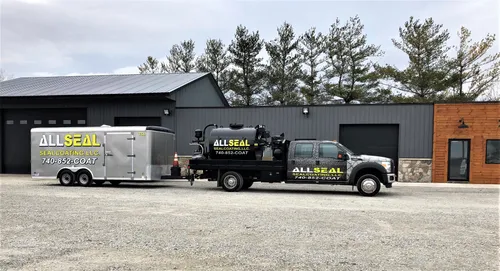
Allseal Sealcoating
252 E 1st St, London, OH 43140
Allseal Sealcoating is a locally owned company based in Columbus, OH, providing a wide range of asphalt and sealcoating services throughout Ohio. Their offerings include sealcoating, pavement striping, asphalt repair, crack filling, paving, concrete work, and signage for commercial, municipal, and residential clients. With over 20 years of industry experience, Allseal Sealcoating serves cities and towns across Central and Northeast Ohio, including Columbus and surrounding areas. They maintain and operate specialized equipment suited for projects of various sizes and types, ensuring quality results for everything from driveways to highways and hospital parking lots.
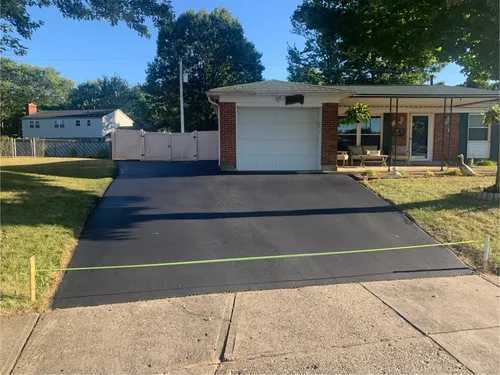
Incredi-Seal Ohio Asphalt Services
Dayton, OH
Incredi-Seal Ohio Asphalt Services provides commercial and residential asphalt solutions in Dayton, OH. They offer a range of services including asphalt sealcoating, parking lot striping and pavement marking, driveway repair and replacement, and asphalt crack repair. With over 20 years of experience, the company handles various asphalt projects to help extend the life and improve the appearance of paved surfaces.
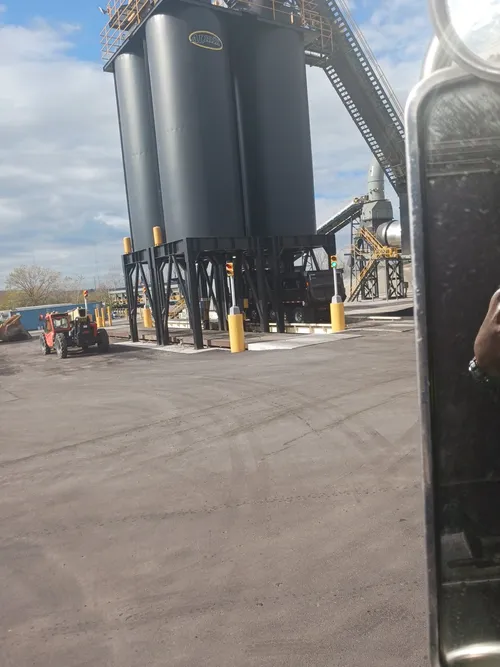
Barrett paving Materials
2701 W Dorothy Ln, Moraine, OH 45439
Barrett Paving Materials is a parking lot paving contractor and repair company based in Dayton, OH. They offer a wide range of paving services and construction materials, including aggregates, ready-mix concrete, and asphalt. The company provides site work, paving, roadway patch and repair, and pavement preservation services. Barrett Paving has over 170 years of experience in building and connecting communities, focusing on safety, effective communication, and delivering projects on time and within budget. Their capabilities include comprehensive paving solutions and project management from start to finish.

Barrett Paving Materials Inc - Fairborn Asphalt
10207 Haddix Rd, Fairborn, OH 45324
Barrett Paving Materials Inc - Fairborn Asphalt is a parking lot paving contractor serving Dayton, OH. They provide a full range of asphalt paving and site work services, supported by multiple asphalt plants across Ohio. The company focuses on using advanced technologies and equipment while emphasizing environmental responsibility, ethics, and safety in their operations.
Vandalia Blacktop & Sealcoating, Inc.
6740 Webster St, Dayton, OH 45414
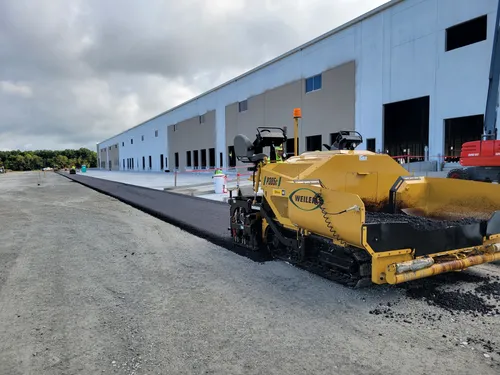
Vandalia Blacktop & Sealcoating, Inc. is a parking lot sealcoating and paving contractor based in Dayton, OH. They provide commercial and residential asphalt, sealcoating, and concrete services throughout the Miami Valley. With 50 years of experience under the same ownership, the company offers reliable paving solutions including large-scale warehouse paving, new construction projects, and residential driveway installations. Their expertise includes asphalt paving, sealcoating to protect surfaces, and concrete work for driveways, patios, and sidewalks.
Understanding Ohio's Paving Standards and Climate Challenges
Parking lot construction in Ohio is not a one-size-fits-all endeavor. The state's climate and traffic demands necessitate designs that go beyond basic installation. The Ohio Department of Transportation (ODOT) Pavement Design Manual and technical guides from Flexible Pavements of Ohio provide the foundational standards for durable construction 1 2 3.
The primary challenge is Ohio's seasonal weather, characterized by significant freeze-thaw cycles. Water that seeps into pavement expands when it freezes, creating pressure that can crack and heave asphalt. When it thaws, the structure weakens, leading to potholes and premature failure 4. To combat this, Ohio paving best practices emphasize:
- Proper Compaction: Achieving 92-96% density during installation to create a dense, impermeable surface that resists water infiltration 5 6.
- Cold-Climate Binders: Using asphalt binders that remain flexible at low temperatures, such as Performance Grade (PG) 64-22 or PG 64-28, to resist cracking 7.
- Strategic Timing: Spring and fall are critical periods for assessing winter damage and performing preventative maintenance like crack sealing before the next freeze 8.
Recommended Asphalt Mixes and Pavement Structure
For strength and flexibility, Hot Mix Asphalt (HMA) is the standard choice for Ohio parking lots 9. ODOT categorizes mixes by "Item" numbers, which specify the aggregate size and binder content. A typical parking lot pavement is built in layered courses, each with a specific function.
- Surface Course: This is the top layer that vehicles drive on. Item 441 Type 1 is a finer, smoother mix commonly used for its excellent ride quality and finish.
- Intermediate/Binder Course: This layer bridges the surface and the base, adding structural strength and helping to distribute loads. Item 441 Type 2 is often specified for this purpose.
- Base Course: This is the main structural layer. Item 301 Asphalt Concrete Base is a common, strong mix placed in thick lifts (often 3 inches or more).
- High-Stress Applications: For lots expecting frequent truck traffic or heavy loading, more advanced mixes like Stone Matrix Asphalt (SMA) or Item 442 Superpave with higher-grade binders (e.g., PG 70-22M) are used to prevent rutting and deformation 10.
The Critical Role of the Base and Subgrade
A paved surface is only as good as what's underneath it. A robust foundation is non-negotiable for longevity, especially in Ohio.
- Aggregate Base: A minimum of 4 to 6 inches of ODOT Item 304 aggregate (crushed stone) is recommended under all flexible pavements. This layer provides stable support and aids in drainage.
- Subgrade Preparation: The native soil (subgrade) must be properly compacted to at least 95% of its maximum dry density to prevent future settling 11.
- Proof Rolling: Before any stone or asphalt is placed, contractors should perform "proof rolling" with a heavy roller to identify and correct any soft, unstable spots in the subgrade 12.
- Geotextile Fabric: In areas with poor soil conditions, a geotextile fabric may be installed between the soil and the stone base. This fabric adds tensile strength and prevents the stone from mixing with the mud below.
Drainage: The Key to Preventing Premature Failure
Water is asphalt's biggest enemy. Effective drainage design is mandatory to move water off and away from the pavement structure quickly.
- Slope (Pitch): Paved surfaces must have a minimum slope of 1% (approximately 1/8 inch per foot) to prevent ponding 13 14.
- Subsurface Drainage: For high-water-table areas or lots with deep bases, pipe underdrains surrounded by porous backfill (like clean stone) are essential to remove water that infiltrates the base layers.
- Catch Basins and Inlets: Properly sized and placed catch basins (such as ODOT standard CB-4, CB-5, or CB-8) are necessary to collect and channel stormwater runoff into the sewer system 15.
Find the perfect parking lot paving contractors for your needs
Get personalized recommendations and expert advice
Cost Considerations for Ohio Parking Lot Paving
Project costs in Ohio vary widely based on size, materials, site conditions, and regional material prices. Understanding the typical cost structure can help in budgeting.
- Small Lots (Under 10,000 sq. ft.): $5.00 - $8.00 per square foot. Higher mobilization costs and less efficiency on small sites drive the per-unit price up.
- Large Lots (Over 50,000 sq. ft.): $3.50 - $6.00 per square foot. Economies of scale make larger projects more cost-effective per square foot 16 17.
- Repair vs. New Construction: A full-depth reconstruction (removing and replacing all layers) will be at the higher end of the cost range. A simple overlay (adding a new surface layer over existing pavement) is a more budget-friendly option if the base is still sound.
Standard Pavement Designs for Different Uses
Following recommended design thicknesses ensures your lot is built to handle its intended load.
-
Light-Duty (Passenger Cars Only):
- 2" Surface Course (Item 441 Type 1)
- 3" Asphalt Base Course (Item 301)
- 6" Aggregate Base (Item 304)
-
Compacted Subgrade
-
Heavy-Duty (Commercial/Truck Traffic):
- 2" Surface Course (Item 441 Type 1)
- 3" Intermediate Course (Item 441 Type 2)
- 4" Asphalt Base Course (Item 301)
- 8-10" Aggregate Base (Item 304)
-
Compacted Subgrade 18
These designs provide a proven blueprint for durability. A qualified paving professional will assess your specific site, soil, and drainage to finalize the optimal design and provide an accurate quote.
Frequently asked questions
Sources
Footnotes
-
Parking Lot Construction in Columbus Ohio - https://paveoh.com/parking-lot-construction/ ↩
-
Untitled - https://www.columbus.gov/files/sharedassets/city/v/1/building-and-zoning/document-library/non-residential-pavement-policy.pdf ↩
-
Technical Resources | Technical Bulletins | FPO - https://www.flexiblepavements.org/technical-bulletins ↩
-
How Long Does Asphalt Paving Last in Cleveland's Climate? - https://legacypaving.biz/asphalt-lifespan-cleveland-climate/ ↩
-
Asphalt Driveway Paving Solutions for Rural Homes - https://www.kingswayservices.com/blog/why-asphalt-is-the-best-upgrade-for-your-rural-driveway ↩
-
Why Asphalt Paving Is the Smartest Investment for Ohio Driveways - https://charlessmithdriveways.com/why-asphalt-paving-smart-investment-ohio/ ↩
-
Climate Adaptation in Asphalt: Designing Pavements for Extreme Weather Resilience - https://www.superioraggregates.net/climate-adaptation-in-asphalt-designing-pavements-for-extreme-weather-resilience/ ↩
-
A 2026 Maintenance Roadmap for Ohio Parking Lots - https://skasphaltconcrete.com/a-2026-maintenance-roadmap-for-ohio-parking-lots/ ↩
-
Ideal Asphalt Mixes for Residential Paving: Factors to Know - https://asphaltdoctors.net/ideal-asphalt-mixes-for-residential-paving/ ↩
-
400 - Flexible Pavement Design - Ohio Department of Transportation - https://www.transportation.ohio.gov/working/engineering/pavement/pavement-design-manual/400 ↩
-
1173.10 PARKING LOT SAFETY STANDARDS. - https://codelibrary.amlegal.com/codes/mentor/latest/mentor_oh/0-0-0-23698 ↩
-
400 - Flexible Pavement Design | Ohio Department of ... - https://www.transportation.ohio.gov/working/engineering/pavement/pavement-design-manual/400 ↩
-
SECTION 2.2 PARKING LOTS FOR CARS - https://irp-cdn.multiscreensite.com/f2c35bed/files/uploaded/section_2.2_parking_lots_for_cars12feb2016.pdf ↩
-
Preventing Parking Lot Injuries: Slope, Condition, and Lighting ... - https://www.thesilverlining.com/hubfs/LC1008%23%20Parking%20Lot%20Condition%20Considerations%20-%207-25.pdf ↩
-
1100 - Drainage Design Procedures | Ohio Department of ... - https://www.transportation.ohio.gov/working/engineering/hydraulic/location-design-vol-2/1100 ↩
-
How to Budget for Commercial Parking Lot Paving Projects - https://thepavementgroup.com/how-to-budget-for-commercial-parking-lot-paving-projects/ ↩
-
Parking lot pavement cost - https://cdn.prod.website-files.com/675db1f4804f900d752a5154/67c816beebe24c84935e747a_xizefobiresiketajijuraza.pdf ↩
-
Technical Resources | Design Guide | FPO - https://www.flexiblepavements.org/design-guide ↩