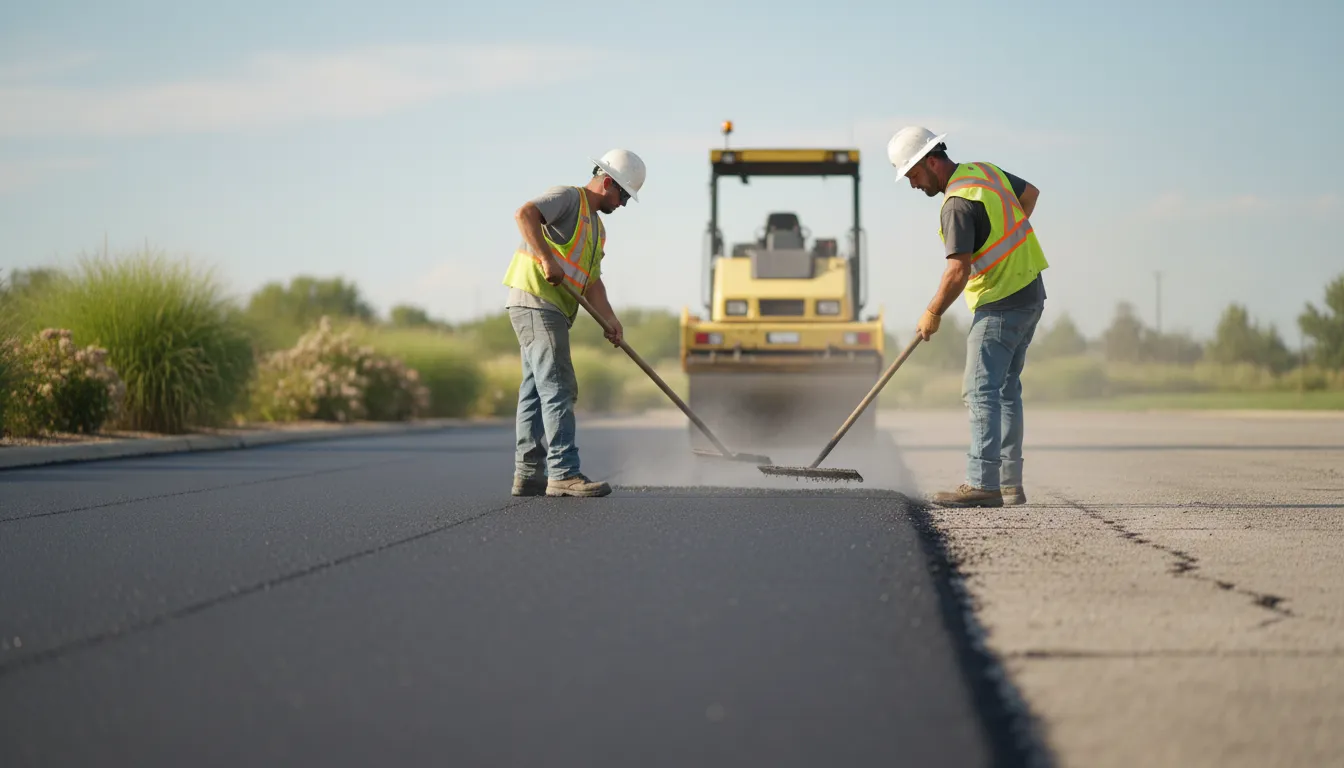
Find the Best Parking Lot Paving Contractors for Your Business
No obligation • Fast responses • Nationwide coverage
Why you can trust Tidy Parking
Tidy Parking is a leading U.S. source for parking lot maintenance services, including striping, sealcoating, sweeping, paving, resurfacing, and repairs. Our content is created independently, and providers cannot pay to influence ratings or recommendations.
Search providers near you
Top Parking Lot Paving Contractors in Chapel Hill, North Carolina Ranked
A new parking lot is a significant investment in your property's functionality, safety, and value. In Chapel Hill, professional asphalt paving involves a precise engineering and construction process tailored to our local climate and soil conditions. This guide explains what goes into a commercial pavement project, from planning and regulations to material selection and long-term durability, helping you understand the scope of work and connect with qualified local paving contractors.
Paving Professionals
815 Purser Dr, Raleigh, NC 27603
Paving Professionals is a parking lot paving contractor based in Raleigh, NC. They provide paving services focused on delivering high-quality asphalt work. The company emphasizes customer satisfaction and guarantees their work, serving clients throughout the Raleigh area.
Ace Asphalt
107 Violet Ann Way, Hillsborough, NC 27278
Ace Asphalt is a family-owned asphalt specialist serving Durham, NC, and the surrounding Triangle and Triad areas since 1970. They provide a full range of services including parking lot paving, resurfacing, and repair for residential and commercial customers. The company is known for hands-on supervision by the owners and offers professional advice to help clients with new construction or maintenance projects.
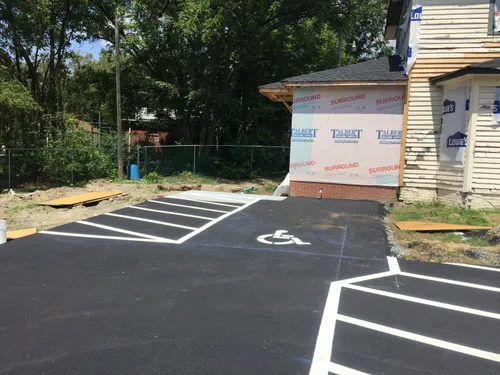
Kapusnik Paving
Greensboro, NC
Kapusnik Paving is a paving contractor based in Greensboro, NC, providing services for both residential and commercial properties. They specialize in asphalt paving, parking lot striping, and sealcoating to maintain and improve driveways and parking lots. Their service area includes Greensboro and surrounding cities such as Raleigh, Durham, and Chapel Hill. Kapusnik Paving also offers concrete driveway installation and replacement, covering a broad range of paving needs.
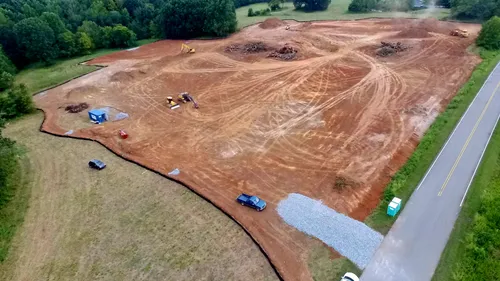
Carroll Contracting, LLC
2552 Saxapahaw-Bethlehem Church Rd, Graham, NC 27253
Carroll Contracting, LLC is a parking lot paving and repair contractor based in Greensboro, NC. They offer a broad range of site development and civil construction services across the Piedmont Triad and throughout North Carolina. Their capabilities include grading, excavation, concrete work, public utility installation, and asphalt paving for private roads and state highways. With over 15 years of experience and an unlimited contractors license in North Carolina, Carroll Contracting brings extensive expertise to projects of all sizes.
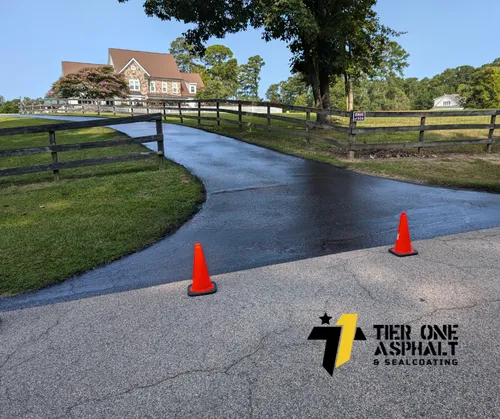
Tier One Asphalt & Sealcoating
Raleigh, NC
Tier One Asphalt & Sealcoating is a locally owned and family-operated company based in Raleigh, NC, specializing in asphalt paving, repair, sealcoating, and line striping for both residential and commercial properties. They serve Raleigh and surrounding areas including Wake County and Johnston County. Their services include asphalt maintenance projects ranging from small driveway repairs to large parking lot sealcoating and striping, helping to protect and extend the life of asphalt surfaces. Tier One Asphalt & Sealcoating is known for assessing pavement conditions to recommend appropriate repairs such as crack filling and patching before sealcoating, which acts as a protective barrier against weather and wear. The company emphasizes community involvement and quality workmanship in their projects.
The Chapel Hill Paving Process: From Groundwork to Finish
Constructing a durable parking lot in Chapel Hill is not simply about laying asphalt. It is a multi-stage construction project that begins long before the hot mix arrives. A proper installation is designed to handle the region's heavy clay soils and high-moisture conditions, ensuring a stable, long-lasting surface.
The typical process includes:
- Site Planning & Engineering: For projects over 20,000 square feet, an approved Erosion and Sedimentation Control Plan from Orange County or the NC DEQ is often required. This planning stage ensures stormwater runoff is managed responsibly from day one.
- Demolition & Grading: Existing pavement is removed, and the land is cleared. Precise grading is crucial, as it creates a sloped, stable foundation to direct water away from buildings and toward drainage systems 1.
- Soil Compaction & Sub-base Installation: North Carolina's dense, clay-heavy soil requires extensive compaction to prevent future sinking. A high-quality, compacted stone base is then installed, which is critical for structural support, especially in wet conditions 2.
- Asphalt Installation: Hot Mix Asphalt (HMA) is usually applied in two layers: a strong binder course for structural integrity and a smooth surface course for the final finish 3.
- Finalization: The project concludes with the installation of necessary drainage structures, concrete curbs, and finally, line striping and sealant.
Navigating Local Regulations and Environmental Factors
Two of the most critical considerations for pavement construction in the Triangle area are soil composition and stormwater management. Ignoring these can lead to premature and costly failures.
Heavy Clay Soils: The region's dense clay does not drain quickly. If not properly treated with a substantial, well-compacted stone base, water can become trapped, leading to instability under the pavement 4 5. This is a primary cause of sub-base failure, where water washes out the supporting material and leads to cracks, potholes, and sinking.
Stormwater Management: Paved surfaces are impervious, dramatically increasing runoff 6. Chapel Hill and Orange County have strict regulations to mitigate this impact. Your project will likely need to incorporate engineered solutions like storm drains, catch basins, or even specialized porous pavement to control water flow and meet local codes 7. Proper planning here is not just a legal requirement-it's essential for the longevity of your investment.
How Climate Influences Asphalt Performance and Material Choice
Chapel Hill's climate presents specific challenges that influence pavement design and material selection. A contractor familiar with local conditions will choose mixes and techniques to maximize durability.
- Heat and Humidity: High summer temperatures can cause standard asphalt to soften, leading to rutting from vehicle tires. Contractors often use stable, high-density mix designs formulated to resist these high-temperature conditions 8 9.
- Freeze-Thaw Cycles: While winters are generally moderate, the area still experiences cycles of freezing and thawing. Water that seeps into small cracks can freeze and expand, widening the cracks. A durable, flexible pavement mix is necessary to withstand this stress 10.
- Intense Precipitation: Sudden, heavy storms are common. Pavement must be constructed to shed water quickly and be durable against constant moisture to prevent premature deterioration like raveling or cracking 11.
Material selection is key. Beyond standard HMA, options like porous asphalt (which allows water to drain through) or polymer-modified mixes may be recommended to manage both water runoff and heat durability effectively 12 13.
Find the perfect parking lot paving contractors for your needs
Get personalized recommendations and expert advice
Understanding Costs for Parking Lot Construction
The cost of a new asphalt parking lot in Chapel Hill can vary widely based on size, site complexity, and materials. Generally, you can expect a range of $2 to $6 per square foot for full, new construction 14 15. For a standard 100-car lot (approximately 30,000-35,000 square feet), this translates to a rough estimate of $90,000 to $350,000. Larger, more complex commercial projects with extensive grading, drainage, and curbing will be on the higher end, while smaller, simpler lots may fall toward the lower end 16.
It's helpful to understand costs for related services:
- Resurfacing an Existing Lot: If your current pavement is structurally sound but worn, a new overlay can cost $1 to $3 per square foot 17.
- Asphalt Patching and Repair: Targeted repair of damaged sections averages around $2.13 per square foot 18.
- Sealcoating: This protective maintenance treatment typically ranges from $0.15 to $0.30 per square foot 19.
Always request detailed, itemized quotes from contractors. A clear breakdown will help you understand what you're paying for, from excavation and base materials to asphalt thickness and finishing work.
Maintenance and Longevity of Your Investment
A properly paved lot is designed to last for years, but its lifespan depends heavily on the initial construction quality and ongoing maintenance. The robust stone base required for Chapel Hill's soils is the most important factor in preventing settling and cracking. After installation, a proactive maintenance plan is essential.
This includes regular sealcoating every 2-3 years to protect the surface from UV rays, gasoline, and oil, as well as prompt repair of any cracks to prevent water infiltration. Addressing minor issues quickly is far more cost-effective than major reconstruction down the line. A well-maintained asphalt pavement in our climate can provide reliable service for 15-20 years or more before a full-depth reconstruction is needed.
Frequently asked questions
Sources
Footnotes
-
Understanding the Roadway Construction Process - https://raleighnc.gov/transportation/services/roadway-design-and-construction/understanding-roadway-construction-process ↩
-
Parking Lot Paving - Regional Asphalt Services - https://www.regionalasphalt.com/services/parking-lot-paving/ ↩
-
Paving a Parking Lot from Scratch (FULL INSTALLATION) - https://www.youtube.com/shorts/4BMJKirANqk ↩
-
Parking Lot Drainage Misconception That Leads to Costly Repairs - https://weaverconstructionservicesinc.com/parking-lot-drainage-misconception/ ↩
-
Yard and Lawn Drainage Experts | French Drains & Hardscapes - https://www.ncdrainage.com/aboutus ↩
-
Paved parking lots generally speed up soil erosion from nearby ... - CK-12 - https://www.ck12.org/flexi/earth-science/avoiding-soil-loss/paved-parking-lots-generally-speed-up-soil-erosion-from-nearby-land-by-increasing-b-%28starts-with-r%29/ ↩
-
Erosion and Sediment Control | Chapel Hill, NC - https://www.chapelhillnc.gov/Business-and-Development/Stormwater-Construction-Regulations/Erosion-and-Sediment-Control ↩
-
NC.indd - Carolina Asphalt Pavement Association - https://www.carolinaasphalt.org/aws/CAPA/asset_manager/get_file/383198?ver=223 ↩
-
Concrete vs Asphalt Parking Lot | Which Lasts Longer in Oklahoma - https://lococoncrete.com/concrete-vs-asphalt-parking-lot-commercial/ ↩
-
An Assessment of the Impact of Climate Change on Asphalt ... - https://www.mdpi.com/2071-1050/15/21/15667 ↩
-
Climate change impacts on roadways | Nature Reviews Earth & ... - https://www.nature.com/articles/s43017-025-00711-9 ↩
-
The Implications of Climate Change on Pavement Performance and ... - https://rosap.ntl.bts.gov/view/dot/24360/dot_24360_DS1.pdf ↩
-
Use of porous pavement catching on despite high price, maintenance - https://www.bayjournal.com/news/pollution/use-of-porous-pavement-catching-on-despite-high-price-maintenance/article_a7969b4d-bac2-575e-8045-b90a5854155b.html ↩
-
How Much Does Asphalt Paving Cost? Breaking Down Your ... - https://americanpavingnc.com/asphalt-paving-cost-breakdown/ ↩
-
How Much Does It Cost to Build a Parking Lot? (2026) - HomeGuide - https://homeguide.com/costs/cost-to-build-a-parking-lot ↩
-
How Much Does Asphalt Paving Cost? Breaking Down Your ... - https://americanpavingnc.com/asphalt-paving-cost-breakdown/ ↩
-
Parking Lot Resurfacing: Complete Cost Guide & Process [2025] - https://www.candcsuperseal.com/parking-lot-resurfacing-complete-cost-guide-process-2025/ ↩
-
North Carolina Parking Lots Costs & Prices - ProMatcher.com - https://parking-lots.promatcher.com/cost/north-carolina.aspx ↩
-
Cost to Pave a Parking Lot Price Guide [2026 Data] | Angi - https://www.angi.com/articles/cost-to-pave-parking-lot.htm ↩