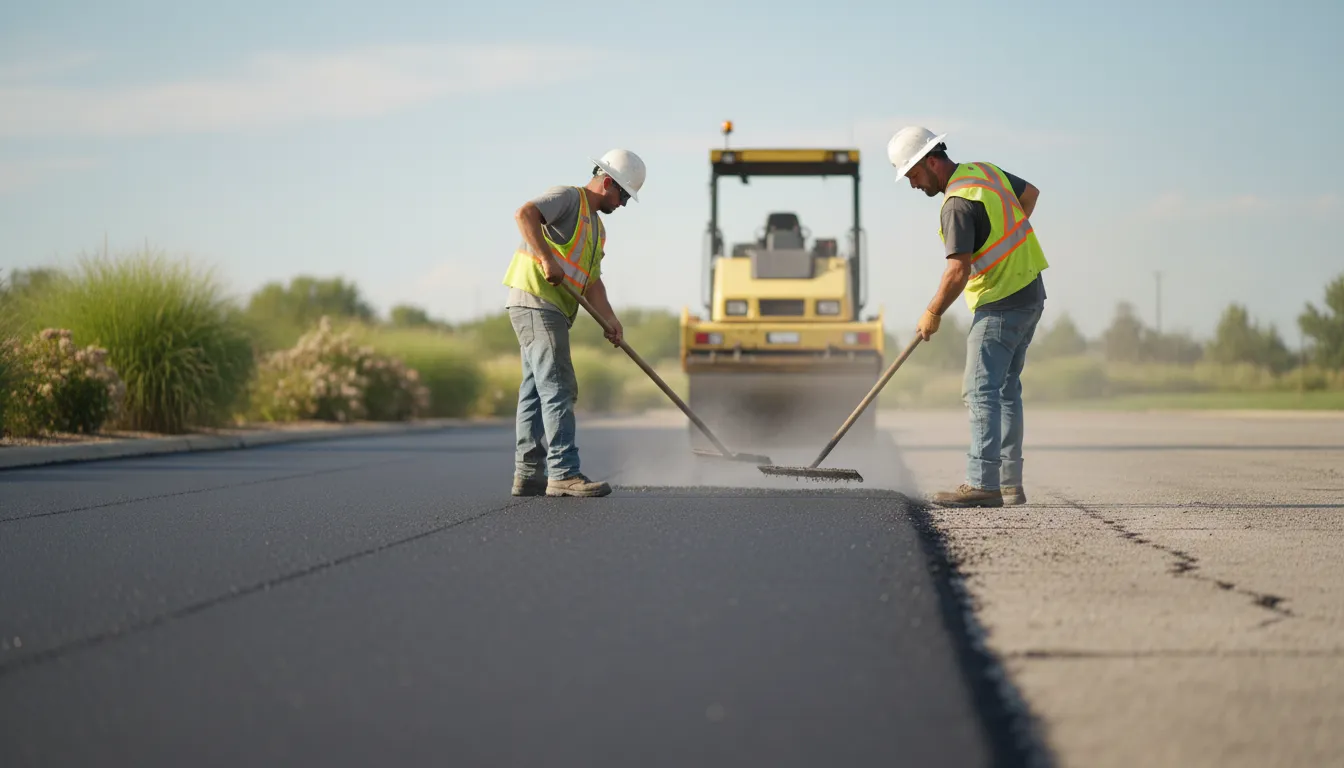
Find the Best Parking Lot Paving Contractors for Your Business
No obligation • Fast responses • Nationwide coverage

Why you can trust Tidy Parking
Tidy Parking is a leading U.S. source for parking lot maintenance services, including striping, sealcoating, sweeping, paving, resurfacing, and repairs. Our content is created independently, and providers cannot pay to influence ratings or recommendations.
Search providers near you
Top Parking Lot Paving Contractors in Lawrence, Indiana Ranked
A well-paved parking lot is a critical asset for any Indiana business or property, providing a safe, durable, and professional first impression for visitors and customers. Given the state's challenging climate with severe freeze-thaw cycles, proper design and construction are not just recommendations-they are necessities to prevent costly, premature failures. This guide explains the key considerations for parking lot paving in Indiana, from material selection and structural design to costs and maintenance, helping you understand what goes into a quality project and how to evaluate local paving professionals.
Why Indiana's Climate Demands Special Attention
Indiana's weather poses a significant challenge to pavement longevity. The cycle of freezing and thawing is particularly harsh on asphalt. Water seeps into tiny cracks, freezes and expands, widening those cracks and weakening the pavement structure from within. This process leads to common issues like alligator cracking, potholes, and base failure. A paving project that doesn't account for these conditions is likely to require repairs much sooner than expected. Therefore, successful parking lot construction in Indiana requires robust design, proper materials, and meticulous attention to drainage to mitigate these environmental stresses.
Key Components of a Durable Parking Lot Structure
A long-lasting parking lot is built in layers, each with a specific function. Cutting corners on any layer compromises the entire system.
1. The Subgrade: The Foundation
The native soil must be properly prepared and compacted to provide a stable platform. An unstable or poorly compacted subgrade will lead to settling and cracking in the layers above, no matter their quality 1.
2. The Base Layer: The Workhorse
This is the most critical structural component. In Indiana, a well-compacted base of 6 to 12 inches of crushed stone (dense-graded aggregate) is standard. This layer distributes the weight of vehicles, prevents frost from penetrating the subgrade, and provides crucial drainage for water to move away from the pavement structure.
3. The Asphalt Pavement: The Surface Course
The asphalt itself is typically applied in two or more layers:
- Base Course: This is the thicker, structural layer of asphalt, designed for strength and stability. For Indiana's variable climate, binders like PG 58E-34 are often specified for their performance across temperature ranges.
- Surface Course: This is the top layer that takes direct traffic and weather. It uses a finer, denser mix of hot-mix asphalt (HMA) for a smooth finish, skid resistance, and durability against wear and tear 2.
Recommended Thickness & Materials for Indiana
The required thickness depends entirely on the expected traffic. A lot serving only passenger cars has very different needs than one handling delivery trucks or semi-trailers.
- Light-Duty (Cars Only): A total asphalt thickness of about 4 inches is common, often consisting of a 2.5-inch base course and a 1.5-inch surface course 3.
- Heavy-Duty (Trucks/Industrial): For lots that will see heavier vehicles, a total thickness of 7 inches or more is recommended. This might include a 4-inch base course and a 3-inch surface course to handle the increased load 4.
In terms of materials, contractors are increasingly using sustainable and high-performance options:
- Warm-Mix Asphalt (WMA): Produced at lower temperatures than traditional HMA, WMA offers environmental benefits, improved compaction, and can extend the paving season.
- Reclaimed Asphalt Pavement (RAP): Incorporating recycled asphalt material is both cost-effective and environmentally friendly, without sacrificing performance when properly engineered.
The Non-Negotiable: Drainage and Slope
Perhaps the single most important design factor in Indiana is drainage. Water is pavement's greatest enemy. Without a way to escape, water saturates the base and subgrade, leading to soft spots, cracking, and complete failure. A minimum slope of 1% to 2% (roughly 1/4 inch per foot) is essential to direct water toward catch basins, drains, or landscaped areas 5 6. Many local ordinances, such as those in Noblesville, also require interior parking rows to end with landscaped islands, which aid in stormwater management 7. Proper planning for where water will go is a fundamental step in the design process.
Find the perfect parking lot paving contractors for your needs
Get personalized recommendations and expert advice
Understanding Costs for Parking Lot Paving in Indiana
Paving costs are highly variable and depend on the project's scope, site conditions, materials, and location within the state. Prices are typically quoted per square foot. It's important to understand that a full reconstruction is a different-and more expensive-project than a simple overlay on an existing, stable pavement.
- Overlay or Resurfacing: If your existing pavement is structurally sound but worn, adding a new surface layer (overlay) is the most economical option. Costs generally range from $3 to $7 per square foot.
- Full Reconstruction (New Construction): This involves complete removal of the old pavement, re-grading and compacting the subbase, and installing new base and asphalt layers. This is necessary for failed lots. For a standard commercial lot, costs typically range from $8 to $15 per square foot.
- Small Lot Example (5,000 sq ft): New construction could cost approximately $35,000 to $65,000.
- Large Lot Example (20,000+ sq ft): A full replacement can easily exceed $160,000 8.
These figures are estimates; obtaining detailed quotes from qualified local contractors is essential. The price should reflect the detailed specifications for base depth, asphalt thickness, and drainage work your site requires.
Seasonal Considerations and Best Practices
Timing matters for a quality pave. Asphalt should not be placed on a frozen subgrade, and ambient temperatures must be suitable for proper compaction. Industry guidance suggests:
- For surface courses (final layer): Pave when temperatures are 60°F or above.
- For lower layers: Can often be placed at 45°F or above.
- In certain conditions with approved mixes, paving may proceed at 32°F or above9.
This makes late spring through early fall the ideal paving window in Indiana. Furthermore, protecting your investment is key. Applying a quality sealcoat every 2 to 5 years is one of the most cost-effective ways to extend the life of your asphalt by protecting it from water, oil, and UV damage 10 11.
Frequently asked questions
Sources
Footnotes
-
Asphalt Paving Industrial Sites Cost-Effective Solutions - https://thepavementgroup.com/asphalt-paving-for-industrial-sites-what-you-need-to-know/ ↩
-
Parking Lots Paving - Hot Mix Asphalt (HMA) Recommendations - https://www.wsbeng.com/parking-lots-paving-hot-mix-asphalt-hma-recommendations/ ↩
-
Paving and Asphalt Calculator - DRYCO - https://www.dryco.com/asphalt-calculator/ ↩
-
The Total Asphalt Pavement For Roads, Streets, and Parking ... - https://docs.lib.purdue.edu/cgi/viewcontent.cgi?article=2922&context=roadschool ↩
-
How Thick is Parking Lot Asphalt? - https://theamericanasphalt.com/2021/05/13/how-thick-is-parking-lot-asphalt/ ↩
-
Parking Lot Paving Tips for Indianapolis Properties - https://dccpaving.com/parking-lot-paving-for-commercial-properties-what-to-know/ ↩
-
§ 159.184 PARKING LOT LANDSCAPING. - https://codelibrary.amlegal.com/codes/noblesville/latest/noblesville_in/0-0-0-10930 ↩
-
Asphalt Paving Cost in Indiana - HSC Pavement Maintenance - https://hscpavementmaintenance.com/asphalt-paving-cost-factors-indiana/ ↩
-
Asphalt Pavement Guidance Specification for Local Agencies - https://www.asphaltindiana.org/docs/APAI_Local_Guide_Specification.docx ↩
-
Sustainable Paving Solutions for Indianapolis Parking Lot Owners - https://www.asphaltsolutionsindy.com/sustainable-paving-solutions-for-indianapolis-parking-lot-owners/ ↩
-
Asphalt Driveways - Asphalt Pavement Association of Indiana - https://www.asphaltindiana.org/asphalt_driveways.php ↩