Find the Best Parking Lot Paving Contractors for Your Business
No obligation • Fast responses • Nationwide coverage

Why you can trust Tidy Parking
Tidy Parking is a leading U.S. source for parking lot maintenance services, including striping, sealcoating, sweeping, paving, resurfacing, and repairs. Our content is created independently, and providers cannot pay to influence ratings or recommendations.
Search providers near you
Top Parking Lot Paving Contractors in Bloomington, Illinois Ranked
A well-paved parking lot is a critical asset for any Illinois business or property, providing safety, functionality, and a positive first impression. However, the state's challenging climate and soil conditions make parking lot paving a specialized engineering task, not a simple lay-and-go project. This guide explains the key considerations, standards, and costs for asphalt paving in Illinois, helping you understand what goes into a durable, long-lasting installation and how to connect with qualified local professionals who can deliver it.

Cullinan RA & Son Inc
121 Park St, Tremont, IL 61568
Cullinan RA & Son Inc is a parking lot paving contractor based in Peoria, IL. The company provides asphalt and concrete paving services for commercial projects, including site development and infrastructure work. They have experience working on a variety of projects such as airports, highways, and commercial sites, showcasing capabilities in asphalt and concrete paving. Cullinan RA & Son Inc is part of a larger network known for its award-winning work in the Midwest, recognized for excellence in safety and quality in the paving industry.
Pete George & Son Blacktop
981 N Pleasant Hill Rd, East Peoria, IL 61611
Pete George & Son Blacktop is a family-operated asphalt paving and sealcoating contractor based in Peoria, IL. Serving Peoria and surrounding counties, they provide a range of services including asphalt paving, sealcoating, resurfacing, patching, crack filling, parking lot striping, concrete work, and dirt hauling. With over 60 years of experience since 1960, they have extensive knowledge of local communities and permit requirements. The company is fully licensed, bonded, insured, and holds an A+ rating with the Better Business Bureau.
Why Illinois Paving is Unique: Climate and Soil Challenges
Illinois parking lots face a relentless environmental battle. The state experiences significant temperature extremes and one of the highest numbers of annual freeze-thaw cycles in the country 1. This cycle is particularly damaging: water seeps into tiny cracks, freezes and expands, then thaws, repeatedly stressing the pavement and subgrade. Over time, this leads to cracking, potholes, and heaving.
Compounding this is the prevalence of poor, clay-heavy subgrade soils common across much of Illinois. Clay is expansive-it swells when wet and shrinks when dry-creating an unstable foundation. A paving project that doesn't properly address these subgrade conditions is destined for premature failure, regardless of the asphalt quality on top. Successful paving here requires designs that manage water and provide a stable, well-drained base.
Core Design & Engineering Standards
To combat these challenges, Illinois paving follows robust engineering standards. The goal is to create a pavement structure that distributes load and resists environmental stress.
The Critical Subgrade and Base The foundation is everything. For clay soils, removal or modification (like mixing with lime or stone) is often necessary 2. Contractors then typically perform "proof-rolling," using a heavy vehicle to identify any remaining soft spots before base installation.
The standard base layer is a minimum of 6 inches of compacted, crushed aggregate (stone). For maximum longevity and a superior moisture barrier, many engineers recommend a full-depth asphalt design, where asphalt is placed directly on the prepared subgrade, eliminating the permeable stone base layer entirely.
Asphalt Thickness & Layering Parking lots are built in layers. A common, durable design for commercial lots includes:
- Binder Course: This is the structural layer, typically a 2.5 to 3-inch thick IL-19.0mm mixture 3.
- Surface Course: This is the final, smooth-wearing layer, usually 1.5 inches of an IL-9.5mm or "Mix D" (N50/N70) mixture for durability and skid resistance 4.
Total asphalt thickness often ranges from 4 inches for light-duty lots to 5.5 inches or more for lots with heavier traffic or truck loading 5.
Material Specifications: The Right Asphalt Mix Using the correct asphalt mix is non-negotiable. Hot Mix Asphalt (HMA) is the standard for its density and durability 6. The asphalt binder (the "glue" that holds the rock together) must be graded for Illinois temperatures. PG 64-22 is commonly specified, meaning it's performance-graded to perform effectively within a range that includes Illinois' average temperatures 7. For high-stress areas like entrances or truck lanes, a polymer-modified binder like PG 76-22 may be used for added strength and flexibility 7.
Find the perfect parking lot paving contractors for your needs
Get personalized recommendations and expert advice
Drainage, Slope, and Local Code Requirements
Proper drainage is the single most important factor in extending pavement life. Without it, water destroys the base and subgrade.
- Slope: Pavement must be crowned or sloped to shed water. Illinois standards typically require a minimum slope of 1.2% to 2% (roughly 1/4 inch of fall per linear foot) from the center to the edges or toward drains 8 9.
- Curbs and Gutters: Most municipal codes, especially for commercial, multi-family, or industrial sites, require concrete curb and gutter (e.g., 6"x18") to contain runoff and direct it to catch basins and storm sewers 10 11.
- Landscaping: Many local ordinances require landscaped islands in parking lots, particularly for rows with 20 or more spaces, to manage stormwater runoff and reduce heat islands 12.
Always check with your local municipality for specific zoning and code requirements before starting a project.
The Paving Process and Ideal Timing
A professional paving project follows a sequenced process:
- Site Evaluation & Demolition: Assessing soil, drainage, and removing old pavement if necessary.
- Grading & Subgrade Prep: Excavating to design depth, correcting soil issues, and establishing precise grade for drainage.
- Base Installation: Spreading and mechanically compacting the aggregate base layer in "lifts."
- Proof-Rolling & Fine Grading: Checking for soft spots and achieving the final grade before asphalt.
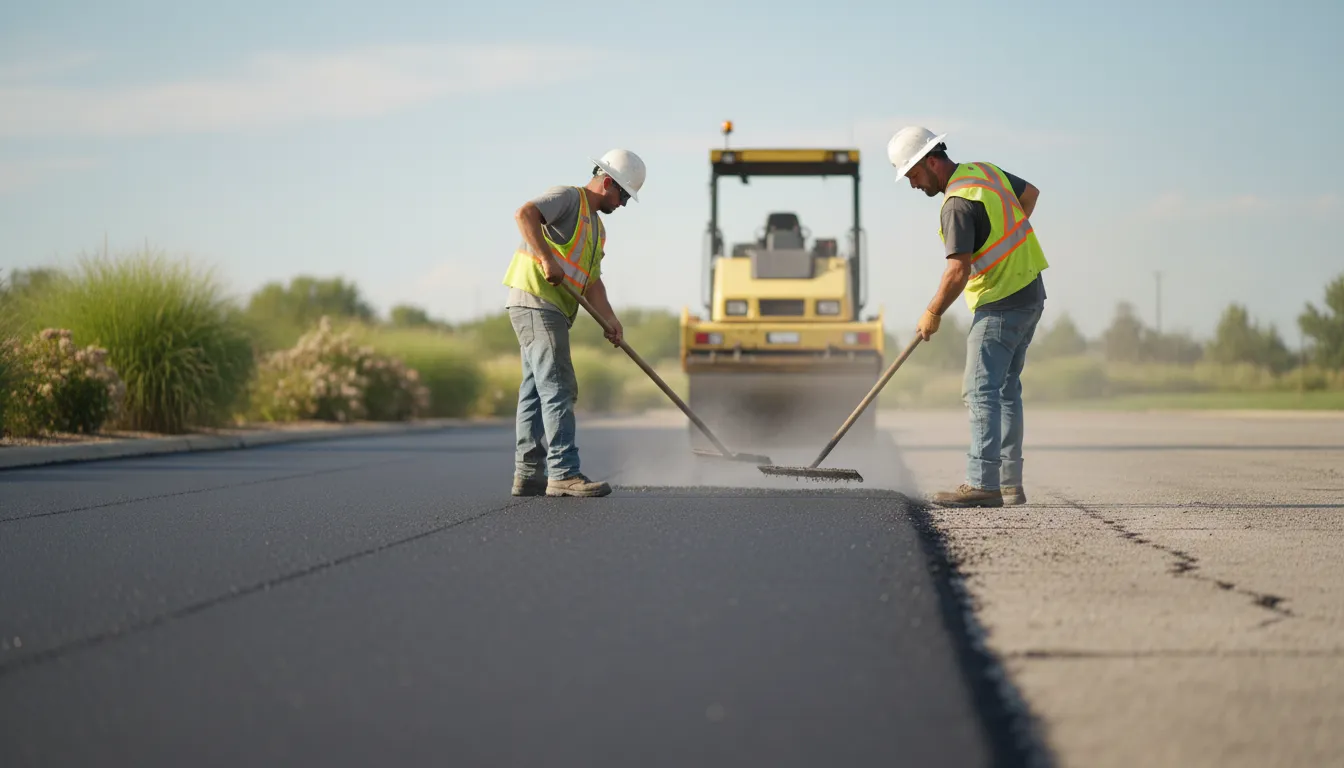
- Asphalt Installation: Placing the binder and surface courses at the correct temperature (typically 275-300°F for HMA) and compacting with rollers.
- Drainage & Finishing: Installing curbs, catch basins, and pavement markings.
When to Pave: The ideal paving window in Illinois is when ambient temperatures are consistently between 50°F and 85°F 13. This temperature range allows the hot mix asphalt to cool at an optimal rate, ensuring proper compaction and long-term density. Spring and early fall are generally the best seasons.
Understanding Parking Lot Paving Costs in Illinois
Costs for asphalt paving in Illinois vary significantly based on site conditions, total thickness, and project complexity. The largest cost drivers are the amount of earthwork and base material needed and the total square footage.
Costs are typically quoted per square foot for the asphalt work, with site preparation, drainage, and curbing as separate line items.
- Per Square Foot Pricing: For the asphalt installation itself, you can generally expect a range of $2.50 to $4.00 per square foot 14. This price is highly dependent on the total thickness and current material costs.
- Project-Scale Estimates:
- A small lot (e.g., 50 spaces, ~15,000-17,500 sq ft) might range from approximately $45,000 to $175,000.
- A large commercial lot (e.g., 200 spaces, ~60,000-70,000 sq ft) could range from $180,000 to $700,000 or more 15.
These are broad estimates. The only way to get an accurate budget is to obtain detailed quotes from licensed contractors who evaluate your specific site.
Maintaining Your Investment
Once paved, proactive maintenance is key. A quality sealcoat applied 6-12 months after paving (and every 2-3 years thereafter) protects the surface from fuel, oil, and water penetration. Promptly crack-filling in the fall prevents water from entering the base during winter freeze-thaw cycles. Regular sweeping and cleaning also prolong the life and appearance of the pavement.
Frequently asked questions
Sources
Footnotes
-
Effect Of The Seasons On Asphalt Parking Lots - https://standardpaving.com/effect-of-the-seasons-on-asphalt-parking-lots/ ↩
-
IAPA :: Driveways - Illinois Asphalt Pavement Association - https://www.il-asphalt.org/asphalt-info/private-commercial/driveways/ ↩
-
2.25" hot-mix asphalt binder course, il-19.0, n50 - Lombard, IL - https://www.villageoflombard.org/DocumentCenter/View/1107 ↩
-
I -------- -------- I HOT-MIX ASPHALT MIXTURE REQUIREMENTS - http://apps.dot.illinois.gov/eplan/desenv/042321/001-60T30/60T30-001%20ADDENDUM%20B/ADDENDUM%20PLANS/PL-60T30-001%20ADDENDUM%20B.pdf ↩
-
IAPA :: Parking Lots - Illinois Asphalt Pavement Association - https://www.il-asphalt.org/asphalt-info/private-commercial/parking-lots/ ↩
-
What Type of Asphalt Mix is Used in Your Parking Lot? - PLS - https://www.plsofflorida.com/asphalt-mix/ ↩
-
MAPA Asphalt Parking Lot Design - https://moasphalt.org/wp-content/uploads/2021/03/Parking-Lot-Design-MAPA-2021.pdf ↩ ↩2
-
IAPA :: Parking Lots - Illinois Asphalt Pavement Association - https://www.il-asphalt.org/asphalt-info/private-commercial/parking-lots/ ↩
-
10-5-12: GENERAL STANDARDS OF DESIGN AND ... - https://codelibrary.amlegal.com/codes/riverwoodsil/latest/riverwoods_il/0-0-0-7466 ↩
-
14-4-8: DRIVEWAYS, DRIVEWAY APRONS, LOADING/ ... - https://codelibrary.amlegal.com/codes/berkeleyil/latest/berkeley_il/0-0-0-11545 ↩
-
SECTION 15.903. OFF-STREET PARKING SPACE AND ... - https://codelibrary.amlegal.com/codes/mettawa/latest/mettawa_il/0-0-0-62032 ↩
-
9-12-8: PARKING LOT LANDSCAPING REQUIREMENTS: - https://codelibrary.amlegal.com/codes/watermanil/latest/waterman_il/0-0-0-3770 ↩
-
How to Prepare for Professional Parking Lot Paving - https://www.raffertypavingteam.com/blog/2025/april/how-to-prepare-your-property-for-professional-pa/ ↩
-
Things to Consider Before Paving an Asphalt Parking Lot - https://bitroads.com/About-Us/Blog/entryid/35/things-to-consider-before-paving-an-asphalt-parking-lot ↩
-
How Much Does It Cost to Build a Parking Lot? (2026) - HomeGuide - https://homeguide.com/costs/cost-to-build-a-parking-lot ↩