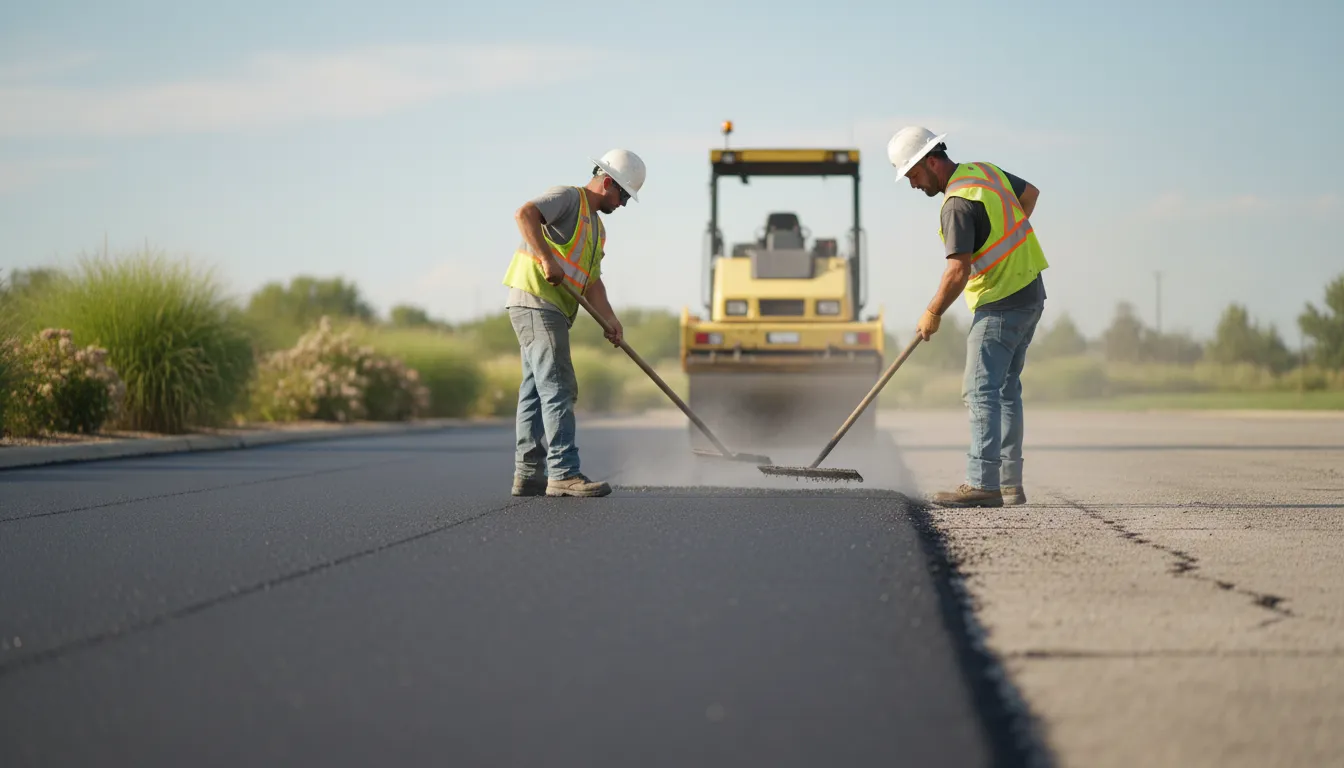
Find the Best Parking Lot Paving Contractors for Your Business
No obligation • Fast responses • Nationwide coverage

Why you can trust Tidy Parking
Tidy Parking is a leading U.S. source for parking lot maintenance services, including striping, sealcoating, sweeping, paving, resurfacing, and repairs. Our content is created independently, and providers cannot pay to influence ratings or recommendations.
Search providers near you
Top Parking Lot Paving Contractors in Manchester, Connecticut Ranked
A well-paved parking lot is a critical asset for any Connecticut business or property, providing safe, durable, and professional access for customers and employees. In Connecticut's demanding climate, a proper asphalt installation is not just about laying down a black surface; it's a complex engineering project that must withstand freeze-thaw cycles, manage stormwater, and support heavy traffic loads for years to come. This guide explains the essential standards, materials, and processes for parking lot paving in the Constitution State, helping you understand what goes into a quality project and how to connect with experienced local professionals who can execute it correctly.
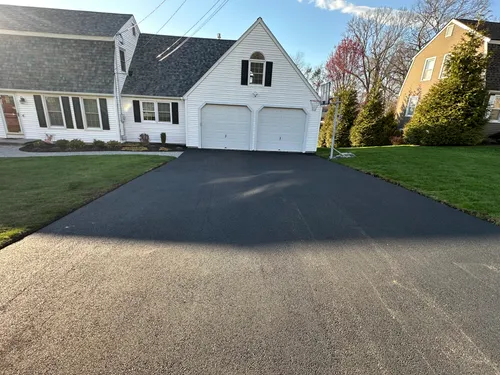
JUGGS PAVING AND MASONRY INC
1251 Old Colony Rd, Wallingford, CT 06492
JUGGS PAVING AND MASONRY INC is a paving and masonry contractor serving Waterbury, CT. This third-generation family business offers a range of services including driveway paving, walkway paving, asphalt installation, concrete work, and poolscape construction. They specialize in installing various types of pavers, asphalt driveways, and concrete surfaces, as well as designing outdoor features like stoops, steps, and retaining walls. The company is licensed and insured and serves clients throughout Connecticut.
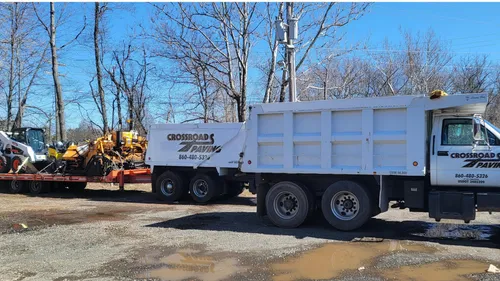
Crossroads Paving CT | Driveway Paving - Commercial Paving - Driveway Sealing
679 Main St, Plymouth, CT 06782
Crossroads Paving CT | Driveway Paving - Commercial Paving - Driveway Sealing is a paving contractor based in Waterbury, CT. They offer a range of services including driveway paving, commercial paving, asphalt repair, sealcoating, and concrete installation. The company has expertise in handling both residential and commercial projects, using modern equipment and quality materials to ensure durable results. With three generations of asphalt contractors behind them, Crossroads Paving CT has over 30 years of experience in the industry. The owner is actively involved on every job site, ensuring attention to detail and quality workmanship.
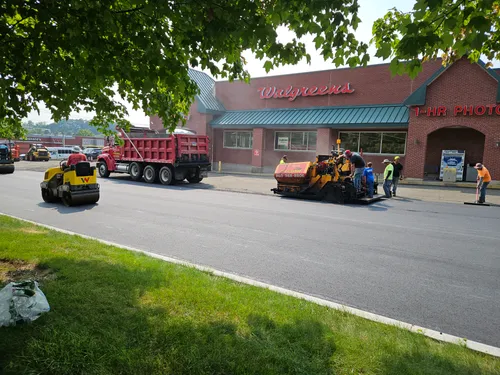
Paving by Custom Construction
309 rear E Center St, Manchester, CT 06040
Paving by Custom Construction is a paving contractor based in Hartford, CT, with 22 years of experience. They offer a variety of services including asphalt paving, parking lot striping, sealcoating, parking lot repair, concrete work, drainage solutions, and stone work. The company provides warranties on complete paving projects and focuses on meeting client goals for cost, schedule, and quality.

Stan's Paving
Springfield, MA
Stan's Paving is a paving contractor based in Springfield, MA, offering a wide range of services including asphalt installation, parking lot paving, resurfacing, crack filling, seal coating, and line striping. Serving Springfield and surrounding cities, the company specializes in creating durable, well-marked parking lots and driveways with attention to detail and safety. With over 23 years of experience, Stan's Paving provides expert solutions designed to extend the lifespan of paved surfaces and enhance their appearance.
Ace Asphalt Paving
997 Tinkham Rd, Wilbraham, MA 01095
Ace Asphalt Paving is a family-owned paving contractor based in Springfield, MA, serving Western Massachusetts and Northern Connecticut. They specialize in commercial and residential asphalt paving, including parking lot installation, resurfacing, and repair. Their services include asphalt milling and paving to extend pavement life and commercial asphalt patching to address localized damage. Established in 2015, the company brings over 20 years of experience to each project and offers a 2-year warranty on their work.
Why Connecticut's Climate Demands Specialized Paving
Connecticut experiences a full range of seasonal weather, from hot, humid summers to cold, snowy winters. This cycle of freezing and thawing is one of the most significant challenges for pavement. Water seeps into tiny cracks, freezes and expands, then thaws, repeatedly stressing the asphalt and sub-base. This process, if not planned for, leads to rapid deterioration, potholes, and costly premature repairs 1.
To combat this, specific material standards are mandated. The standard asphalt binder (the "glue" that holds the rock aggregate together) specified for Connecticut is Performance Grade (PG) 64S-22 2 3. This designation means the binder is engineered to perform at high temperatures up to 64°C (147°F) without softening and at low temperatures down to -22°C (-7.6°F) without becoming brittle and cracking. For parking lots expecting heavy use or in particularly harsh microclimates, polymer-modified binders are often recommended to provide even greater resistance to thermal cracking and rutting.
Key Design & Structural Standards
A durable parking lot is built from the ground up. Connecticut's official guidelines, often referencing the CTDOT Pavement Design Handbook, provide a blueprint for success 4 5. The structure is a layered system, each with a specific purpose:
- Subgrade Preparation: This is the native soil. All organic material (topsoil, roots) must be removed, and the soil must be thoroughly compacted to at least 95% of its maximum density (Standard Proctor) to provide a stable, unyielding foundation 6 7.
- Aggregate Base Course: This layer, typically 4 to 6 inches of processed ¾" crushed stone, is the workhorse of the pavement structure, providing up to 80-90% of its strength 8 9. It must be properly graded and compacted in layers (lifts). In areas with poor soil, a geotextile fabric is often laid between the subgrade and base to prevent the soils from mixing and weakening the structure 10.
- Asphalt Layers: The asphalt itself is installed in multiple layers. A common specification for a commercial lot is a 2.5-inch asphalt base layer topped with a 1.5-inch surface layer, for a total of 4 inches 11 12. For areas with frequent truck traffic or dumpster service, thickness may increase to 6 inches. The surface mix uses a finer aggregate for a smooth, impermeable, and durable finish 13.
Summary of Typical Commercial Parking Lot Structure in CT:
| Component | Typical Requirement |
|---|---|
| Compacted Subgrade | 95% Standard Proctor Density |
| Aggregate Base | 4-6 inches of Processed ¾" Stone |
| Asphalt Thickness (Total) | 4 inches minimum for commercial |
| Binder Grade | PG 64S-22 (Standard) |
| Surface Slope | Minimum 1%-2% |
Material Choices: Hot Mix, Warm Mix, and Porous Asphalt
- Hot Mix Asphalt (HMA): The traditional and most common choice. It is produced and laid at high temperatures (300°F-350°F), which allows for excellent compaction and long-term density.
- Warm Mix Asphalt (WMA): An increasingly popular technology that allows asphalt to be produced and placed at temperatures 30 to 100 degrees Fahrenheit lower than HMA. Benefits include reduced fuel consumption, lower greenhouse gas and fume emissions, and the ability to pave effectively in cooler weather 14.
- Porous Asphalt: This is a special open-graded mix placed over a deep, clean stone reservoir. It allows rainwater to drain directly through the pavement and into the ground, recharging groundwater and significantly reducing stormwater runoff. The Connecticut Department of Energy and Environmental Protection (DEEP) encourages its use in suitable applications as a Low Impact Development (LID) technique.
Critical Drainage and Stormwater Management
Proper drainage is non-negotiable in Connecticut. Ponding water ("bird baths") accelerates pavement failure, creates ice hazards in winter, and violates most municipal codes. The pavement surface must have a minimum slope of 1% to 2% to direct water toward drains, curbs, or landscaped areas 15.
More importantly, Connecticut enforces strict stormwater regulations under its Municipal Separate Storm Sewer System (MS4) permit program. Any new paving project that creates or replaces significant impervious surface area may require a permit and a stormwater management plan 16 17. This often means incorporating features like:
- Catch Basins and Curbing: To collect and convey runoff.
- Vegetated Swales or Bioretention Areas: Landscape features that naturally filter and absorb runoff.
- Subsurface Retention Systems: Stone chambers or tanks that temporarily hold and slowly release water.
Ignoring these requirements can lead to project delays, fines, and environmental harm.
The Paving Process: From Site Prep to Final Roll
- Planning & Permitting: The process begins with design, including surveying for proper slope and determining drainage needs. Necessary local building and DEEP stormwater permits must be secured.
- Demolition & Excavation: Existing failed pavement is removed. The subgrade is excavated to the required depth to accommodate the new base and asphalt layers.
- Subgrade & Base Installation: The subsoil is graded and compacted. The aggregate base is spread in layers and compacted to create a rock-solid platform.
- Binder & Edge Installation: A tack coat (asphalt emulsion) may be applied to help the new asphalt bond to the base. Concrete curbs are often installed at this stage.
- Asphalt Placement: The hot or warm mix asphalt is delivered, spread by a paver, and preliminary compacted by a roller following closely behind.
- Compaction: This is the most critical step for longevity. Steel-wheel and pneumatic rollers achieve the final density, eliminating air pockets and creating a seamless, dense mat.
- Striping & Landscaping: Once the asphalt has cooled, new pavement markings are applied. Final landscaping and drainage connections are completed.
Find the perfect parking lot paving contractors for your needs
Get personalized recommendations and expert advice
Understanding Costs for Parking Lot Paving in Connecticut
Costs are highly variable and depend on site conditions, size, materials, and drainage requirements. Economies of scale apply, so the cost per square foot generally decreases as project size increases.
- Small Parking Lots (< 10,000 sq ft): Projects in this range can cost between $4.00 and $9.00 per square foot 18 19. Site preparation, excavation, and bringing in smaller equipment contribute to the higher per-unit cost.
- Large Commercial Lots (> 50,000 sq ft): For extensive projects like shopping centers or office complexes, prices often range from $2.50 to $6.00 per square foot 20 21. These estimates typically include a standard 4-inch asphalt overlay on a prepared base. Costs will rise significantly if extensive excavation, a thick new aggregate base, complex drainage systems, or porous asphalt is required.
Maintenance: Protecting Your Investment
A new pavement is a major investment. Protect it with a regular maintenance plan:
- Sealcoating: Apply a protective coal tar or asphalt-based sealant every 2-3 years to shield against UV rays, gasoline, and water.
- Prompt Crack Sealing: Fill hairline cracks annually with hot-pour rubberized sealant to prevent water infiltration.
- Proper Snow Removal: Use plows with rubber blades or keep metal blades slightly raised to avoid gouging the surface.
Frequently asked questions
Sources
Footnotes
-
How Weather Affects Asphalt Paving | Blog - https://crossroadspavingct.com/how-weather-affects-asphalt-paving/ ↩
-
Guidance for Superpave Bituminous Concrete Mixes - CT.gov - https://portal.ct.gov/dot/-/media/dot/pavement/guidance-for-superpave-bituminous-concrete-mixes.pdf?rev=f8cfc749be3b43b986ddd5d05d556cc4&hash=B6D2FA36A69EC3D23501EADFA889B8D9 ↩
-
Guidance for Superpave Bituminous Concrete Mixes - CT.gov - https://portal.ct.gov/dot/-/media/dot/pavement/guidance-for-superpave-bituminous-concrete-mixes.pdf?rev=f8cfc749be3b43b986ddd5d05d556cc4&hash=B6D2FA36A69EC3D23501EADFA889B8D9 ↩
-
Guidance for Parking Lot Pavements - CT.GOV/DOT - https://portal.ct.gov/dot/-/media/dot/pavement/guidance-for-parking-lot-pavements.pdf?rev=d101cbe3ae0643f592f6ed8823420edc&hash=87D80CBE22C58F09623761794FC11A45 ↩
-
CTDOT Pavement Design Handbook - ROSA P - https://rosap.ntl.bts.gov/view/dot/57390/dot_57390_DS1.pdf ↩
-
driveway apron permit application & procedures - Andover, CT | - https://www.andoverconnecticut.org/building-land-use-department/files/driveway-apron-permit-application-procedures-0 ↩
-
Proper Base and Subgrade Construction for Parking Lots - https://www.mypavementguy.com/proper-base-and-subgrade-construction-for-parking-lots/ ↩
-
a guideline for the design and construction of asphalt parking lots in ... - https://www.co-asphalt.com/assets/docs/CAPA-Parking-Lot-Design-Guide-2nd-edition-DEC2016.pdf ↩
-
Base for Pavers: How to Prep & Lay a Paver Base - Western Interlock - https://westerninterlock.com/how-to-prep-lay-a-base-for-pavers/ ↩
-
Permeable Pavement - CT.gov - https://portal.ct.gov/-/media/DEEP/water_regulating_and_discharges/stormwater/manual/CH11PPS6pdf.pdf ↩
-
How to Prepare Your Property for Professional Parking Lot Paving - https://www.raffertypavingteam.com/blog/2025/april/how-to-prepare-your-property-for-professional-pa/ ↩
-
HOT MIX ASPHALT PAVEMENTS - City of Meriden - https://www.meridenct.gov/file-repository/DownloadFile.aspx?FileID=407 ↩
-
What Type of Asphalt Mix is Used in Your Parking Lot? - PLS - https://www.plsofflorida.com/asphalt-mix/ ↩
-
Things to Consider Before Paving an Asphalt Parking Lot - https://bitroads.com/About-Us/Blog/entryid/35/things-to-consider-before-paving-an-asphalt-parking-lot ↩
-
Preventing Parking Lot Injuries: Slope, Condition, and Lighting ... - https://www.thesilverlining.com/hubfs/LC1008%23%20Parking%20Lot%20Condition%20Considerations%20-%207-25.pdf ↩
-
Chapter 4 - CT.gov - https://portal.ct.gov/-/media/DEEP/water_regulating_and_discharges/stormwater/manual/Chapter4pdf.pdf ↩
-
Chapter 4 - CONNECTICUT STORMWATER QUALITY mANUAL - https://portal.ct.gov/-/media/deep/water/water_quality_management/guidance/chpt_47_swm_mar_2024.pdf?rev=b773bb57b189491fb423ece2984f3ad6&hash=2384AAC163549215ECCAF4D490ADA6C2 ↩
-
How Much Does Paving a Parking Lot Cost? - https://crossroadspavingct.com/how-much-does-paving-a-parking-lot-cost/ ↩
-
Cost to Pave a Parking Lot Price Guide [2026 Data] | Angi - https://www.angi.com/articles/cost-to-pave-parking-lot.htm ↩
-
Step-by-Step Guide to Planning Your Commercial Asphalt Paving Project - https://thepavementgroup.com/step-by-step-guide-to-planning-your-commercial-asphalt-paving-project/ ↩
-
Organic-Lock 2025 - https://www.organic-lock.com/installation-costs-and-maintenance-of-popular-paving-materials/ ↩