
Planning a parking lot striping layout for traffic flow
Start with how you want vehicles to move
Before you think about lines and arrows, decide how cars should move through the site:
- Where do most vehicles enter and leave?
- Where is the front door or main destination?
- Where will trucks, delivery vans, and emergency vehicles go?
Sketch a simple "traffic diagram" first (even on paper): draw the drive aisles, main circulation loop, and where vehicles should not go. Your striping layout will then reinforce that plan instead of improvising it with paint.
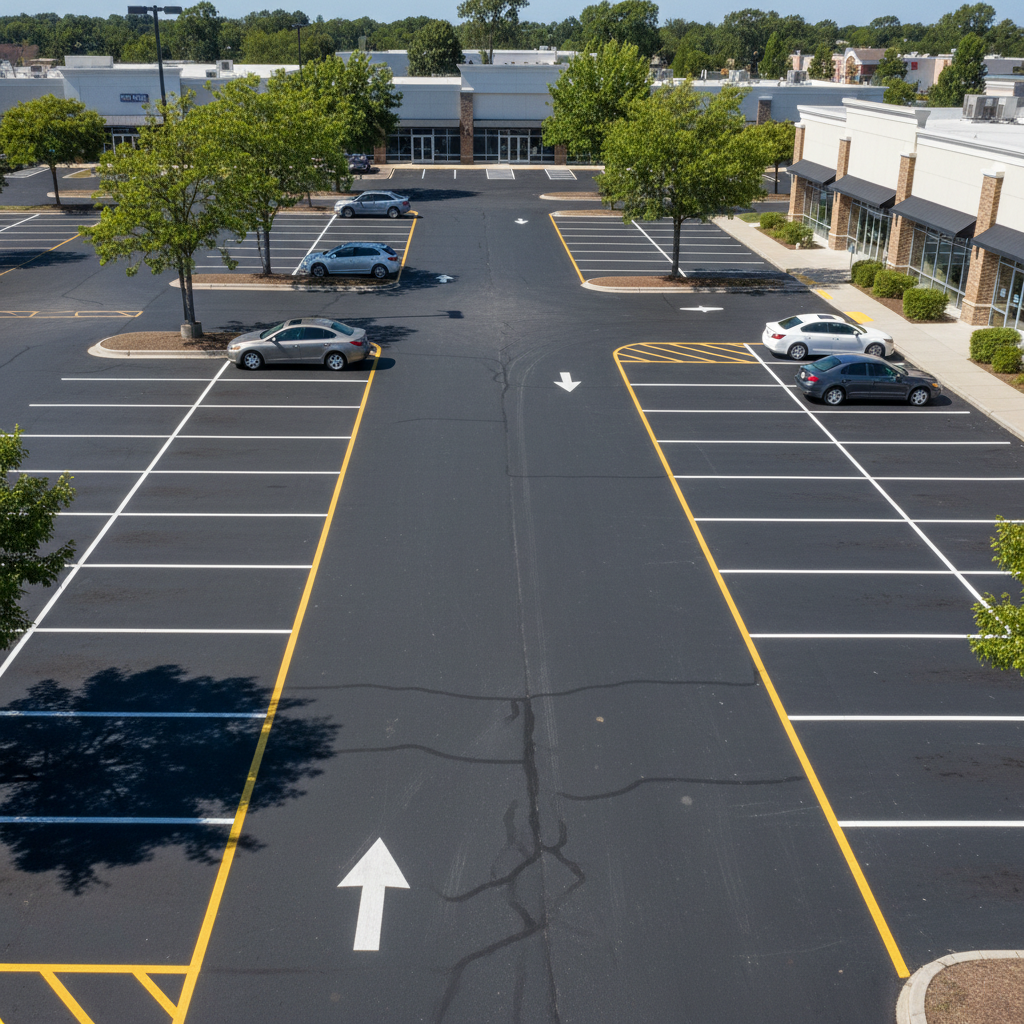
Choosing stall angles to shape traffic
Stall angle is one of the biggest drivers of traffic flow and driver behavior.
90-degree (perpendicular) parking
- Pros: Maximum stalls per square foot; familiar to drivers; works with two-way aisles.
- Cons: Harder to pull into and back out of, especially for larger vehicles; more conflict with through-traffic.
- Best for: Employee parking, long-term parking, or lower-turnover areas where capacity matters more than speed.
60-75-degree (angled) parking
- Pros: Easier and faster to enter/exit; strongly encourages one-way circulation; better visibility when backing out.
- Cons: Slightly fewer stalls than 90°, requires one-way aisles and good directional markings.
- Best for: Customer spaces near entrances, high-turnover retail, quick-stop zones.
Use angled stalls on your primary customer-facing aisles to nudge drivers into a one-way loop that feels intuitive.
45-degree parking
- Pros: Very easy to enter and exit, good for tight sites.
- Cons: Noticeably reduces stall count; can lengthen the site.
- Best for: Small lots or awkward parcels where comfort and flow beat raw capacity.
Bottom line: Pick one main stall angle for each area, and let that angle dictate one-way vs two-way aisles instead of mixing too many patterns.
Laying out drive aisles for smooth circulation
Drive aisles are the "streets" of your lot. Get them right, and drivers rarely have to stop, back up, or make awkward turns.
One-way vs two-way aisles
- One-way aisles pair with angled parking and make decisions simple: pull in, back out with traffic, follow arrows.
- Two-way aisles pair with 90° stalls and need more width and clearer centerlines or edge lines.
Use one-way aisles for most customer stalls where possible, then connect them with a wider two-way perimeter drive for circulation and fire access.
Aisle width and turning
Follow your local codes and design standards for exact dimensions, but in general, wider aisles:
- Reduce fender-benders and door conflicts when vehicles back out.
- Make it easier for SUVs and pickups to maneuver.
- Help delivery and emergency vehicles navigate without hopping curbs.
At internal intersections, paint clear centerlines, stop bars, and directional arrows so drivers know who should yield. High-conflict crossing points near building entrances often benefit from crosswalk striping and advance arrows to slow traffic.
Entrances, exits, and wayfinding
Your layout should make it almost impossible for a new visitor to get confused.
Position entrances and exits with intent
- Line up main drive aisles with the dominant driveway to avoid immediate sharp turns.
- Avoid placing an exit directly opposite the building entrance doors if it encourages pedestrians to walk through live traffic.
- Where possible, plan separate in and out movements using arrows, DO NOT ENTER markings, and signs.
Use striping to guide the "desire line"
A desire line is the path people naturally want to take. Use:
- Directional arrows in aisles, not just at intersections.
- Stop bars at key conflict points and at the end of aisles feeding into major drives.
- Crosswalks across main pedestrian routes-from parking fields to building entrances.
Keep your visual language consistent: same arrow style, same line thickness, and predictable placement so drivers immediately "read" the lot.
Integrating loading zones, fire lanes, and special areas
Striping is also how you protect critical operational space and keep heavy vehicles out of regular parking flow.
Loading and delivery areas
- Place loading zones off the main customer aisles when possible, using a side or rear drive.
- Use bold hatch striping to reserve truck maneuvering areas and keep regular cars from "borrowing" that space.
- Avoid backing movements that cut across primary pedestrian paths.
Fire lanes and emergency access
In most jurisdictions, fire code requires clear fire lanes along certain building faces and access routes. These are typically marked with curb or pavement legends such as FIRE LANE and NO PARKING; exact markings and widths are set by your local fire authority.1
Keep regular striping patterns out of these zones so it's visually obvious they are not for parking.
Accessible (ADA) parking, pickup, and EV
- Accessible stalls and access aisles must follow the Americans with Disabilities Act (ADA) Standards for Accessible Design, including location, count, and striping of access aisles.2
- Place these spaces on the shortest accessible route to the main entrance, away from loading docks and heavy through-traffic.
- If you have curbside pickup or EV charging spaces, separate them from main accessible rows, and use markings to control in-and-out movements so vehicles don't queue across drive aisles.
Safety, visibility, and maintenance
A good layout fails if markings fade or are hard to see at night.
Make markings easy to see
- Choose line widths and colors that comply with local standards (commonly 4-inch or 6-inch white or yellow for stalls and aisles). Many jurisdictions reference the Manual on Uniform Traffic Control Devices (MUTCD) for color and pattern conventions.3
- Use contrasting colors for no-parking zones, crosswalks, and accessible areas so they stand out from regular stalls.
- Ensure lighting supports your layout: critical decisions (turns, crossings, stops) should be well lit so stripes and arrows are readable after dark.
Design for long-term clarity
- Avoid overly complex patterns, tiny stalls, or unnecessary short aisles that invite creative parking.
- Leave room for future adjustments-for example, extra space near an entrance that could later be re-striped for added accessible stalls or short-term parking.
- Plan for restriping cycles. High-traffic areas and entrances often need more frequent repainting; a simple layout is cheaper and quicker to refresh.
Simple planning workflow before you call a striping company
- Map circulation. Sketch how cars, trucks, and pedestrians should move.
- Assign stall types by zone. High-turnover vs long-term, customer vs employee, accessible, EV, pickup.
- Choose stall angles. Angled with one-way aisles for customer convenience; 90° with two-way aisles where capacity is critical.
- Place entrances, exits, and key aisles. Align them with driveways and doors; minimize sharp turns.
- Layer in special areas. Loading, fire lanes, accessible stalls, crosswalks, and no-parking zones.
- Review for conflicts. Look for backing movements across busy walkways, confusing intersections, or blind spots.
- Hand off a clean sketch (or simple CAD/base plan) to your striping contractor and ask for their input; they'll be familiar with local preferences and code details.
Conclusion
Plan traffic flow first, then let stall angles, aisles, and special zones work together in your striping layout to make the parking lot safer, easier to navigate, and more efficient.
Glossary
- ADA (Americans with Disabilities Act): Federal law setting accessibility requirements, including for parking spaces and access aisles.
- EV (electric vehicle): Vehicles that may need dedicated charging spaces, often signed and striped differently.
- MUTCD (Manual on Uniform Traffic Control Devices): National standard for traffic signs, signals, and pavement markings.
Sources
Footnotes
-
Example local fire lane marking requirements referencing the International Fire Code via a U.S. city fire department. ↩
-
U.S. Department of Justice, 2010 ADA Standards for Accessible Design, parking and passenger loading zones. ↩
-
Federal Highway Administration, Manual on Uniform Traffic Control Devices (MUTCD), pavement marking standards. ↩