Parking lot sealcoating costs and what affects price
Quick answer: what does parking lot sealcoating cost?
For a commercial asphalt parking lot in the U.S., professional sealcoating typically runs about $0.20-$0.35 per square foot as of 2025-2026, with a broader range of roughly $0.17-$0.40 depending on lot size, condition, access, and scope.1 2
On a medium-size lot (say 20,000-50,000 square feet), that often means something like $4,000-$16,000 for two coats of sealer with basic prep and crack filling, assuming no major repairs are needed.1 Very small, chopped-up lots tend to cost more per square foot; very large, wide-open portfolios tend to land closer to the low end of the range.1 2
Costs and price drivers (with ballpark ranges)
This section is about getting you in the right ballpark before you start collecting bids.
Typical national ranges (2025-2026)
Recent commercial sealcoating data from U.S. projects shows most professional jobs falling in these bands:1 2
- National "normal" range: about $0.17-$0.40 per sq ft for commercial lots, depending on size and complexity.1
- Common sweet spot for many medium jobs: roughly $0.20-$0.32 per sq ft.1 2
Industry cost breakdowns that look at paving projects as a whole put sealcoating itself in the $0.18-$0.30 per sq ft range for the sealer line item alone, before adding things like striping or major repairs.2
Quick example
Let's say you have a 30,000 sq ft shopping-center lot in average condition and get a quote of $0.24-$0.28 per sq ft for two coats and basic crack filling:
- Low end: 30,000 × $0.24 ≈ $7,200
- High end: 30,000 × $0.28 ≈ $8,400
If the same work must be done overnight in phases around tenants, with lots of hand work, you might see that climb toward the low-to-mid $0.30s per sq ft.
Typical price by lot size (ballpark)
These are rough U.S. commercial numbers for 2025-2026 assuming two coats, basic crack filling, and no major patching:
| Lot type | Approx. size (sq ft) | Typical cost per sq ft | Rough project total* |
|---|---|---|---|
| Small retail / office | 5,000-10,000 | $0.24-$0.40 | ~$1,200-$4,000+ |
| Medium center / office park | 20,000-50,000 | $0.20-$0.32 | ~$4,000-$16,000+ |
| Large center / portfolio | 75,000-200,000+ | $0.17-$0.28 | ~$12,750-$56,000+ |
*Totals are intentionally wide ranges; actual bids depend heavily on condition, layout, and access.
Bottom line on cost: sealcoating is a relatively small, repeatable maintenance expense that, when timed well, is dramatically cheaper than overlaying or repaving the lot.
What really affects the price per square foot
Once you're in the right ballpark, these are the levers that actually move your quote up or down.
1. Lot size and layout
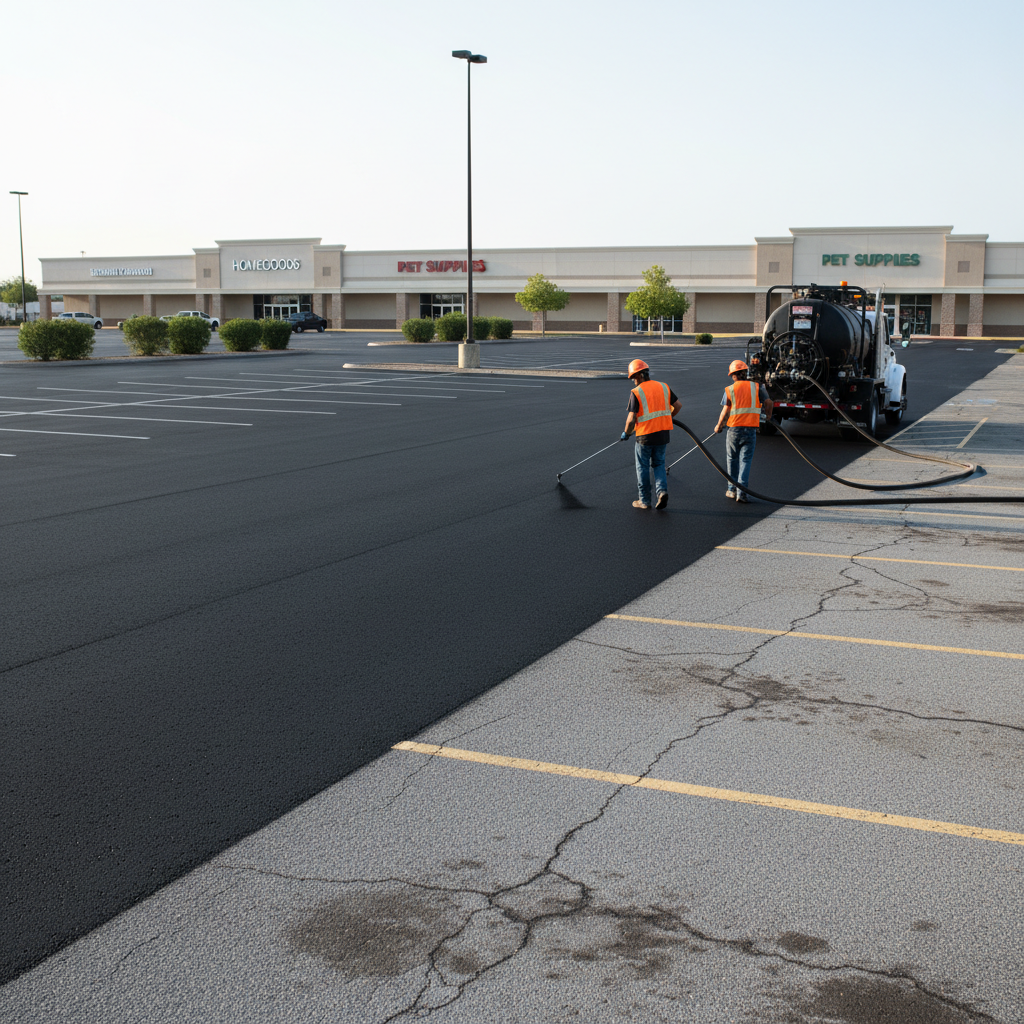
- Size: Bigger lots usually get better per-square-foot pricing because the contractor spreads mobilization, set-up, and travel costs over more area. That's why large portfolio sites can see rates in the high-teens or low-20-cent range while a tiny strip center might see high-20s to high-30s.1
- Layout: Lots with many islands, tight corners, and obstacles require more squeegee/hand work and careful edging, so the rate per sq ft climbs.
- Phasing: If the lot must be done in many small phases to keep traffic flowing, the crew loses efficiency. Expect a higher rate than for one or two big sections.
2. Existing pavement condition & crack filling
- Light wear, few cracks: You'll see bids closer to the lower end of the range.
- Lots of cracks: Linear crack sealing is usually priced separately (e.g., per linear foot). Heavy cracking can easily add thousands of dollars to a project and may push your "all-in" per-square-foot cost up even if the sealer rate looks low.
- Patching and potholes: Sealcoat is not a structural repair. If the lot needs skin patches or full-depth repairs before coating, those line items will dwarf the sealcoat price itself.
3. Number of coats and material type
- Coats: For busy commercial lots, two thin coats are standard, not one heavy coat. That uses more material and labor than a basic single-coat residential job but gives a more durable film.3
- Material:
- Asphalt-emulsion sealers (often recommended by engineering groups) are common for parking lots.3
- Products based on coal-tar pitch are still used in some regions but are discouraged by some technical bodies and face growing environmental scrutiny.3 4
- Specialty high-solids, sand-slurry, or polymer-modified sealers cost more per gallon but may allow longer recoat intervals.
4. Access, traffic control, and business disruption
Contractors charge more when the job is harder to execute:
- Night or weekend work to keep tenants open during the day.
- Tight working windows (e.g., must reopen by 6 a.m. daily).
- On-site traffic control, flaggers, or temporary signage.
- Shared access drives with neighboring properties, which can require extra coordination and phasing.
If your tenants demand minimal disruption, assume a higher per-square-foot number than a similar but empty lot.
5. Region and timing
- Labor and material markets: High-cost metro areas and remote regions typically see higher rates than small towns with lots of competition.2
- Season: In many states, the peak sealcoating season runs late spring through early fall. Prices often climb when contractor schedules are packed and drop slightly in shoulder seasons when weather is still workable but demand is lower.2
- Climate: Harsh freeze-thaw cycles can mean more cracking and more prep work per job, while very hot, sunny climates may drive more frequent sealcoat cycles.
How to read sealcoating quotes (and compare apples to apples)
When quotes are vague, "cheap" bids can become very expensive change orders. Ask each contractor to clearly spell out:
-
Measured square footage
- Your proposal should state the total square footage they're pricing and the unit price per sq ft. If one proposal is pricing 40,000 sq ft and another 55,000 sq ft for the same property, your comparison is off from the start.
-
Scope of work, by line item Look for separate lines (with quantities and unit prices where practical) for:
- Cleaning (blowing, sweeping, power washing if needed)
- Crack sealing (include how many linear feet are in the base price)
- Patching or skin repairs (quantity or allowance)
- Oil-spot priming or degreasing
- Number of sealcoat coats and application method (spray, squeegee, or both)
- Line striping and pavement markings (or note that striping is excluded)
- Traffic control and barricades
-
Materials and application details
Without endorsing brands, make sure the quote tells you:
- Whether the sealer is asphalt-emulsion or coal-tar-based, and whether it meets any local restrictions.
- Whether sand and additives (e.g., latex, hardeners) are included.
- Approximate coverage rate per gallon and whether the price is for one or two coats.
-
Schedule, phasing, and access plan
The written quote should address:
- How many phases are planned.
- Which areas will be closed when.
- How long areas must stay closed to traffic before reopening.
-
Exclusions and allowances
Look for a short list of what is not included (for example, drainage work, concrete repair, or major ADA layout changes). Clear exclusions are a good sign that the contractor has thought your project through.
Avoiding surprise extras and change orders
Here are the most common ways a "cheap" sealcoating quote gets expensive later-and what to ask up front.
1. Crack sealing overruns
If the proposal says "crack sealing as needed" with no quantity, you're taking on risk. Instead, ask for:
- A stated included quantity (e.g., "Up to 2,000 linear feet included").
- A unit price for additional crack sealing beyond that amount.
2. Undisclosed repairs and bad areas
Walk the lot with the estimator and ask them to:
- Mark areas they believe need patching before sealcoat.
- Tell you whether those repairs are priced now or "T&M" (time and materials) later.
If your asphalt is already heavily alligatored or rutted, no amount of sealcoat will fix it-expect patching, overlay, or even repaving to be recommended.
3. Cleaning and oil-spot treatment
Old, dirty lots and restaurant pads often need much more cleaning than a fairly new office park. To avoid add-ons:
- Confirm whether pressure washing or degreasing is included or extra.
- Ask how they treat heavy oil spots before sealing.
4. Extra mobilizations and off-hours premiums
If tenant demands or last-minute changes force:
- Extra mobilization days, or
- More night or weekend work than expected,
most contractors will charge more. Ask for their hourly or daily rates for extra mobilizations and off-hours work in advance.
Bottom line: the more detail you have on quantities, unit prices, and what happens "if we hit X condition," the fewer surprises you'll see once the crew is on site.
Local factors to keep in mind (U.S.)
Because sealcoating is sensitive to weather, materials, and local rules, location really does matter.
- Climate window: In colder states, contractors may have just a few good months each year when temperatures and humidity are right. This tight window can drive higher prices and busier schedules.
- Material choices and rules: Engineering groups often recommend asphalt-emulsion sealers and caution against coal-tar-based products, which contain much higher levels of certain polycyclic aromatic hydrocarbons (PAHs).3 4 Some U.S. jurisdictions have responded to PAH concerns by evaluating or adopting restrictions on coal-tar-based sealers-so it's smart to check local rules and stormwater requirements before specifying a product.4
- Regional labor and competition: West Coast and Northeast metros often see higher labor and equipment costs than parts of the Midwest or Southeast, and sparsely populated areas may pay more due to travel and limited competition.2
When you request quotes, mention your state and city, your preferred work months, and any property-specific rules (quiet hours, shared drives, HOA regulations). That context helps contractors price accurately the first time.
Conclusion
Sealcoating a parking lot in 2025-2026 typically falls in the $0.17-$0.40 per-square-foot range, and understanding how size, condition, access, and scope drive that number-plus insisting on clear, detailed quotes-is the best way to control your costs and avoid surprise extras.
Glossary
- Sealcoating (sealcoat): A thin protective coating applied over existing asphalt to slow oxidation, water damage, and surface wear.
- Crack sealing: Filling and sealing cracks in asphalt with flexible material to keep water out and prevent further damage.
- Mobilization: The cost of getting crews, trucks, and equipment to your site and set up to work.
- Overlay: A new layer of asphalt placed over existing pavement, thicker and more expensive than a sealcoat.
- Asphalt-emulsion sealer: A water-based sealer made from asphalt binder, water, and additives; widely used for parking lots.
Sources
Footnotes
-
https://gotdriveway.com/blog/average-cost-per-square-foot-commercial-sealcoating-2025 ↩ ↩2 ↩3 ↩4 ↩5 ↩6 ↩7
-
https://dailycalculate.com/asphalt-cost-calculator/ ↩ ↩2 ↩3 ↩4 ↩5 ↩6 ↩7 ↩8
-
https://www.asphaltinstitute.org/faq/how-should-driveways-and-parking-lots-be-sealed/ ↩ ↩2 ↩3 ↩4
-
https://pubs.usgs.gov/fs/2011/3010/pdf/fs2011-3010.pdf ↩ ↩2 ↩3