
Choosing a parking lot striping contractor
Parking lot striping is one of those projects that looks simple from the curb, but has big consequences if it's done poorly: safety issues, ADA (Americans with Disabilities Act) violations, fire lane problems, traffic confusion, and a worn-out look that hurts your property's image.
For property managers, the goal isn't just to "get lines painted." It's to hire a striping contractor who understands layout, accessibility, traffic flow, your tenants' schedules, and the legal standards that apply to markings and accessible spaces.1 2 This guide walks through exactly how to vet contractors, with specific questions to ask and red flags to avoid.
1. Get clear on your scope before you call
Before you start calling parking lot striping companies, define what you actually need. A contractor who understands your scope up front can give you a cleaner proposal and fewer change orders.
Clarify these items first:
- New layout vs. restriping existing lines
- Whether stall count or layout will change
- ADA upgrades needed (number and location of accessible spaces, van spaces, access aisles)
- Fire lanes, no-parking zones, loading zones, and curb markings
- Directional arrows, stop bars, crosswalks, and specialty markings (numbers, logos, EV spaces)
- Any related work (sealcoating, crack repair, sweeping) that must happen before striping
Red flags at this stage
- A contractor who won't look at a site plan or visit before quoting a complex job
- One-line quotes like "stripe parking lot - $X" with no detail on layout, colors, or quantities
2. Evaluate experience and capabilities
Parking lot striping is a niche trade. You want someone who does it all the time, not a general handyman with a paint sprayer.
Questions to ask about experience
- How long have you been doing parking lot striping specifically?
- What types of properties do you regularly stripe? (retail centers, medical, industrial, multi-level garages, HOAs, campuses)
- Can you show recent jobs similar to mine? Ask for photos of lots with a comparable size and use.
- Who handles layout? Is there an in-house foreman who lays out stalls, ADA spaces, and traffic flow, or is it left to the crew to "eyeball it" in the field?
- How do you handle ADA and accessibility markings? They should reference the 2010 ADA Standards for Accessible Design and any local amendments.1
Experience-related red flags
- No photos or references for similar properties
- "We just re-paint what's there, we don't really worry about ADA"
- Can't explain how they plan stall dimensions, aisles, accessible spaces, or fire lanes
3. Equipment, materials, and workmanship
Professional gear and the right paint matter for durability, line quality, and compliance.
Key questions about equipment and paint
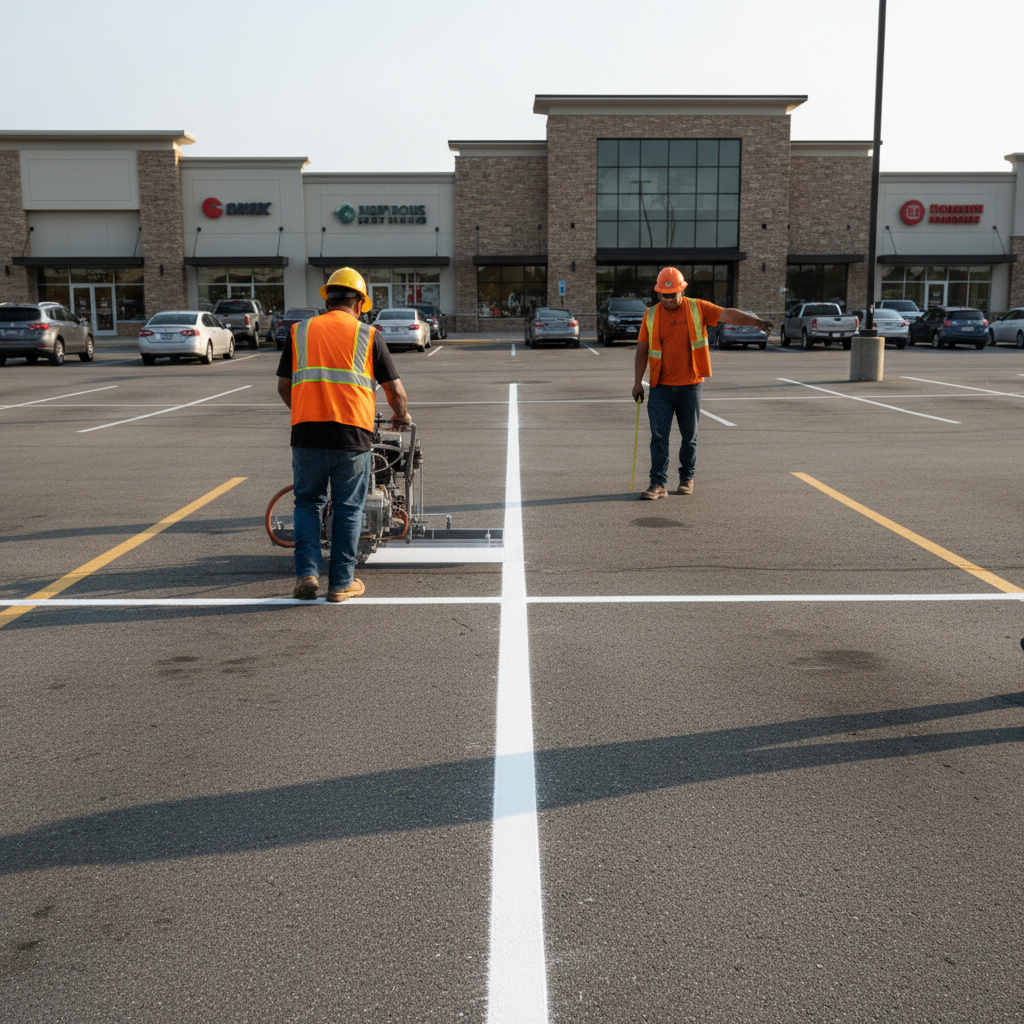
- What striping machines do you use? Look for professional airless striping machines, not hardware-store wheeled rigs.
- Do you use automatic line-width settings? Consistent 4" or 6" line widths are a sign of good equipment and setup.
- What paint do you recommend for this lot? They should specify commercial traffic paint (water-based or solvent-based) appropriate to your climate and pavement, not generic exterior paint.
- Is the paint DOT-grade and low-VOC where required? Many states reference highway-paint standards and VOC (volatile organic compound) limits.
- Do you offer reflective glass beads or high-visibility markings where needed? Important for darker lots, garages, and high-traffic areas.
- How do you prep the surface? They should talk about cleaning, blowing, or sweeping, and avoiding striping over loose sealer, oil, or heavy dirt.
Workmanship red flags
- "We can paint over anything" (no mention of cleaning or surface prep)
- No specifics about paint brand, type, or drying time
- No mention of using chalk lines, string lines, or layout tools to keep lines straight
- Extremely short claimed drying/curing times that sound unrealistic for your climate
4. Scheduling, phasing, and traffic control
Your biggest day-to-day risk isn't the paint-it's disruption to tenants, customers, and traffic. Striping contractors should have a clear plan for when and how they'll work.
Questions to ask about operations
- When do you typically stripe active commercial lots? (Nights, early mornings, weekends)
- Can you phase the work so part of the lot stays open? Ask how many phases they recommend and how they'll coordinate.
- How do you handle traffic control and pedestrian safety? They should describe cones, barricades, caution tape, and signage, and align with the same principles used for traffic control devices on roads open to public travel, such as those in the Manual on Uniform Traffic Control Devices (MUTCD).2
- How will you communicate closures with our tenants or security? Look for willingness to provide simple maps or notices.
- What happens if weather changes? Ask how they monitor conditions and decide whether to proceed.
Operational red flags
- "We'll just show up and knock it out" with no phasing plan for a busy site
- No mention of cones, barricades, or pedestrian routing
- Not willing to work off-hours for a high-traffic property
5. Insurance, licensing, and safety culture
Striping crews are working around moving cars, pedestrians, and sometimes at night. You need proof they're insured and take safety seriously.
Insurance and licensing questions
- Can you send a current Certificate of Insurance (COI)? Ask for it before work starts.
- What are your liability limits? Many commercial properties expect adequate commercial general liability coverage to protect against bodily injury or property damage arising from operations.3
- Do you carry workers' compensation? Essential if they have employees on your site.
- Do you have commercial auto coverage for your trucks and striping rigs?
- Are you licensed or registered if our state or city requires it? Some jurisdictions require specific contractor registrations.
Safety questions
- What safety training do your crews receive? Look for mention of PPE (personal protective equipment), working around live traffic, and night work.
- Who is the on-site supervisor, and how can we reach them?
- How do you protect pedestrians from wet paint and work areas?
Insurance and safety red flags
- Unable or unwilling to provide a COI listing your ownership/management entity as certificate holder
- No workers' compensation despite having multiple crew members
- Crews that typically work without high-visibility vests, cones, or clear delineation
6. References, photos, and written proposals
A professional parking lot striping contractor should be able to back up their promises with real-world results.
What to ask references
When you call references, ask:
- Did they show up when they said they would and finish on schedule?
- How well did they coordinate phasing and tenant access?
- Was the site clean and open on time each morning?
- How do the lines, arrows, and ADA markings look a year or two later?
- Were there any surprise charges or change orders?
What to look for in photos
- Straight, uniform stall lines with consistent spacing
- Correctly sized and placed accessible spaces, van-accessible spaces, and access aisles
- Clear, properly oriented arrows and legends
- Crisp edges, not fuzzy overspray everywhere
What a good proposal includes
- A clear written scope: number of stalls, line widths and colors, all markings, and any ADA adjustments
- A basic plan or sketch for new layouts
- Surface prep responsibilities (who's sweeping, who's repairing)
- Working hours, phasing, and traffic control approach
- Warranty on workmanship (what's covered and for how long)
7. A quick vetting checklist
Use this short checklist when comparing parking lot striping contractors:
- Scope - Do they understand whether it's a simple restripe or a layout/ADA change?
- Experience - Have they done lots like yours, with photos and references to prove it?
- Standards - Can they speak intelligently about ADA accessible parking and relevant marking standards?1 2
- Equipment & materials - Do they use professional striping machines and traffic-grade paints suited to your climate?
- Scheduling & phasing - Do they have a written plan to keep the property functional and safe during work?
- Insurance & safety - Can they provide a COI and describe concrete safety practices on site?3
- Proposal quality - Is their quote detailed and specific, or a vague lump sum?
Conclusion
The right parking lot striping contractor is the one who can show-with clear answers, documentation, and past work-that they understand your property, your risks, and the standards that keep your lot safe, compliant, and easy to use.
Glossary
- ADA (Americans with Disabilities Act) - Federal civil rights law that, among other things, sets accessibility requirements for parking facilities.
- MUTCD (Manual on Uniform Traffic Control Devices) - National standard that governs traffic control devices and pavement markings on roads open to public travel.2
- COI (Certificate of Insurance) - Summary from an insurer that proves a contractor's coverage is in place and shows policy limits and dates.
- PPE (Personal protective equipment) - Safety gear such as high-visibility vests, hard hats, gloves, and eye protection.