
ADA parking lot striping requirements explained
Why ADA striping details matter
If your lot serves the public, employees, or tenants, the Americans with Disabilities Act (ADA) almost certainly applies to your parking layout. The paint on the ground isn't just cosmetic: it defines the width of accessible stalls, access aisles, and van spaces, and works together with signs and slopes to make the spaces usable.
This guide focuses on the striping-related parts of the ADA rules for U.S. parking lots: how many accessible spaces you need, where they go, how wide they must be, how to stripe access aisles and van spaces, and the common mistakes that get properties in trouble. It's information only, not legal advice, and you should always confirm final details with your local building or zoning department.
Core ADA layout requirements for accessible parking
At a high level, the 2010 ADA Standards for Accessible Design require that:
- Any parking facility that provides parking must also provide accessible spaces. A "parking facility" means each lot or structure; you calculate required accessible spaces for each one separately.1
- The number of accessible spaces is based on a table. For example, 1 accessible space is required for lots with 1-25 total spaces, 2 for 26-50, scaling up to 2% of spaces for large lots and additional rules for very large facilities.1
- Van spaces are a subset of the total accessible spaces. At least 1 out of every 6 accessible spaces (or fraction of 6) must be a van-accessible space.1
- Location matters. Accessible spaces must be on the shortest accessible route to an accessible building entrance they serve; if a lot serves more than one accessible entrance, accessible spaces should be dispersed near those entrances.1
For striping projects, that translates into two questions you should answer before you open a paint can:
- Does each lot or deck have enough accessible stalls (and van stalls) based on its total count?
- Are those stalls as close as reasonably possible to accessible entrances, without steep slopes or obstacles along the way?
Striping details: widths, aisles, and van spaces
Once you know where your accessible spaces go, striping sets their usable width and the shape of access aisles.
Minimum widths and aisles (per ADA 2010 Standards):1
- Standard accessible car space
- Stall width: 96 inches (8 ft) minimum.
- Access aisle: 60 inches (5 ft) minimum.
- Van-accessible space (two allowed configurations):
- Option A: Stall 132 inches (11 ft) wide with 60-inch access aisle, or
- Option B: Stall 96 inches (8 ft) wide with 96-inch (8 ft) access aisle.
- Access aisles
- Width: 60 inches (5 ft) minimum for both car and van spaces.
- Extend the full length of the adjacent parking space.
- Two spaces can share one common access aisle.
- Must connect to an accessible route.
The Standards also require accessible spaces to be marked to define their width and access aisles to be marked so as to discourage parking in them.1 They do not specify a particular color or hatch pattern; those details are often set by state or local codes.
Surfaces matter too:
- Parking spaces and aisles must be nearly level-no steeper than 1:48 (about 2%) in any direction.1
- Access aisles must be at the same level as the parking spaces they serve. Built-up curb ramps can't project into accessible stalls or their aisles.
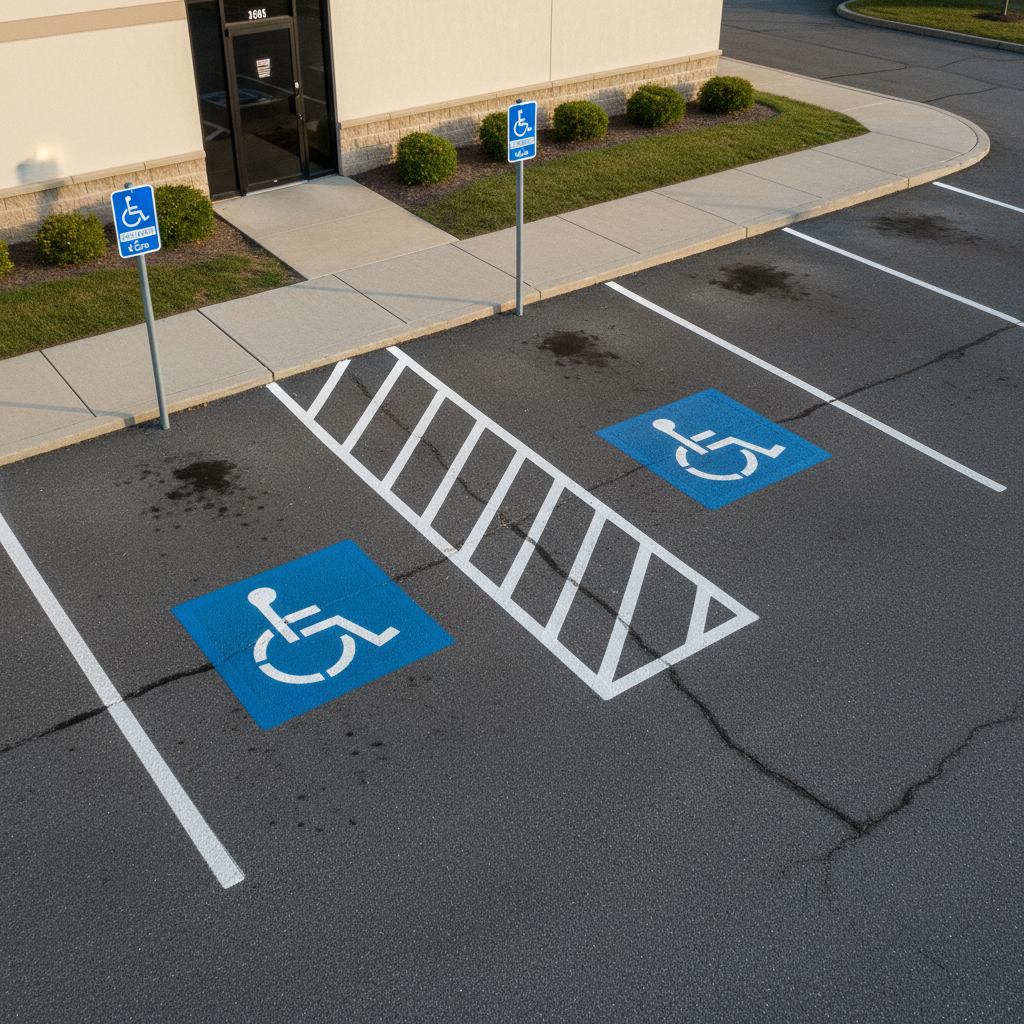
Practical striping tips:
- Use clear diagonal hatching in the access aisle and make sure it visually contrasts with the stall markings.
- End stripes cleanly at the boundary of the aisle; don't "fade" them into drive aisles where the layout becomes ambiguous.
- For angled van spaces, the access aisle must be on the passenger side of the van.1
Pavement markings, colors, and signs
Federal ADA rules are very specific about signage and relatively flexible about paint details.
Required identification signs
Under ADA section 502.6:1
- Every accessible space must be identified by a sign with the International Symbol of Accessibility (ISA).
- Van-accessible spaces must also be labeled with "van accessible" on the sign.
- Signs must be mounted at least 60 inches (5 ft) above the ground to the bottom of the sign so they're visible even if snow, leaves, or another vehicle obscure pavement markings.
Pavement symbols alone (a wheelchair painted on the asphalt with no sign) do not meet ADA's identification requirements in most lots.
Pavement colors and text
The ADA Standards say that access aisles must be "marked so as to discourage parking," but they intentionally do not set colors or exact wording; they note that method and color may be covered by state or local rules instead.1 2
Common local requirements or practices include, for example:
- Blue background blocks for accessible stalls with a white ISA symbol.
- Diagonal striping in access aisles, often in a contrasting color.
- The words "NO PARKING" painted inside each access aisle, required by some state building codes.
Because these details vary widely, your striping contractor should verify exact colors, symbol sizes, and any required wording with your local code or state accessibility standard before work starts.
Common ADA striping mistakes to avoid
Striping crews and property owners often assume that if something "looks accessible," it is. Many violations show up only when someone checks measurements, slopes, or the link to the accessible entrance. Typical mistakes include:
- Wrong number of accessible spaces after a restripe or reconfiguration.
- No van space, or not enough van spaces for the total number of accessible stalls.
- Undersized stalls or aisles (e.g., an 8 ft space with only a 3-4 ft aisle).
- No clearly marked access aisle or an aisle so faint that it looks like another stall.
- Placing accessible stalls on a steeply sloped section of the lot and trying to "fix" usability with extra paint.
- Blocking access aisles with wheel stops, bollards, or landscaping, forcing wheelchair users into drive aisles.
- Accessible stalls striped far from the actual accessible entrance, even though closer, level parking exists.
The bottom line: repainting without checking the ADA dimensions, slope, and shortest-route rules is a reliable way to turn a previously compliant lot into a noncompliant one.
Permits and local rules
ADA is a federal baseline, but it sits on top of state building codes and local ordinances that can be more specific or more stringent:
- Many states set exact pavement colors, hatch patterns, and required pavement text (for example, specifying blue outlines, diagonal stripes in access aisles, and "NO PARKING" text within each aisle).2 3
- Local ordinances may require extra sign panels noting minimum fines, tow-away language, or jurisdiction-specific codes.
- Some jurisdictions treat simple restriping in the existing layout as maintenance (no permit), while a new layout or change in stall count triggers a permit and a full accessibility review.
Under DOJ guidance, when you restripe, you're expected to make sure the lot's accessible spaces meet the 2010 ADA Standards, and barrier removal in parking is generally considered "readily achievable" for existing facilities.4
Before a restriping project that changes your layout, it's wise to:
- Ask your local building or planning department if a permit or plan review is required.
- Confirm whether your city or state has its own accessibility standard or amendments that change colors, text, or dimensions beyond ADA minimums.
Local factors: planning ADA striping in your area (USA)
Because the ADA rules apply nationwide, but climate and enforcement vary, U.S. property owners should factor in local conditions:
- In snow-belt regions, plowing can quickly erase thin or low-contrast striping. Using durable paint systems and ensuring upright ISA signs are correct and visible is critical so spaces remain identifiable even when pavement markings are obscured.4
- In sunny, high-UV climates, standard traffic paints fade faster; dull blue and white markings can undermine visibility and, over time, effective compliance.
- Debris, snow, and ponded water in access aisles can make a technically compliant layout functionally unusable; DOJ stresses that accessible features (including parking and routes) must be maintained, not just installed once.4
Working with a local parking lot striping contractor who routinely delivers ADA-compliant layouts in your state is often the easiest way to navigate both federal rules and local quirks.
Conclusion
ADA-compliant parking lot striping comes down to getting the number, location, dimensions, markings, and signs right-and confirming the paint details with your local code before you stripe.
Glossary
- ADA (Americans with Disabilities Act) - U.S. civil rights law that, among other things, sets accessibility requirements for parking serving public and commercial facilities.
- ISA (International Symbol of Accessibility) - The standardized wheelchair pictogram used on accessible parking signs and pavement markings.
- Access aisle - The striped, no-parking zone beside an accessible space that provides room to deploy a lift, open doors fully, and maneuver mobility devices.
- Van-accessible space - An accessible stall with extra width (or extra-wide aisle) and vertical clearance so vans with lifts or ramps can load and unload.
- DOJ (U.S. Department of Justice) - Federal agency that issues and enforces ADA regulations for public accommodations and commercial facilities.